
The fate of the popular Erasmus+ education programme is in limbo after ministers reached no agreement on Thursday. The failure comes even as the item enjoys a significant boost to €41bn in the latest MFF proposal, up from the current €27bn.
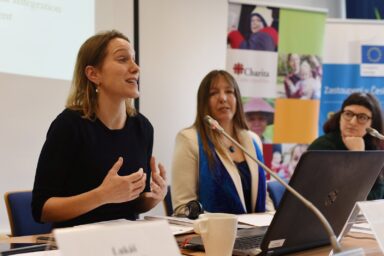
The Youth and Education Council of the European Union did not, on Thursday, 27 November, agree a resolution whose principal objective was to okay the Commission proposal to bolster the Erasmus Plus programme. “I regret that the Council could not approve today a resolution on the European education area on the next cycle, looking at what we need to do together in Europe until 2030,“ Commission Vice-President Roxana Mînzatu said during the following press conference.
“The resolution would have set a key transformative path for our cooperation in education and training for the next five years. The education area evaluation report and the union of skills package provided important input for this resolution,“ the commisisoner said. “And of course, we are ready to start from where we are, from the state of play and work with the Cypriot presidency towards defining the ambitions, the strategic priorities, the targets that will drive our action in education and skills in the next five years.“
Everybody wants more
Erasmus Plus pays for study-abroad semesters, traineeships, apprenticeships and staff exchanges within (and beyond) Europe. It funds partnerships between schools, universities, companies and NGOs to modernise teaching and develop new curricula. It also supports youth work, volunteering (formerly the European Solidarity Corps) and grassroots sport projects.
The programme has been around since 2014, when it merged the original Erasmus student-exchange programme with Comenius, Leonardo da Vinci, Youth in Action, et al. The current long-term EU budget (2021-2027) earmarks about €27bn to support the programme, roughly double the previous period.
You might be interested

The Commission proposal for the next budget, or Multiannual Financial Framework, adds another 50 per cent increase. Despite that, the ministers did not agree on how to divide the increase. “Of course, everybody wants more funding from Erasmus,“ Ms Mînzatu said but did not elaborate any further. “We want more funding for mobilities overall. I’m supporting the idea of Erasmus for all. Erasmus is right. This is the vision that should drive the budgeting of the program as we look even beyond 2034. If there’s any other perspective, it’s difficult to really enhance the budget as it should be.“
Critical thinking
One of the chief stated purposes of Erasmus+ is to “help young people look beyond cultural and language learning so they can take part in civic life and think critically about society“, as Danish Minister for children and education Mathias Tesfaye put it at the press conference. With that in mind, observers could be thankful for the conference itself offering a real-life lesson in critical thinking about society.
Vice-President Mînzatu and Minister Tesfaye spoke at length of how Thursday’s Council session “showed a strong shared commitment to strengthening education and vocational training as a foundation for Europe’s competitiveness“ (Mr Tesfaye). They waxed lyrical about “Erasmus and youth resilience. Such an important discussion, discussing how to strengthen resilience among young people“ (Ms Mînzatu).
I’m supporting the idea of Erasmus for all. Erasmus is right. — Commission Vice-President Roxana Mînzatu
Both dignitaries kept an upbeat tone, extolling the virtues of their institutions‘ “strong and for constructive cooperation“. Between them, they took over a thousand words to get to the heart of the matter, the failure to reach an agreement.
Focus on vocational training
Other topics discussed during Thursday’s Council included vocational training, something Denmark pays a lot of attention to. “We have, among other initiatives, decided that the share of students and apprentices who complete part of their vocational education abroad must increase fivefold by 2035. This priority has guided our presidency,“ Mr Tesfaye said.
He mentioned that, in September, ministers and partners endorsed the Herning Declaration confirming that strong and inclusive vocational education is essential for resilient societies and for Europe’s economy and competitiveness. “In addition, today, we had a state of play on the second cycle of the strategic framework for European cooperation in education, and training towards the European education area,“ the minister said.
Ms Mînzatu emphasised citizenship skills and digital skills, “both relevant for engagement in the civic engagement of our young generation and for supporting their involvement in the future of the project of European Union“, as she put it.
‘Not quite close‘
“My message was clear for our ministers in Europe that vocational education and training (VET) is the way that we turn Europe’s talent into Europe’s advantage. We discussed targets where we measure we can Our 2030 target is that 12 per cent of VET learners should be able to train in another member state, so mobility for VET students, including with the support of Erasmus+.“
We have, among other initiatives, decided that the share of students and apprentices who complete part of their vocational education abroad must increase fivefold by 2035. — Mathias Tesfaye, Denmark’s minister for children and education
The vice-president acknowledged that “where we are now is not quite close, just five per cent of students are currently doing mobilities in VET education. We do allocate resources. Erasmus+, allocates resources to VET in the current 21-27 program of around five billion euros.“ so this is important.
The next European Education, Youth, Culture and Sports Council will be held on 11-12 May 2026, under the Cypriot presidency.