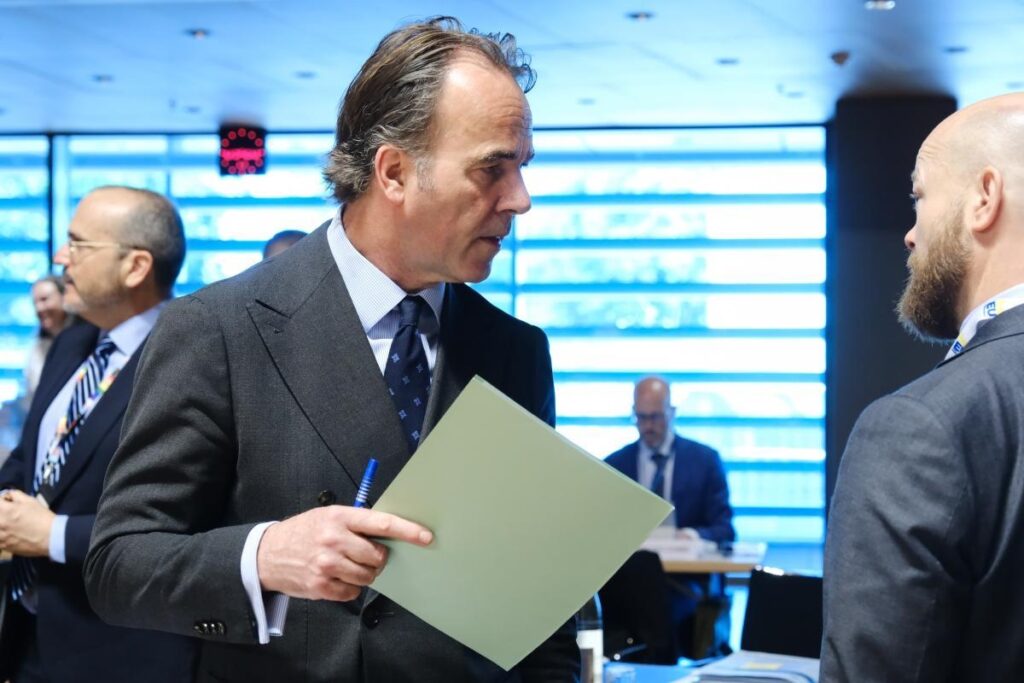

In a meeting of the Democracy Shield at the European Parliament, Bartjan Wegter, EU Counter-Terrorism Coordinator, sounded the alarm over a ’new generation of extremist content’ powered by artificial intelligence. He warned that the technology is helping terrorist organisations and lone-actor radicals to produce sophisticated propaganda with unprecedented ease.
Speaking during a wide-ranging debate on security and online radicalisation, the Coordinator argued that Europe’s core challenge is no longer the lack of legislation, but the implementation gap between rapidly evolving digital threats and the EU’s ability to enforce its own rules. “We have the Digital Services Act, the Terrorist Content Online Regulation, and the AI Act,” he noted. “But technology is moving faster than our operational response.”
A force-multiplier for extremists
The Coordinator described AI-generated manifestos, tutorials and recruitment materials as the “new front line” of radicalisation. Unlike traditional extremist propaganda, which once required resources, networks or technical skills, AI systems allow individuals including minors to create professional-looking content within minutes.
Technology is moving faster than our operational response. – Bartjan Wegter, EU Counter-Terrorism Coordinator
This evolution, he argued, is reshaping the threat landscape: extremist narratives now permeate mainstream digital spaces frequented by young people, creating “a conveyor belt of subtle, curated radicalisation” that blends entertainment with extremist ideology.
We have to realize that terrorism is changing. Its demographics have shifted and its methods have evolved and technology has reshaped terrorists’ reach, Mr Wegter underlined.
Reluctance to intelligence sharing
While AI dominated the debate, the Coordinator stressed that Europe’s most enduring vulnerability remains human and political. That includes the reluctance of some member states to share intelligence with one another and with Europol. “We can not defend ourselves against cross-border threats with national silos,” he cautioned, urging governments to fully use Europol’s analytical tools and to trust common databases.
Several MEPs echoed his concerns, criticising what they described as a two-speed counter-terrorism effort across the Union. Without a shared risk picture, they warned, Europe remains exposed.
You might be interested
Reinforcing Europol’s Internet Referral Unit
Another key message was the need to strengthen the Internet Referral Unit (IRU), Europol’s team responsible for detecting and flagging terrorist content online. The Coordinator called for more staff, more advanced tools, and a mandate adapted to AI-generated multimedia. He rejected claims of censorship, describing the IRU instead as “a rapid-reaction capability essential in the hours following any attack or plot.”
At the same time, the Coordinator drew attention to ’worrying patterns’ in youth environments, where extremist narratives—both Islamist and far-right—are appearing in videos, memes and influencer-style formats designed to evade detection. Prevention, Mr Wegter said, must be rooted in education and local communities, with teachers and youth workers equipped to recognise online radicalisation.
We can not allow counter-terrorism to become a justification for eroding the freedoms we are trying to protect. – Bartjan Wegter, EU Counter-Terrorism Coordinator
In contrast to calls for harsher surveillance powers, the Coordinator insisted that Europe’s response must remain grounded in fundamental rights and democratic values. “We cannot allow counter-terrorism to become a justification for eroding the freedoms we are trying to protect,” he told the chamber. The debate ended with a broader appeal for the Justice and Home Affairs Council to adopt a more ambitious, coordinated approach. Fragmentation, the Coordinator warned, is itself becoming a security risk.
As Europe heads into a year marked by global tension, electoral volatility and fast-moving technologies, the Coordinator’s message was clear: the EU is not short on laws but it must act faster, smarter and more decisively if it wants to stay ahead of the next wave of extremism.