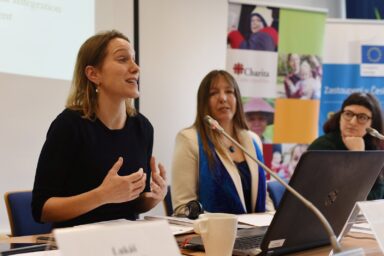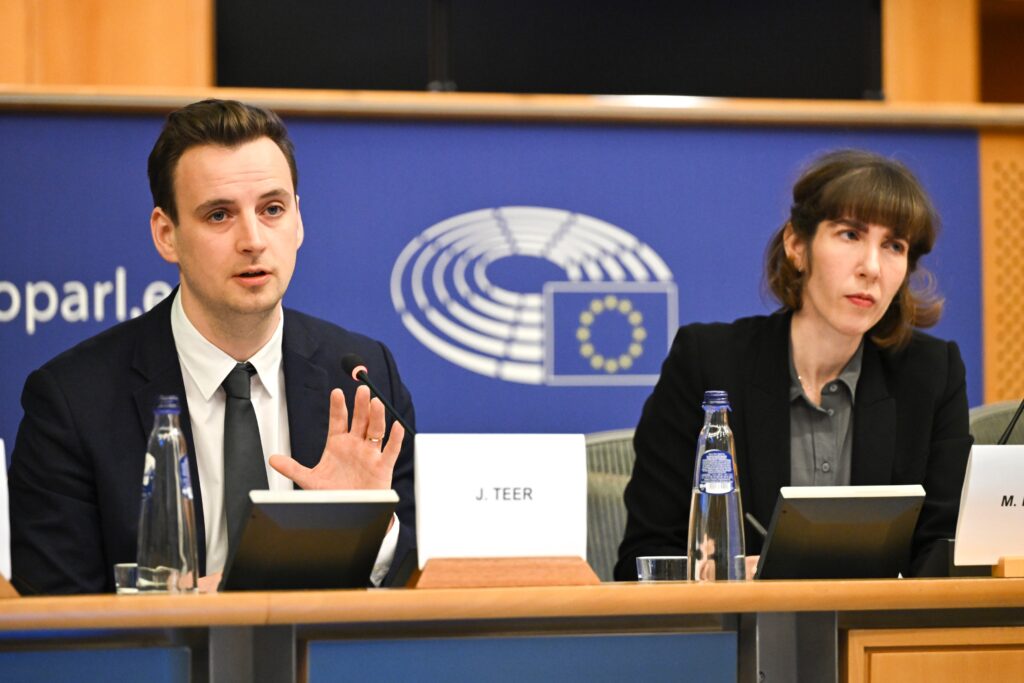

A public hearing of the European Parliament’s trade committee on 2 December saw intellectual heavyweights battling out a crucial issue. How far should the EU try to stick to ‘normal‘ trade rules — and what to do when it cannot?
The INTA chair, MEP Bernd Lange (S&D/DEU), who chaired the debate, invited experts to judge how Europe can protect commerce without strangling it. Talk of pipelines, magnets and gallium soon eclipsed talk of tariffs.
Mona Paulsen, a Canadian-born LSE trade lawyer steeped in history, opened the debate. She rejected the idea that the world has stumbled into unprecedented “weaponised interdependence”. “After the war,” she reminded MEPs, “the architects of GATT never separated economics from security.” Multilateral rules always linked trade and defence.
Ms Paulsen warned that today’s obsession with stockpiles and subsidies repeats mistakes. “Cooperation, not unilateral self-help, is the safest response to shocks,” she insisted. Europe should update multilateral instruments, not junk them.
You might be interested
Lessons from 1950
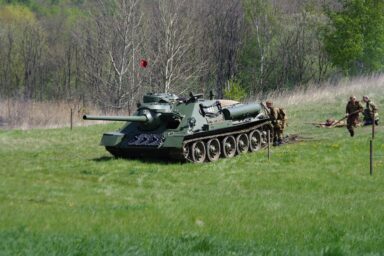
Shortages of 14 strategic materials during the Korean war offered a lesson. America, France and Britain did not scramble; they gathered producer and consumer countries—mostly GATT members—to allocate resources. Committees met quarterly for three years. They shared information, spread supply and avoided trade wars. The episode, said Ms Paulsen, showed “security through cooperation”.
She fears history now bends the other way. Talk of “weaponised interdependence”, she argued, fuels sweeping security exceptions and invites retaliation. Trust in the rules-based system erodes. The Commission’s foresight work on global risk clusters matters, but multilateral backing matters more.
Ms Paulsen outlined a fix. A new WTO tool would centre on economic-security risk assessment. States would share intelligence, trigger early warnings and apply time-limited safeguards. The device would mimic existing safeguards yet focus on hazards before they bite, upholding equitable distribution.
Procedures and precedents
The WTO’s “situation complaint” procedure languishes, Ms Paulsen lamented. Reviving it would give due process and collective remedies when many measures combine to hurt trade. She urged the EU to think beyond countervailing duties and to file broader complaints that reflect systemic harm.
Europe’s flirtation with rare-earth stockpiles could backfire. “A blanket security exception would convert economic power into a routine political weapon,” she warned. If Brussels claims leeway for magnets, others will claim it for wheat or oil. That risks a “law-of-the-jungle” spiral.
She ended with an appeal: pool efforts with allies, let firms experiment across borders and treat uncertainty as a spur for deeper collaboration—“not defence-driven isolation”.
China’s industrial siege
Joris Teer, a security analyst, answered from the opposite flank. Beijing, he argued, has turned the trading system into a weapon. Since “Made in China 2025” and the “dual circulation” plan of 2020, China has sought a “self-reliant fortress” while binding others to Chinese supply. Five levers drive the push: a 70-million-strong workforce, forced technology transfer, vast subsidies, local-content rules and orders from Xi Jinping.
Those levers work. Chinese procurement now excludes foreign firms from “90 % of health tenders”. Exports, propped up by subsidies, undercut global prices. “China is not trading freely,” Mr Teer told the room. “If you don’t respond, you get the very rapid de-industrialisation of Europe that we see right now.”
A blanket security exception would convert economic power into a routine political weapon. — Mona Paulsen, London School of Economics
Manufacturing, he stressed, is no longer about jobs alone. It underpins deterrence. Nineteen of the EU’s 34 critical raw materials are chiefly mined or refined in China, which now restricts gallium and germanium. Semiconductors, chemicals and smart transformers form other choke points.
Dependence and deterrence
China already turns out more than 30 % of global manufactured goods and could reach 45 %. Such dominance creates a second layer of risk: sensor-laden equipment can be switched off or updated remotely. The Netherlands has barred Chinese transformers from its grid, fearing a repeat of Europe’s gas dependence on Russia. Renewable-energy kits may follow.
Mr Teer said the world has left the post-cold-war era of efficiency. Power politics now drives trade. Beijing fuses mercantilism with “power-trader” tactics—securing inputs, enforcing buy-Chinese rules and backfilling Russia’s war machine. Europe, he warned, de-risks slower than China tightens its grip.
He offered remedies. First, rebuild capacity in magnets, chips and minerals. Second, form “a larger coalition … to create supply in trusted places.” Procurement rules must reward resilient supply, “not default to China”.
Coalitions and cash
Mr Teer liked partners such as Korea, Canada and Japan. “The larger your coalition is, in which you can generate sufficient demand to create supply in trusted places, the better.” He urged joint offtake deals and co-investments with allies refining rare earths. “We don’t have to do this alone.”
Ms Paulsen backed clearer ground rules. “The WTO is no band-aid, it is not a medicine. It is just a house for governments to come together and talk trade. … What we need is clearer guidance on what constitutes an ally or an adversary and exit strategies such as sunset clauses.” Shared criteria, she said, keep national measures in line with EU coordination.
China is not trading freely. If you don’t respond, you get the very rapid de-industrialisation of Europe that we see right now. — Joris Teer, European Union Institute for Security Studies
MEP Kathleen van Brempt (S&D/BEL) wanted big moves. She asked Mr Teer for five actions if he held the Commission’s purse. He answered crisply. “Close the cost gap by using defence budgets for dual-use innovation—permanent magnets go into jet engines as well as EVs.” Then: build an EU-Japan-US refining club, tie public tenders to non-Chinese supply chains, create a state investment arm modelled on Japan’s and “change procurement directives so price isn’t the only scoring factor; security of supply must count.”
Testing the toolkit
Why, Ms van Brempt pressed, has the anti-coercion instrument been used only once? Ms Paulsen replied that “there is no defined rule of economic coercion in international law. … Unilateral action begets unilateral action.” She favoured collective WTO complaints under the situation procedure: “Governments come together and say, ‘We are not concerned with pinpointing one measure; we are dealing with a global situation of economic uncertainty.’”
Is the WTO still fit for purpose? “The World Trade Organization continues to function for the majority of partners,” Ms Paulsen insisted. Europe should lead new work on “anti-monopolisation of particular materials” and transparent, time-limited security reviews.
Some proposals jarred. Ms Paulsen called allocating defence cash to civilian goods legally risky. Mr Teer shot back that “permanent magnets are dual use. … If raising the price by 20 % means the weapon system becomes unaffordable, we end up with 5 % NATO spending and no new kit.”
Commission plans unveiled
Denis Redonnet, the Commission’s chief trade-enforcement officer, closed the hearing with hints of Brussels’ next steps. Tomorrow the executive will unveil an economic-security package and a “Resource EU” plan that treats rare earths as seriously as the dash away from Russian gas.
Partnership sits at the core. “Protect, promote and partner” guides policy, and the last element “cannot come as an after-thought.” The EU will deepen dialogues with “trusted partners” and use the G7’s economic-coercion platform to shape norms. Whether the WTO can host broader talks remains open, but “there is certainly space in the international rule-book that must apply.”
Resource EU will mix supply and demand levers. On supply, Brussels plans diversification projects with allies. On demand, it mulls “economic-security standards” so public money rewards resilient, non-Chinese inputs. The aim is to make projects “viable in a distorted context” where Chinese firms can undercut prices.
Costs and commitments
Mr Redonnet acknowledged hard trade-offs. Resilience costs money. The new plans will weigh the fiscal burden on firms and consumers. Attention will fall “not just to the supply side … but also to the demand side.” He also pointed at China’s recent export licences on gallium, germanium and rare earths. The measures “lack evidence-based parameters” and may breach WTO duties. Brussels is examining legal options and courting partners for a “collective normative approach.”
Europe now stands at a fork. One path follows Ms Paulsen’s multilateral discipline; the other chases Mr Teer’s hard-nosed industrial policy. The divide between the two experts, however, is narrower than it seems. Both want Europe to de-risk; both insist on coalitions. Mr Teer speaks the language of arsenals and stockpiles. Ms Paulsen answers with clauses and committees. Yet they agree on one point: timidity costs more than action.
The World Trade Organization continues to function for the majority of partners. — Mona Paulsen
Ms Paulsen’s remedy starts with rules. She wants the EU to file broader WTO complaints—“Governments come together and say, ‘We are not concerned with pinpointing one measure; we are dealing with a global situation of economic uncertainty.’ ” Such “situation” cases, she believes, would expose cumulative harm and mobilise collective pressure. Sunset clauses would keep safeguards from ossifying. Evidence, shared in confidence, would ground decisions. “The WTO is just a house for governments to come together and talk trade,” she said, “but it is still our best house.”
Mr Teer’s checklist is blunter. “Close the cost gap by using defence budgets for dual-use innovation,” he urged. Permanent magnets matter to missiles and motors alike, so let NATO cash finance scale-up. Create an EU-Japan-US rare-earth club; tie public tenders for wind, solar and grid gear to non-Chinese supply chains; launch a state investment arm like Japan’s; revamp procurement so that “security of supply must count”. His premise is stark: if Europe clings to price-only scoring, it will funnel money straight to the cheapest Chinese bidder.
Counting the cost
The Commission will soon decide how far to travel down either route. Mr Redonnet confessed that resilience is not free: “There are trade-offs between efficiency and resilience and there is a cost to increasing resilience through policy.” That cost can be cushioned, he thinks, if demand pulls new projects into life. Economic-security standards in public contracts could nudge buyers towards safer suppliers and justify higher bids.
Whether member states accept such nudges is less certain. MEP José Ignacio Zoido Álvarez (EPP/ESP) fretted about subsidiarity. Ms Paulsen’s answer—clear criteria, shared reviews, exit plans—offered a legal map. Yet she conceded that rules lose force if politics turns ugly. “Unilateral action begets unilateral action,” she warned. Europe may hope to stay virtuous, but virtue crumbles when others weaponise trade.
That dilemma haunts the Anti-Coercion Instrument. Adopted with fanfare, it has been wielded just once. Ms Paulsen questioned its legal footing; Mr Teer questioned its deterrent power. If China can close a market overnight, the EU must respond in minutes, not months. Process, for once, may trail power.
Standards, stockpiles, et al.
Resource EU aims to tilt that balance. By putting rare earths on a par with Russian gas, Brussels signals that minerals are now strategic. Diversification projects will grab headlines, but demand-side rules may matter more. If carmakers and turbine builders must trace inputs to “trusted places”, investment will follow contracts, not subsidies. Mr Teer’s desire to rewrite procurement thus meshes with Mr Redonnet’s plan for economic-security standards.
Yet Europe’s record gives little comfort. Ms van Brempt noted that dependence on Chinese minerals has grown since the last strategy. Capacity flows to the cheapest shore. Without firm guard-rails, it will flow again.
Mr Teer doubts soft law will suffice. China, he said, already produces more than 30% of global manufactures; UN projections put the share at 45%. Its conglomerates mine 78% of rare earths and refine almost all heavy rare earths. They hold stockpiles big enough to sway prices. If Beijing squeezes now and floods later, investors elsewhere will hesitate. Only “trusted demand”, locked in by rules or money, can break that cycle.
A rulebook rewritten?
Ms Paulsen sees danger in matching China tool for tool. Turn every magnet into a military item and the WTO’s boundary between civil and defence trade blurs. “There is a danger,” she cautioned, “in being able to turn everything into a dual use application.” Subsidies funded from defence budgets could invite copy-cats—or retaliation. She prefers new multilateral norms, perhaps on “anti-monopolisation of particular materials”, to stop any one country cornering a market.
If carmakers and turbine builders must trace inputs to “trusted places”, investment will follow contracts, not subsidies. – Denis Redonnet, Deputy Director-General, Directorate-General for Trade and Economic Security.
Mr Redonnet did not reveal whether the Commission leans towards Teer’s industrial muscle or Ms Paulsen’s legal finesse. He did hint at legal action over China’s export licences, which lack “evidence-based parameters”. Such a case would test both resolve and patience. WTO disputes crawl. Supply disruptions strike fast.
The hearing closed without a verdict. Mr Lange thanked the speakers and promised that their ideas would feed into forthcoming legislation. Parliament will haggle; governments will balk; companies will lobby. But one truth emerged. Europe can no longer separate trade from security. The choice is not whether to act, only how.
Elemental urgency
The discussion will resume when the Commission unveils its twin proposals. Expect skirmishes over budgets, procurement scores and legal bases. Watch also for alliances: Japan on refining, Canada on mining, Korea on components. Mr Teer and Ms Paulsen may disagree on the means, but both want Europe to anchor itself in a wider, rule-bound network. Alone, the continent looks small.
If lawmakers fumble, the stakes are clear. Replace rare-earth magnets with gallium, germanium or smart transformers and the story repeats: Europe depends, China decides. The committee’s hearing offered no panacea, yet it mapped the exits. Braver procurement, tighter coalitions, sharper WTO tools—none are easy, all are cheaper than another decade of drift.
One sentence from Ms Paulsen lingered in the corridor after the gavel fell. “Uncertainty is a case for deeper collaboration, cooperation and coordination, not defence-driven isolation.” The words echoed oddly against Mr Teer’s warning that de-industrialisation is “strategically reckless”. Between them lies Europe’s narrow path to economic security.