
Conceived as a housekeeping tool, the long-term budget has become a battlefield. Over seven decades it has mirrored Europe’s widening membership, shifting priorities and recurring worries about who pays, who gains and who decides.
Brussels has never lacked for money squabbles. Today, the argument centres on the European Union’s long-term budget, formally the Multiannual Financial Framework (MFF). At the outset the budget was not a single instrument but three. The European Coal and Steel Community of 1951, then the European Economic Community and Euratom of 1957, each relied on yearly transfers from national treasuries. Ministers haggled every December, broke for Christmas and returned to the table in spring. Integration advanced, yet the purse remained on a fraying shoestring.
A later study by the European Parliament summed up those annual rituals as “highly conflictual bargaining”. The phrase captured both the bureaucratic drudgery and the political risk of governing without predictable cash.
Designing a common purse
Frustration sent leaders to The Hague summit in 1970. There they approved the Own Resources Decision, granting the Communities genuine revenue from customs duties and agricultural levies. A one per cent slice of a harmonised value-added-tax base followed in 1978. Member states kept 10 per cent—later 20—as a collection fee, yet the principle had turned: income would rise and fall with European trade rather than with parliamentary moods in national capitals.
Independence brought hope but not harmony. By the early 1980s the Common Agricultural Policy (CAP) was gobbling up to 70 per cent of spending. Every time Brussels bought surplus butter or grain, costs leapt. Meanwhile the directly elected Parliament—armed with a veto on discretionary items by the 1975 Budgetary Treaty—demanded more money for regional schemes. Annual deals drifted within hours of collapse.
You might be interested
Officials inside the Berlaymont warned that farm politics had turned the budget into a hostage. Reform could wait no longer.
Britain’s fury
No capital seethed louder than London. The United Kingdom paid heavily into the VAT pool yet collected scant benefit from the CAP. At the Fontainebleau summit in 1984 Margaret Thatcher, British Prime Minister, brandished spreadsheets and declared, “I want my money back”. (That is how the line entered the European psyche; the actual quote was a shade less menacing “We are simply asking to have our own money back.”)
We are simply asking to have our own money back. — Margaret Thatcher, British Prime Minister 1984
Fellow leaders flinched and yielded. Britain secured a permanent rebate worth roughly two-thirds of its excess contribution.
The deal cemented a doctrine soon known as juste retour. Governments measured the budget less by shared purpose than by the net flow across their borders. West Germany and the Netherlands promptly capped how much of Britain’s discount they would refill. Other net contributors took careful note.
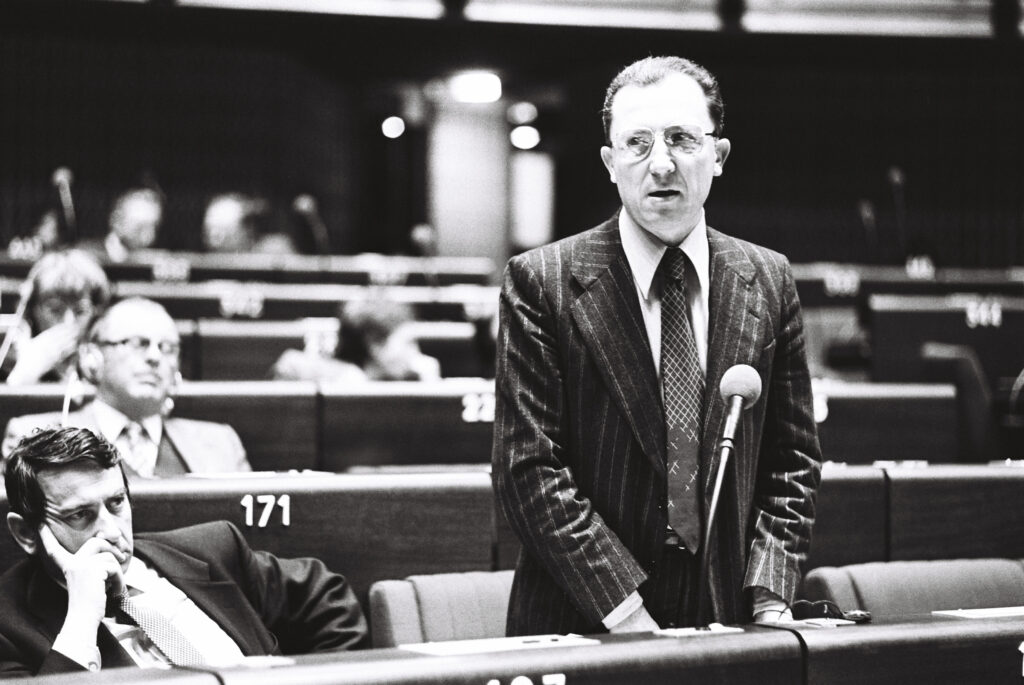
Jacques Delors became Commission President in 1985. He judged yearly brinkmanship a threat to the 1992 single-market timetable and to public faith in the European project. He sought a sturdier frame.
From firefighting to planning
In 1988 Mr Delors unveiled the first Financial Perspective, covering the period 1988–1992. Payments were capped at 1.15 per cent of Community GNP in 1988 and 1.20 per cent by 1992. Cohesion funds for Spain, Greece and Portugal doubled. A new guideline slowed agricultural growth. “(To have) a Europe built on competition that stimulates, cooperation that strengthens, and solidarity that unites, we must replace improvisation with foresight,” Mr Delors told ministers.
Weary of drama, Europeans agreed. “This financial framework is an investment in Europe’s future; without solidarity the single market will not endure,” Helmut Kohl, the German Chancellor was quoted as saying.
The plan worked. Spending still grew, but finance chiefs escaped annual cliff-edges. Scholars hailed the shift from ad-hoc wrangling to rule-based management. Parliament enjoyed steady influence in place of last-minute showdowns.
Delors II extended the horizon to 1999 and nudged the ceiling to 1.24 per cent of GNP. It prepared for Austria, Finland and Sweden. It also kept trimming VAT’s share of income in favour of GNP-based contributions. Rebates still rankled, yet the framework held.
Preparing for enlargement
The fall of the Berlin Wall set the next test. Agenda 2000, negotiated for 2000–2006, kept the spending ceiling at 1.24 per cent of GNP but invented pre-accession funds for Central and Eastern Europe. Rural-development lines multiplied, cohesion remained generous and agricultural reform edged on. Parliament, now empowered to approve the entire package, demanded stricter oversight of how money was spent.
By 2004 ten newcomers had joined. Cash coursed east for roads, sewage plants and laboratories. CAP still claimed a large bite, yet its dominance slipped again. Net contributors, led by Germany and the Netherlands, asked why their taxpayers should remain the main financiers.
This financial framework is an investment in Europe’s future; without solidarity the single market will not endure. — Helmut Kohl, Germany’s Chancellor, 1988
Their doubts sharpened as the next budget round opened. The Union now had 27 members, and ambitions had grown with the map.
Frugal undercurrents
The 2007–2013 MFF fixed total commitments at 1.045 per cent of EU GNI. Research and innovation climbed the hierarchy; farm support fell once more. Negotiations turned raw. Austria, Denmark, the Netherlands and Sweden—quickly christened the Frugal Four—demanded fresh rebates and tighter ceilings. Net recipients retorted that cohesion cash was the price of the single market. A bargain emerged, but goodwill thinned.
Before the ink dried, the euro-zone crisis erupted. Growth vanished, debts soared and austerity spread. The forthcoming framework would be leaner still.
Drawn up amid bail-outs and joblessness, the 2014–2020 plan became the first to shrink in nominal euros. Commitments were capped at €960bn—about 0.95 per cent of EU GNI.
Drafting in hard times
The Parliament called the figure timid, yet lacked votes to block it. Flexibility and an Emergency Aid Reserve sat outside the ceiling, prompting accusations of ‘shadow budgeting‘.
We must replace improvisation with foresight. — Jacques Delors, European Commission President, 1988
The migration surge of 2015 exposed these limits. Parliamentarians scoured the books for money to shelter refugees and patrol borders but found ceilings locked. Meanwhile Britain’s 2016 vote to leave meant the loss of the second-largest net contributor and reopened every ledger.
Finance ministers braced for thornier sums. Then a virus arrived.
Pandemic, debt, and conditionality
Covid-19 froze economies just as talks on the 2021–2027 MFF began. After lengthy meetings in July 2020 leaders stitched a €1.8tn deal: a €1.074tn framework plus a €750bn recovery fund named NextGenerationEU, financed by common debt. Thirty percent of combined spending was earmarked for climate action; other headings favoured digital upgrades and economic resilience.
The agreement also attached funds to respect for the rule of law. Warsaw and Budapest threatened a veto but relented after procedural reassurances. Charles Michel, President of the European Council, hailed the arrangement as “Europe’s Hamilton moment” immediately after the marathon 2020 summit. (The phrase gained traction across leaders that summer, with Olaf Scholz, the then-finance minister of Germany, popularizing it earlier amid Merkel-Macron proposals.)
Net contributors frowned at the debt but signed nonetheless. Inflation and Russia’s invasion of Ukraine soon added strain, yet the framework held, showcasing the value of built-in flexibility and the hard-won habit of compromise.
Next on the docket
Attention now swings to 2028–2034. The European Commission sketches a pot nearing €2tn , roughly 1.26 per cent of EU GNI. Six priorities dominate the draft. The first is flexibility, allowing funds to move swiftly when crises strike. The second is simplification through national and regional partnership plans. The third is competitiveness, channelled via a European Competitiveness Fund into green technology, biotechnology and defence.
The fourth priority is social inclusion and skills. The Erasmus+ scheme will grow, fostering mobility and civic ties. A fifth is preparedness: a €400bn crisis mechanism promises quicker support during shocks. The sixth is security: more than €131bn would reinforce cyber-defence, ammunition stocks and joint procurement—sums unimaginable when the CAP ruled alone.
How to pay remains contested. Carbon-border and digital levies exist on paper, yet national treasuries still shoulder most of the load. The reflex of juste retour—cold accounts of give and take—shows no sign of fading.
Patterns in the ledger
Across seven decades familiar rhythms emerge. Agriculture starts dominant, recedes, then ignites new discord. Enlargement calls forth generosity; ensuing downturns claw it back. Each solution seeds the next hassle. Rebates breed rebates, off-budget instruments foster opacity and debt mutualisation prompts constitutional jitters.
Yet the framework endures. It has shifted from annual scraps to five-year spans, then six, now seven. The budget has paved roads in Andalusia, wired classrooms in the Baltics and modernised factories in Bavaria. It weathered Ms Thatcher’s fury, Franco-German horse-trading and populist tirades.
Whatever the next cycle brings, the budget will bend again—never quite breaking, always reflecting Europe’s untidy but persistent search for common purpose. Whether it can save the Union amidst current challenges is another matter.