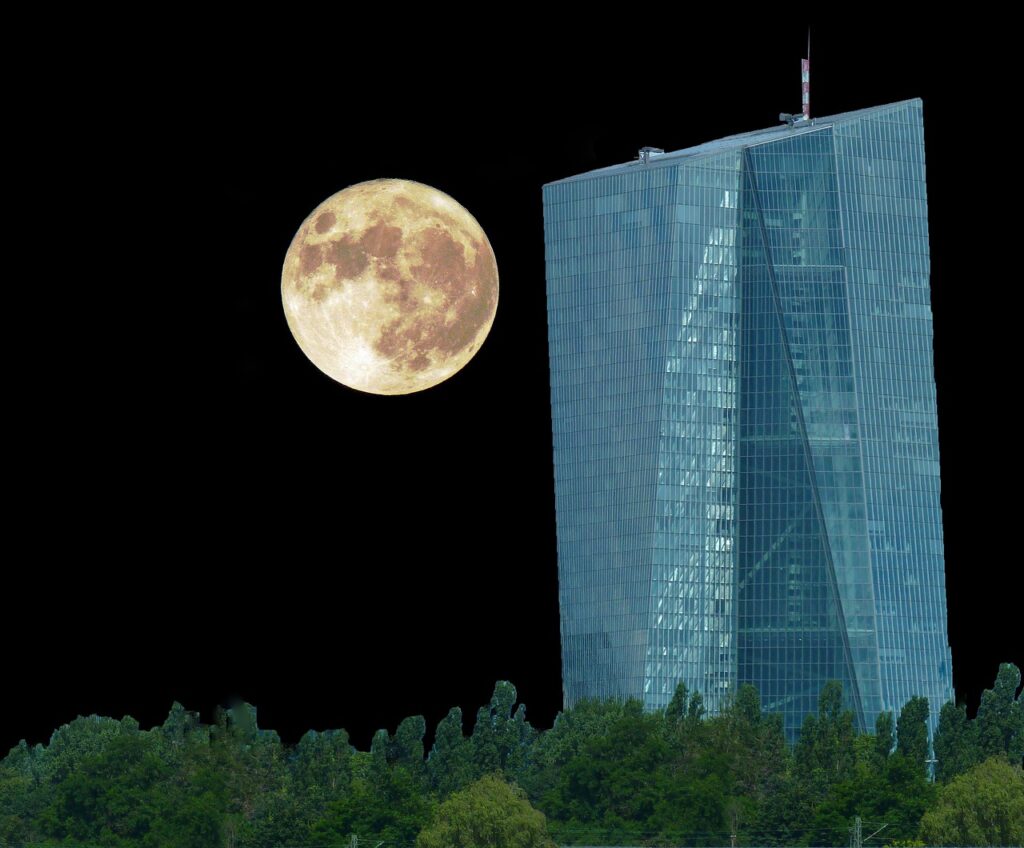

The European Central Bank’s refusal to act as a backstop for the EU’s proposed €140bn “reparations loan” to Ukraine has thrown one of the bloc’s most politically sensitive financial projects into uncertainty—and exposed the legal constraints limiting Europe’s ability to make use of frozen Russian state assets. The decision, first reported by the Financial Times, is more than a technical setback. It highlights the structural limits of the EU’s attempts to innovate financially under wartime pressure. It is also likely to reshape the funding debate ahead of a critical leaders’ summit on 18 December.
At the heart of the matter is a simple but essential question: can the EU use immobilised Russian central-bank reserves to underpin a large, multi-year financing package for Kyiv without violating its own treaties or risking destabilisation in financial markets? The commission’s proposal sought to raise up to €140bn — effectively securitising the future value of the frozen assets — while using state guarantees and a liquidity backstop to protect Euroclear, the Belgian securities depository that holds the bulk of the funds.
A step too far
The ECB concluded that the blueprint crossed into prohibited territory. Providing emergency liquidity to Euroclear, as envisaged during discussions between the Commission and the central bank, could — in the view of ECB analysts — resemble a contingent commitment by member states, raising concerns about whether the arrangement meets the definition of monetary financing: a red-line embedded in EU treaties to preserve central-bank independence.
Publicly, the ECB stressed that any arrangement must comply with treaty law. Its position, officials say, is not about geopolitics or Ukraine policy, but about precedent. Legal experts argue that if the ECB were to assume contingent liabilities linked to political decisions by member states, it would erode the firewall separating monetary and fiscal realms — a boundary that has been carefully defended since the eurozone debt crisis.
Other workarounds?
The Commission, for its part, has tried to strike a measured tone. A spokesperson reiterated in recent days that Brussels has been “in close contact” with the ECB throughout the design of the loan structure and has been examining options to ensure liquidity in all scenarios, including the theoretical obligation to return assets to the Russian central bank if sanctions were lifted following a ceasefire or peace deal. The line reflects both realism and political sensitivity: officials acknowledge the legal hurdles but remain under intense pressure from EU capitals to find a workaround that can support Kyiv through 2026.
Pressure on the EU to act is increasing: despite charges that Russia is falsely amplifying its success in a key town, Ukraine is facing worsening conditions on the battlefield, a widening budget deficit, and uncertainty about US support as Washington pursues its own, now modified, peace plan. The EU, which has promised steady financial backing, must demonstrate that it can deliver large-scale, predictable support even amid internal disagreements. Several member states — particularly those in the Baltics and Eastern Europe — view the use of frozen Russian assets as a strategic (and moral) imperative, arguing that Moscow should pay for the devastation wrought since 2022. The EU’s top diplomat Kaja Kallas has repeatedly reminded observers that there is only “one aggressor and one victim” in the conflict.
You might be interested

Belgium hesitant at best
Belgium, home to Euroclear, has come out strongly against touching the frozen funds without proper guarantees. Prime Minister Bart De Wever has demanded that all EU states sign binding, unconditional guarantees before any loan is issued. Brussels fears that a peace deal negotiated primarily by Washington — or a sudden shift in EU domestic politics — could lead to sanctions being lifted before a long-term repayment mechanism is in place. In that scenario, Euroclear would face immediate obligations to return Russian funds that it cannot meet without a deep liquidity pool or external guarantee. Without the ECB in the backstop position, that risk becomes harder to manage.
Some observers suggest that other member states may have additional, quieter concerns. Anchoring such a large instrument to assets that are frozen but not confiscated could, they say, pose legal questions at the EU or international level. Others worry that reliance on financial engineering might obscure the need for a more straightforward, politically negotiated fiscal commitment to Ukraine.
Alternative schemes face own hurdles
For now, the European Commission is working on alternative designs. Officials describe potentially involving the European Stability Mechanism or a bespoke EU vehicle — but acknowledge that any new scheme will still require unanimity among the 27 member states. That unanimity has been elusive: Hungary has already signalled reservations over rolling over Russia-related sanctions, a decision that must be taken every six months. Even a small group of dissenters could stall the entire loan.
The ECB’s stance has forced the EU to confront the legal boundaries of its own system. While many policymakers see the frozen Russian assets as a tempting source of leverage, the European architecture built over decades — treaty-bound institutions, legal protections, and a politically sensitive central bank — was not designed for wartime improvisation. As EU leaders prepare for what could well be a defining summit, they face a difficult truth: securing funding for Ukraine requires navigating a complex mix of legal, financial, and political constraints, and they are nowhere near out of the woods yet.