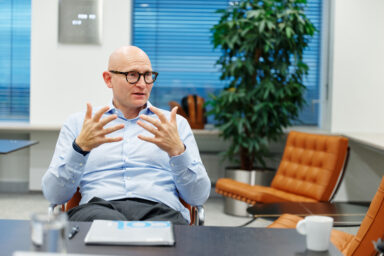

As the European Commission rolls out the latest health package, revised rules for medical devices sit at the centre of the debate. In an interview with EU Perspectives, Jesús Rueda Rodríguez, Director General for Industrial Affairs & Strategies at MedTech Europe, warned Europe risks losing medical innovation and delaying access to critical devices for patients.
Brussels frames the proposal as a long-awaited course correction, aimed at boosting innovation, competitiveness, and resilience. Industry representatives, however, warn that Europe is running out of time to fix systemic flaws that already delay patient access and push innovation elsewhere. Mr Rodríguez insists that governance and implementation improve quickly.
The Commission has presented a broad health package, including revised medical device rules. What was your first reaction?
The fact that this proposal exists is already a recognition by the Commission and by the authorities that things are not going well. That is encouraging, because there have been a number of very serious challenges that we are facing working under the current framework. We have seen a situation where our ability to deliver medical technology solutions to patients has become more and more compromised. So simply the fact that it exists is the first good news.
When you look at the proposal itself, does it solve those challenges?
Going into the details of the text itself, it has some good things and some not so good things. It is a little bit challenging. We are still doing a very in-depth review. It is good to see that there are questions around efficiency being addressed, like the recertification issue. But there are some topics where the Commission could have gone further. We are not quite sure whether what is being proposed is going to be enough to resolve the issue, or whether it is just keeping the current system and trying to clean it up a little bit. I am not sure that would be sufficient, especially when it comes to governance.
You might be interested

Why does governance remain such a concern?
What the Commission is doing is trying to streamline and reinforce the existing governance, but not really changing governance. If existing governance could work, it would work. We are not sure how that is going to play out. That is definitely a challenge going forward.
SMEs have struggled under the current system. Does the proposal ease that pressure?
SMEs have always been very challenged under the current regulations. To be fair, the Commission has tried to put forward some proposals. Some things will undoubtedly help, like no longer having the recertification burden automatically, so certificates do not expire and only need to be redone if there is a fundamental change.
It is also good to see that the Commission has been looking at notified body fees and at giving SMEs a discount. But nobody is sure how that discount is actually going to work, because notified bodies are not public entities. If you have a notified body where 80% of its client base are SMEs, how are they going to be able to afford to give that kind of a discount? It is written in the text, but it is not clear how it is going to work.
Is that gap between intention and implementation a wider issue?
Yes. There are a number of cases where it sounds good when you read the text. Then you stop and think, “How is this actually going to work?” And you do not really see it working. There is at times a little bit of a gap between the intentions and the practical implementation of the proposal.
Do you expect the proposal to change significantly during negotiations?
I think this text is a starting point for co-decision. I do not believe it is going to finish like this. There are going to be significant modifications. It generally points in the right direction, but that does not necessarily mean that the fixes are always the solutions that we need.
How do you assess whether the proposal is sufficient?
There are two different criteria. One is whether this takes the pain away that people are feeling right now. That is a very important criterion. But there is another question, which is whether this is a system that is going to be viable for the next 20 years. Interestingly, you get different answers depending on which question you ask.
Is there one element that shows the Commission has understood the challenges well?
The proposal for breakthrough innovations and orphan devices is very important. That will really allow those technologies to get through to patients much faster, hopefully, and with a simpler process. Under the existing MDR and IVDR, key innovations, especially orphan devices and breakthroughs in paediatric medicine, really struggle. Having a mechanism that allows these technologies to reach the market in a simplified manner is going to make a real difference to patients across the EU.
Does the proposal help Europe become more competitive globally?
There is a change in philosophy. Europe is no longer alone in the world. It needs to collaborate globally and look at what happens in international settings. It needs to understand why patients in other jurisdictions get access to technology and we do not. That global view that is infused into the text could help make Europe more attractive and competitive, if it is really implemented.
What is MedTech Europe’s red line as negotiations move forward?
Anything that blocks or makes access to technology more difficult. Exactly what that looks like in practice will vary, but that is our guiding principle. We want innovation to remain accessible, safe, and effective.
How urgent is reform for the medical device sector?
It is very urgent. We are seeing the dismantling of important medical technology infrastructure in Europe. Smaller companies are going under. Others launch in the US or Japan first and then move their operations there. Clinical studies and evidence generation are also moving away from Europe. The original MDR was proposed in 2012 and published in 2017. We cannot wait another five years.
Is it already too late for some companies or products?
For some individual products and companies, it is already too late. Mainly smaller companies. Many have reduced their portfolios because development is no longer feasible. This is particularly true for devices intended for specific patient groups, such as paediatrics, pregnant women, or rare conditions. It is those patients, often the most vulnerable, who end up suffering.
How does this package connect with the Biotech Act and other initiatives?
There is a very important link, especially with IVDR, which comes from the biotech field. Diagnostics play a major role in areas like antimicrobial resistance and One Health. Companies now develop tests for humans, animals, and the environment.
There is also a strong link with clinical studies. The EMA has told us that 25% of all drugs now require a medical device to function properly. We increasingly see hybrid studies involving both drugs and devices. It is really important that the two regulatory systems work properly together.
If Europe gets this right, what should patients expect?
Innovation will reach patients faster. You will get solutions for more patient groups in a more efficient way. The biggest impact will be in paediatric care, maternal care, rare diseases, and personalised medicine, supported by digital and AI tools.
Any final message for policymakers?
The full impact of the problems with MDR has not yet reached hospitals. We really want to avoid that full impact ever becoming a reality. This is not just about industrial competitiveness. It is about patient access. If this fails, patients will suffer.