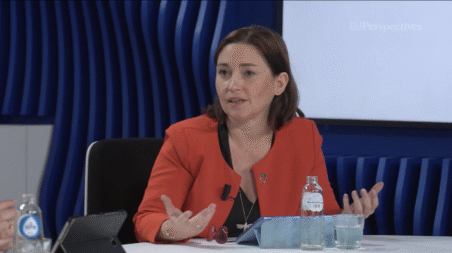

With the Digital Networks Act’s January unveiling approaching, telecom operators are urging Brussels to boost investment, simplify regulation and strengthen Europe’s digital infrastructure. EU Perspectives discussed this with Alessandro Gropelli, Director General of Connect Europe, the leading association for the continent’s major operators.
Connect Europe represents Europe’s leading top connectivity providers. Mr Gropelli spoke to EU Perspectives about what the industry expects from the legislation, where the gaps lie, and about the political challenges ahead.
What gaps is the Digital Networks Act likely to solve that current EU and national rules do not?
The Digital Networks Act is a reform. It’s about putting order into existing EU-level rules. Telecoms have been regulated for more than 20 years, starting in the 1990s, and it’s time to simplify and deregulate.
When telecom rules started in the 1990s, the goal was to liberalise markets and create competition. They have achieved that objective. Markets today are vibrant and competitive. The political objective now is different: it is investment in digital infrastructure.
You might be interested

If you look at the 2030s and 2040s, the key infrastructure for growth is no longer just roads or energy, but digital infrastructure. AI and digital networks are the main productivity engines, and connectivity networks are part of the AI infrastructure. That’s the main gap the Digital Networks Act should address, and that’s why we agree it needs to be ambitious.
Some argue that the DNA has lost ambition compared to early discussions. Do you share that concern?
We need to see the final text on 19 January. But there is no doubt it must be ambitious. Today, Europe invests significantly less in telecom networks than the US. Investment per capita is about half. According to the Commission’s own projections published in June, if we continue at the current pace, Europe will only reach full fibre coverage in 2051.
That’s a major competitiveness problem. China has already built its manufacturing base on high-speed networks and advanced 5G standalone. The US has done the same. Europe is behind. This is not just a sector problem, it’s an economic problem. That’s why an ambitious Digital Networks Act is so important.
Several member states have warned against shifting powers from national regulators to the EU level. How do you see that balance?
I agree with the conclusions of the Letta report on the single market, which was requested by the European Council itself. If Europe believes in the single market, it must harmonise where it makes sense. In telecoms, we are double-regulated. We have EU rules and national gold-plating on top. That holds the sector back and directly harms Europe’s digital sovereignty.
We need harmonised rules, for example, on spectrum and on access to fixed networks. Today, national regulators apply these rules very differently. We need more European harmonisation and less national fragmentation. I agree with Letta and with Draghi on this
What would the Digital Networks Act change for consumers and businesses in practice?
Let me start with users. If we do nothing, by 2030, there will still be 40 million Europeans without gigabit connectivity. That is not acceptable from a socio-economic point of view, especially if at the same time we tell young people and workers that they need to engage with AI and digital jobs. You cannot do that without connectivity.
If we do nothing, by 2030, there will still be 40 million Europeans without gigabit connectivity — Alessandro Gropelli, Director General of Connect Europe
For companies, the situation is also clear. According to figures cited in the Draghi report, telecom returns on capital are below the cost of capital. That means if you invest one euro today, you get back less than one euro. This is not sustainable.
Returns and investment go hand in hand. If returns remain too low, investment slows down, and we are talking about strategic infrastructure, not discretionary spending. From our perspective, over-regulation reduces the appetite to invest. If the DNA deregulates access where possible and harmonises rules at EU level, companies will see better prospects for returns and invest faster. If not, we stay on the current path, and that means full fibre in 2051.
You’ve spoken about overregulation. What exactly do you mean?
We have three layers of regulation. First, telecom-specific EU rules. Second, national rules were added on top. Third, horizontal EU rules like GDPR and the Consumer Rights Directive.
We are not asking to reduce consumer protection. But when two or three layers regulate the same issue, you should choose. If a horizontal rule already applies to everyone (banks, telecoms, big tech), then sector-specific rules are not needed.
A study we conducted found 34 different sets of rules applying to telecoms. That level of complexity adds cost without adding consumer benefit. Simplification is essential.
What would an “ambitious” Digital Networks Act look like for Connect Europe?
There are three red lines. First, deregulate fibre rollout to send a clear signal to investors that returns are possible. Second, simplify, simplify, simplify. We cannot continue with three layers of rules. Where sector-specific regulation is redundant, it should be removed. That also helps create a level playing field with big tech.
Simplify, simplify, simplify. We cannot continue with three layers of rules — Alessandro Gropelli
Third, spectrum reform. Spectrum is the lifeblood of mobile communications. Today, licence prices, duration and conditions vary widely across member states. Licences are often too short to recover investments.
Ideally, licences should be indefinite, as in the US. If not, they should at least be much longer. That would free up capital for actual network investment. If these three things deliver, Europe will send a strong signal, and investment will follow.
Given member states’ resistance, do you foresee implementation challenges?
The biggest challenge is the status quo, and that is not unique to the telecom industry. You see the same dynamic in almost every major political decision currently being discussed in Brussels. If I may say it this way, may the spirit of Mario Draghi be with us. Because if we do not reform, we will not get different or better results. If you want better outcomes for your economy, including for the connectivity sector, you need reform.
If you keep doing things the way they have always been done, the result will not change. That is the core challenge the Digital Networks Act needs to address.