The Mercosur trade agreement, the world’s largest of its kind, would normally suffice to keep the leaders busy till dawn. This time, however, it did not even make it to the list of the EUCO session’s formal conclusions. Yet EU leaders emerged from their bleary-eyed summit proclaiming triumph.
In reality, the Council had merely kicked a bruising trade row into January. The two-day European Council, on 18-19 December, failed to secure unanimous backing for the long-awaited pact with the Mercosur bloc of South American countries. The meeting, however, ended with claims of a ‘breakthrough’ and talk of a ‘clear pathway’.
The deal matters. If sealed, it would create the world’s biggest free-trade area, scrap duties on cars and machinery flowing to Latin America and cut import tariffs on beef, soy and minerals entering Europe. Negotiations have dragged on for 26 years. France and Italy, worried about cheap farm imports, refused to budge. Germany, Spain and Nordic states, hungry for new export markets and critical minerals, lobbied hard for signature this month.
Outside the summit farmers made their feelings plain. Tractors snarled Brussels traffic, tyres burned and a wooden coffin marked “agriculture” smouldered beneath winter drizzle. Police fired water cannon and tear gas. Inside, leaders haggled over safeguards, compensation and sequencing.
You might be interested
Consensus on ice
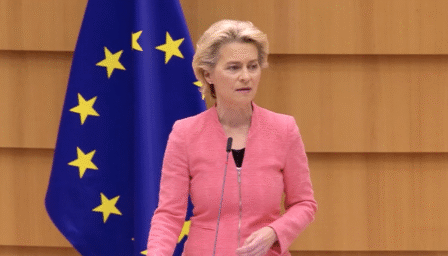
At a press conference Ursula von der Leyen, president of the European Commission, tried to sell the delay as victory. “And one part of this was a discussion about the Mercosur agreement. This evening, we have achieved a breakthrough to pave the way for a successful completion of the Mercosur agreement in January. We need a few extra weeks to address some issues with member states. And we have reached out to our Mercosur partners and agreed to postpone slightly the signature. In a year dominated by news of rising tariffs and new trade restrictions, the positive impact of this pact matters, not just for our two regions, but for the global economy.”
Moments later Ms von der Leyen turned to the arithmetic of votes. “So, yes, I’m confident that we have the sufficient majority. There is still, as I said, work to do with member states. Therefore, we needed a slight postponement.” How those votes will materialise she did not say.
After 26 years negotiating the Mercosur, we agreed to sign. (…) I think the world won’t lose a lot with these three weeks after 26 years. — António Costa, European Council President
António Costa, president of the European Council, echoed the upbeat line. “I like that we have now, after 26 years negotiating the Mercosur, have agreed to sign. Not on Saturday, but three weeks later. I think the world won’t lose a lot with these three weeks after 26 years,“ he peddled a positive spin on the story.
Winners and whingers
Not everyone left happy. Emmanuel Macron arrived in Brussels demanding “further concessions”. Giorgia Meloni, Italy’s prime minister, backed him. Their worry is simple: poultry, beef and sugar cane from Brazil and Argentina could swamp home markets. The two capitals joined forces with Poland, Belgium, Austria and Ireland to hold up the deal, at least for now.
The postponement spared Ms von der Leyen an embarrassing dash to Brazil with an empty briefcase. Luiz Inácio Lula da Silva, Brazil’s president, signalled patience, saying Ms Meloni had asked for “three weeks”. Even so, Mercosur ministers, who had threatened a now-or-never ultimatum, will be weighing whether Europe can ever deliver.
The Commission insists further safeguards will placate sceptics. Officials talk of quotas, phased tariff cuts and “additional checks”. Details remain sparse. Farmers’ unions doubt anything short of fresh subsidies can level the field.
Three weeks? Three years?
The timetable is tight. To sign in January Ms von der Leyen needs a qualified majority of EU governments and assent from the European Parliament. France holds municipal elections in March; Italy faces restive farmers and a shrinking economy. Both governments may see advantage in prolonging the fight.
This morning when we came, there was no clear pathway to Mercosur. Now, at almost 4am, we have a clear pathway. — Ursula von der Leyen, European Commission President
Delay also feeds questions about Europe’s reliability. Leaders tout the pact as proof the bloc can still shape globalisation rather than be shaped by it. Yet another slippage weakens that claim and offers rivals space to woo South America.
At the press conference, however, Ms von der Leyen offered a final flourish. “This morning when we came… there was no clear pathway to Mercosur… now at almost 4am, we have a clear pathway.” The pathway may be clear, but the route is strewn with political potholes. If January brings only more detours, the self-declared breakthrough will look like what it was: a photo finish without a finish line.
According to unofficial reports that surfaced later during Friday, Commission plans to sign the Mercosur trade agreement on 12 January 2026 in Paraguay. That is, however, yet to be confirmed.