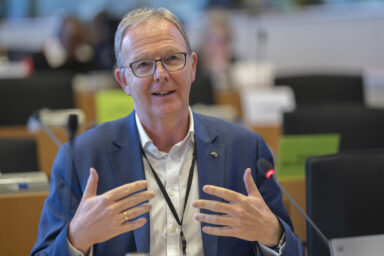

The European Parliament’s Budgets Committee convened on 11 December 2025 to begin deliberations on the interim report for the next Multiannual Financial Framework (MFF). The Commission first presented its proposal on 16 July 2025, launching what has been described as the most ambitious and expensive MFF ever. The plan integrates increased spending on security, defence, competitiveness, and recovery programmes while also proposing reforms to traditional policies such as the Common Agricultural Policy (CAP) and cohesion policy. These reforms left many MEPs concerned about potential impacts on regions, farming, and social cohesion.
Co-rapporteurs Siegfried Mureşan (EPP/ROM) and Carla Tavares (S&D/PRT) framed their draft report on Thursday as nothing less than a starting point: amendments will be accepted until the end of January, and opinions from other committees are due by 5 March 2026. MEP Mureşan underscored the timing: “When it comes to the MFF as a whole, Karla Tavares and myself are now putting forward the draft report on the interim report on the multi-annual financial framework. When adopted, this report will constitute the official mandate of the European Parliament for the negotiations with the Council and with the Commission.”
Parliament front and centre
Both co-rapporteurs emphasised Parliament’s central role in allocating funds and overseeing implementation. Mr Mureşan rejected anything resembling a Europe “à la carte” approach: “We need a budget which responds to new challenges, a budget which sees security, defence and competitiveness as new priorities but not at the expense of the traditional policies.”
Ms Tavares, meanwhile, highlighted governance and transparency: “In this draft we think that access to funding should be linked to the rule of law, to the rules of the EU and our own resources are of course essential to fund the union’s priorities, reduce our dependency vis-à-vis national contributions.” She also praised work on own resources, underlining the importance of genuinely European revenue.
Next Gen repayment and priority funding
A central proposal is to treat Next Generation EU (NGEU) repayment separately from the MFF ceiling. Previously, NGEU borrowing was financed through the EU budget, effectively reducing operational funds. The co-rapporteurs argued that repayment should instead be treated as a separate cost outside the MFF ceiling, potentially leading to a de facto ten per cent increase for priority programmes.
Fabienne Kelley (Renew/BEL) welcomed the draft’s clarity and governance focus: “Because the more you identify clearly European policies, the more that we will be able to monitor the implementation of what has been decided by the different member states and to consolidate that at the European level.”
You might be interested

Fellow MEP responses and policy priorities
The Greens’ Rasmus Nordqvist (SWE) stressed the need for the budget to reflect EU commitments: “I think we still from the parliament side should push on the commission and here come into the question of the size because we have some policies we have to live up to and that also means there has to be a budget behind it.”
S&D’s Jean-Marc Germain (FRA) advocated maintaining overall budget levels while targeting increases: “We will not build the Europe of tomorrow by destroying what we have done today.”
Thomas Geisel (EPP/DEU) warned against consolidating too much power with the commission: “This draft as MFF as proposed by the Commission means a relatively clear shift of power away from this parliament (…) it will be the Commission that negotiates the deals with the member states and the parliament will have very little, if anything, to say when it comes to how the money will be spent and how the use of these funds will be controlled.”
Carlo Ressler (EPP/DEU) highlighted risks of fragmentation: “Europe cannot deliver security, competitiveness and geopolitical stability on a budget that is stuck at close to 1% of GNI… this new idea of consolidation of more than 50 programmes with the strong idea of the national and regional partnership plans can only work with really clear rules, with accountability and with predictability, because otherwise we risk ending up with 27 different patchwork models and not with the European added value of the budget.”
Critical Voices on debt, CAP, and cohesion
Patriots for Europe speakers, not unexpectedly, warned that rising EU debt and centralisation could overshadow operational priorities. Angéline Furet (PfE/FRA) stressed the need to recover detected fraud first and safeguard CAP while Jana Nagyova (PfE/CZE) cautioned that centralising control over national and regional plans, CEF, and competitiveness funds could weaken Parliament’s co-legislative role:
“The proposals, the regulation on different funds are relatively empty from what was in the past… we should… very much push on the commission to be as specific as possible,” she said.
Framing the interim report
Throughout the session, Mr Mureşan and Ms Tavares reminded members that the draft is intentionally non-exhaustive. CAP and cohesion remain central, NGEU repayment is proposed outside the MFF ceiling, and governance is a key concern. Members debated not only the size and priorities of the budget, but also the balance between new programmes and long-standing policies, highlighting the need for clear rules, accountability, and predictability. The interim report is a first step, shaped by amendments and committee opinions, establishing the foundation for Parliament’s official stance in negotiations moving forward. Further discussions and inputs over the coming months will determine how these concerns are addressed before the plenary vote.