
Just when Europe’s diplomats thought they had cleared a path to peace in Ukraine, the US president went full trump over Greenland. Then the threat of Russian-style invasion somewhat subsided, and Brussels returned its foreign policy attention back to Kyiv. It found itself having to rely on a partner it no longer can trust.
At an emergency Council summit, in the wee hours of 23 January, European Union leaders claimed to have steadied the alliance, yet few doubted the scars. “There is certainly no reason for any kind of excessive optimism,” said Polish Prime Minister Donald Tusk. “But very serious tasks still lie ahead of us, and we have wasted some time.”
António Costa, president of the European Council, warned colleagues not to confuse the easing of one drama with the end of another. “Long-term security in Europe must be achieved through a just and lasting peace in Ukraine. Because Ukraine’s security is Europe’s security,” he said. The union’s strategists agree. So do its voters, up to a point.
Swedish Prime Minister Ulf Kristersson put it bluntly. “I really hope that we can now get back to serious discussions,” he told Bloomberg. His plea captured the mood in Brussels: wary, frustrated and painfully aware that Europe cannot ditch America, economically or militarily. The bloc still needs American markets, capital and—above all—security guarantees for Kyiv.
You might be interested
A case of trust bruised
Even Mr Trump’s climb-down left bruises. Friedrich Merz, the German Bundeskanzler, spoke for many when he said, “It has become clear that unity and determination on the European side can indeed make a difference. I am very grateful that President Trump has refrained from his original plans to take over Greenland, and I am also grateful that he has refrained from imposing additional tariffs. All of this is the result of our joint efforts between Europe and the US to find a way to move forward together.” Europeans took note: firmness works, but only for the crisis at hand.
Spain’s Pedro Sánchez sounded angrier. “The government of the US is not respecting international law and is provoking tension in the transatlantic relation between the USA and EU like never before.” Ursula von der Leyen, the commission’s president, sought a calmer register yet stayed sharp. “Firmness, outreach, preparedness and unity. And it was effective, so going forward we should maintain this very approach.”
There’s no hope of achieving a long-term settlement to the war until Russia’s demands for territory in Ukraine are accepted. — Yury Ushakov, Kremlin foreign policy adviser
Such unity helped unblock the trade deal, but it has not settled deeper doubts. Romanian President Nicuşor Dan offered a reality check. “We all need this transatlantic relationship to work,” he was quoted as saying by Financial Times. Few in Brussels dispute that. Fewer still think it will run smoothly.
Refocusing on Kyiv
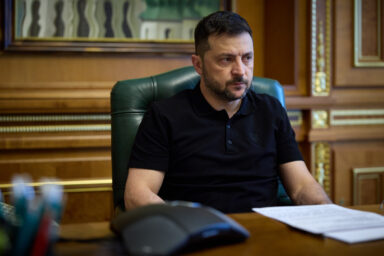
Europe’s wobble emboldened Volodymyr Zelenskyy. Flying into the World Economic Forum at Davos on January 22nd, the Ukrainian president scolded his allies. “Europe loves to discuss the future but avoids taking action today. Where is the line of leaders who are ready to act?” He worries that the Greenland drama distracted Washington and Brussels from Kyiv’s suffering as Russian missiles batter power plants in sub-zero weather.
Ms von der Leyen insists the numbers prove Europe’s resolve. “We Europeans have decided to provide Ukraine with a loan of €90bn for 2026–27 so that it can bolster its defence on the battlefield and strengthen its position at the negotiation table.” She added: “What we can do is stand by their side. I think the figures speak for themselves.” Mr Merz backs the message. “We must continue supporting Ukraine in its fight for just peace. We must become capable of defending ourselves on our own in Europe.”
Money alone will not shield Kyiv. Ukraine wants missiles with longer range; Europeans hesitate. “Here, in Europe, we’re advised not to mention Tomahawks to the Americans – not to spoil the mood,” Mr Zelenskyy complained. “We’re told not to bring up Taurus missiles.”
Talks in the Gulf
Diplomats now rush to salvage momentum. Mr Zelenskyy told reporters, “My team will meet American team and I think that it will be the first trilateral meeting in the Emirates.” He hopes the session in Abu Dhabi will coax Russia into direct contact.
Progress, however, remains fragile. Yuri Ushakov, Vladimir Putin’s foreign-policy aide, dampened expectations after four hours with American envoys. “There’s no hope of achieving a long-term settlement to the war until Russia’s demands for territory in Ukraine are accepted.”
Wouldn’t it be cheaper and easier to just cut Russia off from the components it needs for missile production? Or even destroy the factories making them? — Volodymyr Zelenskyy, President of Ukraine
Still, the mere prospect of three-way talks cheers EU officials, who believe only Washington can twist the Kremlin’s arm. Mark Rutte, NATO’s secretary-general, praised the alliance’s anchor. “NATO is crucial, not only for the defence of Europe, but also for the defence of the United States.”
Drones and deterrence
But Mr Rutte also sounded a manufacturing alarm. “We need European industries to ramp up production and innovation in areas like AI and drones.” Ukrainian commanders share that wish: Russian infrastructure burns under Kyiv’s long-range drones, yet production lines in Europe remain slow.
Ms von der Leyen seeks to fix that. “Since 2022 the market value of European defence-industry companies has tripled … we now have three unicorn start-ups working on advanced dual-use and surveillance drones.” Expansion helps, but European factories still lag American and Chinese rivals. EU officials eye looser state-aid rules, bigger joint orders and a fresh push for cross-border mergers, hoping economies of scale will cut costs and speed deliveries.
Defence planners argue that a thicker industrial base raises deterrence and bargaining power. Mr Merz put it crisply in Davos. “Boosting our military capabilities means to assert our sovereignty.” Few disagree, although finance ministers blanch at the bills. The chancellor wants Germany to spend five percent of GDP on defence, double today’s level. Some capitals baulk. Brussels murmurs about a new common bond to fund weapons, yet frugal northerners resist.
Preparing for more turbulence
Meanwhile Brussels preaches, Russians bombard and Ukrainians shiver. Mr Zelenskyy pressed his case again. “Wouldn’t it be cheaper and easier to just cut Russia off from the components it needs for missile production? Or even destroy the factories making them?” Sanctions tighten but loopholes persist. Black-market chips still reach Russian assembly lines.
Christian Stocker, Austria’s Chancellor, warned colleagues not to relax. “That crisis did not materialise, but how will we deal with the next one?” The question haunts Brussels. Europe’s response to Mr Trump’s Greenland gambit—swift tariffs, sharper rhetoric and a united front—worked once. It may not suffice if Washington next questions NATO’s mutual-defence clause or slaps carbon levies on European steel.
I really hope that we can now get back to serious discussions. — Ulf Kristersson, Sweden’s prime minister
For now the union bets on engagement. Officials want the stalled “prosperity plan”, an $800bn reconstruction fund for Ukraine, signed before spring. They also hope the Abu Dhabi meetings unlock the 20-point ceasefire document that American, Russian and Ukrainian negotiators have haggled over for months. Success would let EU coffers shift from artillery shells to bridges and schools.
Uphill battles
Yet diplomats admit they can only ease, not solve, transatlantic angst. EU trade commissioner Valdis Dombrovskis mutters that the bloc must keep de-risking from America even while embracing it. The slogan irritates Washington and bewilders voters. But de-risking now shapes Brussels’ thinking on everything from liquefied natural gas to cloud computing.
Unity, outreach and a dose of luck steadied Europe this week. None of those is guaranteed next time. The Greenland fiasco reminded European leaders that they face a world where allies shock, adversaries probe and peace in Ukraine still hangs on drones, trenches and summits in desert emirates. To survive, the continent’s political elite must talk to Washington, arm its militaries and keep Kyiv alive—all at once and all the time.