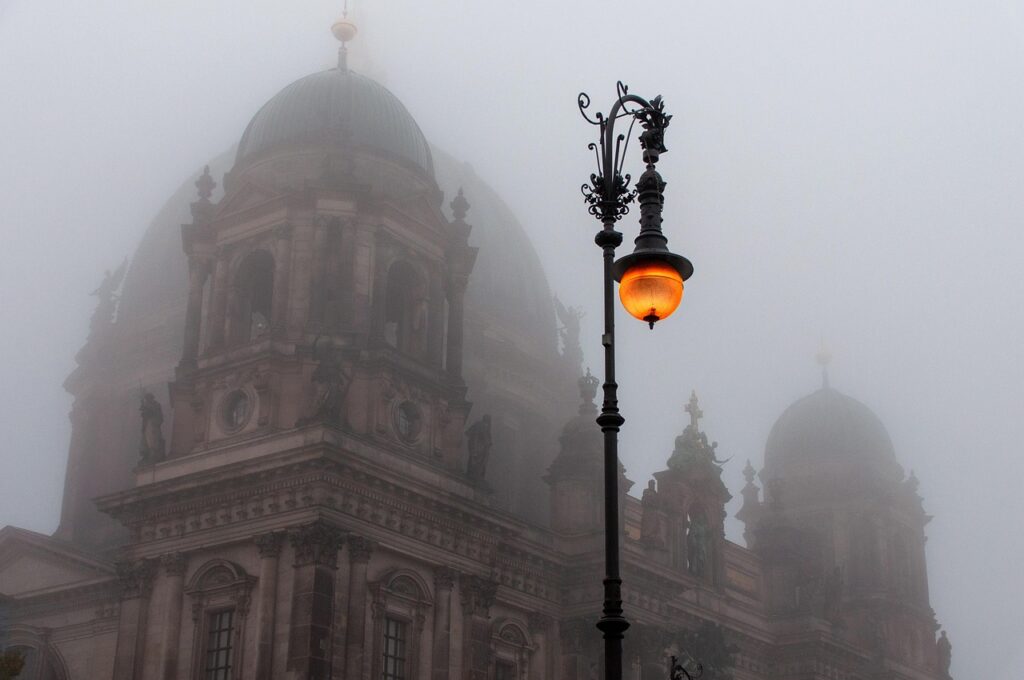

Forty-five thousand households, two thousand firms and a number of hospitals going without electricity, heating and mobile service in sub-zero weather. That is not a Kyiv scene – for the past couple of days, it was the German capital. Authorities look to Moscow but their own mismanagement appears to have played a role as well.
It was not a pretty sight. Berlin went dark soon after dawn on January 3rd. Flames licking a cable bridge over the Teltow canal severed six high-voltage lines feeding the genteel south-western districts of Steglitz-Zehlendorf, Lichterfelde and Wannsee. Grid engineers warned that repairs would take nearly a week—the longest blackout in the German capital since the war.
As torches replaced streetlamps, Berliners looked in vain for decisive leadership. The city’s Christian-Democrat mayor, Kai Wegner, reached the scene only the next afternoon; he later admitted that he had been on a tennis court while residents shivered. The senate declared a state of emergency on Sunday—almost 36 hours after the blaze—yet many citizens outside the affected boroughs still received a mismatched “extreme danger” alert on Wednesday, long after power had begun to return.
Local dithering mirrored federal hesitancy. Ministers offered sympathy but little practical aid until the Bundeswehr dispatched generators late on Monday. Alexandra Prokopenko, a scholar at the Carnegie Endowment who spent two frigid nights in her darkened flat, voiced a common worry. “If a group of German anarchists can be that disruptive, imagine what foreign secret services can do,” she said.
You might be interested
Slow fuse
The German-anarchists narrative, however, is not self-evident. Investigators soon branded the fire arson. A communiqué posted online by the self-styled ‘Vulkangruppe‘, a fringe outfit blamed for earlier attacks on railways and Tesla’s Berlin gigafactory, claimed responsibility. Yet a rival statement—signed by people purporting to be the ‘authentic‘ Volcano—denied involvement.
The confusion widened when security analysts noticed odd Cyrillic transliterations in the first text, suggesting machine translation from Russian. They spotted the curious name “Vans” on a list of right-wing bêtes noires, apparently a mistransliteration of J. D. Vance, America’s vice-president. Such slips, the analysts argued for the Berlin Story News German-language website, smacked of a false-flag exercise designed in Moscow (including a typically Russian amount of attention paid to detail).
If a group of German anarchists can be that disruptive, imagine what foreign secret services can do. — Alexandra Prokopenko, Carnegie Endowment
Berlin has reason to suspect the Kremlin. Sabotage of undersea cables, GPS spoofing in the Baltic and cyber-intrusions at ministries have become almost routine since Russia invaded Ukraine. Chancellor Friedrich Merz speaks often of “Russian hybrid warfare”. His interior minister, Alexander Dobrindt, saw the outage as further proof. “Leftwing terrorism is back in Germany with increasing intensity,” Mr Dobrindt declared, hinting that the far left might be a Russian cat’s paw.
Systemic frailty
Technical failings gave the saboteurs an easy target. Berlin’s grid has too few backup lines to reroute power. Much of the equipment dates from the 1980s; spare parts are scarce. Manuel Atug, a veteran campaigner for stronger critical-infrastructure rules, complained to Financial Times that politicians focus on culprits not contingencies. He called the crisis response “catastrophic”, noting that the operator pleaded on Saturday for specialists to start “a complex operation”.
Peter Neumann, a security professor at King’s College London, sees ideology and pragmatism aligning. “This means they (the arsonists) see sabotage as a politically legitimate means to accelerate the supposed decline of the existing system,” he observed. Such zeal finds fertile ground when authorities appear inept.
Privation revealed social rifts as stark as the outage itself. Well-heeled villa owners booked hotels or decamped to second homes. Wolfgang Ischinger, a former ambassador and now chairman of the Munich Security Conference, fumed on X that the state should stop planting trees and instead spend infrastructure funds so that “one sabotage team cannot shut down the entire capital”. Others lacked such options. Elderly residents were moved from nursing homes whose diesel generators ran dry; dozens slept on camp beds in Zehlendorf’s town hall.
Unequal darkness
“The wealthy this is supposed to target are well provided for. They have cars, they can stay in hotels, they can buy supplies. It’s hitting the wrong people—full stop,” argued Emilia von Fumetti, a volunteer with Die Linke who served soup at the shelter. Her colleague, Trille Schünke, nodded as hastily charged phones lit the hall.
Ordinary Berliners spoke of fear as well as discomfort. “There are extremists everywhere,” said Joachim Schönleiter, a 98-year-old pensioner who once survived Soviet captivity and now lay beneath fluorescent gym lights. Sabine, a 65-year-old office worker on sick leave, felt unnerved by rumours of poisoned pipes. “I was afraid even to drink tap water,” she said. “I am not the only one thinking this.”
Leftwing terrorism is back in Germany with increasing intensity. — Alexander Dobrindt, Germany’s interior minister
Such anxiety is the saboteur’s true goal. Russian doctrine prizes the sowing of discord more than material damage. The outage therefore served as a stress test for Germany’s crisis machinery—and revealed many loose bolts. Emergency text messages directed citizens to websites inaccessible without power or data. Petrol for hospital generators arrived only after ad-hoc calls to private fuel depots. Municipal staff confessed they lacked paper maps when traffic lights failed.
Lessons unlearned
Berlin’s senators promise upgrades. Mr Wegner vows to bury more cables, fit smart breakers and stockpile spare parts. The federal government plans to harden a handful of “system-relevant” substations behind blast walls and armed guards. Yet money and time are scarce, and Germany’s planning laws are glacial. Opposition parties already brand the proposals too timid.
Meanwhile, prosecutors must decide whether to treat the fire as home-grown extremism, foreign sabotage or some murky mix. Proof of a Russian hand would heighten calls for deterrence; proof of purely domestic vandals would still expose a gaping security hole. Either way, the blackout has altered perceptions. A metropolis that touts itself as Europe’s tech hub spent five nights huddling round candles and transistor radios. As Ms Prokopenko warned, Berlin’s vulnerability will invite harsher tests unless it acts faster and thinks bigger.
Europe’s largest economy once prided itself on Ordnung. The January inferno showed how easily that order can flicker out. No missile required, merely a match and a modicum of malice.