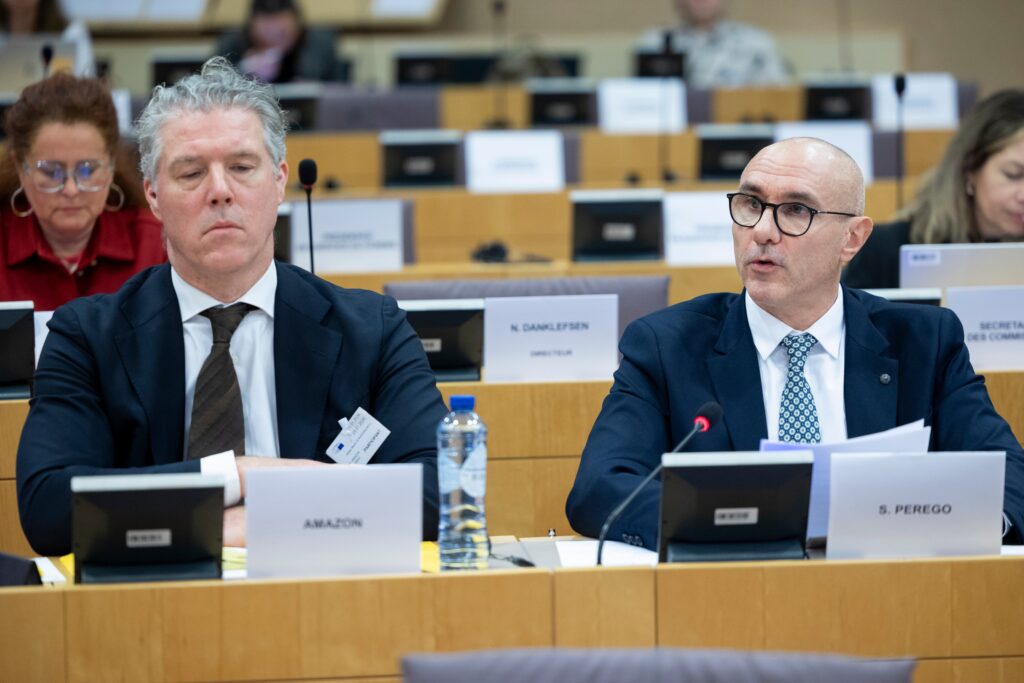

Senior Amazon staff faced a thorough grilling in the latest salvo between the European Parliament and the tech giant over working conditions. Members from across the political spectrum expressed frustration and dissatisfaction with the company while union representatives despaired over failures to improve.
On Wednesday, three Amazon vice-presidents sat through a bruising two hours as MEPs questioned them about working conditions in the company’s warehouses. The Amazon representatives were speaking before a hearing of the Employment and Social Affairs Committee in the European Parliament despite a ban on Amazon lobbyists entering the institution over a failure to engage meaningfully on the issue.
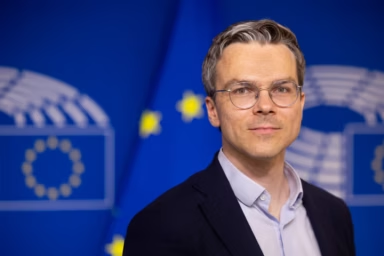
UNI Europa’s Regional Secretary, Oliver Roethig told EU Perspectives on Thursday: “Amazon pulled off a rare feat yesterday and over the past years in the European Parliament: it united everyone from the far left to the far right. Across the political spectrum, parliamentarians are irritated by Amazon’s intransparent and evasive behaviour. At times, it felt like we were hearing not a broken record, but more like a dysfunctional AI responding on behalf of Amazon: repeating the same empty, unsubstantiated phrases.”
MEPs in this case agreed that based on the evidence at hand, working conditions in the tech giant’s warehouses are “alarming and Amazon executives have done their best to avoid public scrutiny.”
You might be interested

Access denied. To warehouses and to the EP
The public hearing on working conditions was just the latest in a long-running saga between the institution and Amazon. The international behemoth has in the past refused to appear before the chamber or allow MEPs to access Amazon warehouses leading the Parliament to revoke its lobby passes in 2024.
According to S&D MEPs, since then nothing has changed: “On the contrary, workers’ testimonies remain deeply unsettling. Reduced to robots, slaves, or cannon fodder, squeezed until they are discarded, forced to work extra hours to compensate for sick leave, tracked during bathroom breaks, fired for demanding accountability – this is how one of the richest companies in the world treats its workers.”
The committee also heard testimony from Amazon staff who have lost colleagues to workplace deaths. Other accusations raised concerns about spying on trade union meetings and invasive digital surveillance of workers. According to a survey by UNI Global Union, 59 per cent of workers feel that Amazon’s monitoring is excessive and 53 per cent fear losing their jobs due to Amazon’s monitoring technologies.
Estelle Ceulemans, S&D spokesperson on employment and social affairs, said: “Big Brother-Amazon monitors and exploits workers to the point of dehumanising them through its ruthless work organisation, which uses surveillance cameras and wifi terminals to exercise total control. Workers are not commodities, and Amazon is not above the law.”
Quality jobs?
According to David Zapolsky, Chief Global Affairs & Legal Officer for Amazon, who appeared via videolink, Amazon has invested more than €225bn in the EU since 2010. “In 2024 alone, the figure was over €38bn. We also support small businesses. More than 127,000 EU-based SMEs currently sell on Amazon. These SMEs generated €15bn in export sales in 2024. Small companies in rural areas generated nearly half of those sales. We now employ more than 150,000 people in the EU in quality jobs across a range of functions.”
But Mr Roethig was scathing of the claim: “It is hard to describe jobs at Amazon as quality jobs when, according to a representative survey, a majority of Amazon workers report feeling ‘stressed, pressured, anxious’ as a result of excessive monitoring and inhumane performance targets in its warehouses.”
Stefano Perego, Amazon Vice President for International Operations and Global Operations Services attempted to address the biggest problem for many in the room: “One of the most common misperceptions about Amazon is the idea that we do not allow employees to join a union. That’s simply not true. We are frequently confronted with misperceptions about our relationship with unions. Our employees have the right to join a union. They always have.”
Once again, Mr Roethig said this was disingenuous: “I believe Amazon didn’t use the word ‘collective bargaining’ once in the hearing. And there’s a good reason as to why: they avoid dealing with trade unions wherever and whenever they can. Just look at Germany: this is Amazon’s biggest market in Europe — and yet for more than ten years Amazon has refused to sign a collective agreement with the trade union ver.di.”
Tighter than prisons
Amazon Vice President of EU Public Policy Lucy Cronin invited MEPs to come and see for themselves. “In 2025 alone, we hosted almost 2,000 policymakers at different sites across the EU. This included many Members of the European Parliament,” she said.
But MEP Leila Chaibi (The Left/FRA) said: “The last time I attempted to visit a warehouse we were not particularly well received. In France elected representatives have the right to visit prison complexes. I can assure you that it’s easier to enter prisons than an Amazon warehouse.”
Fellow MEP Per Clausen (The Left/DNK) added: “Amazon does not respect the labour market model we have in Europe. How can they then feel it is reasonable for Amazon to then win public contracts to use taxpayers money to undermine the European labour market model?”
Different groups, one objective
In summarizing what had been a heated hearing, EMPL Committee Chair Li Andersson said (The Left/SUO): “We will continue our work in the committee regarding these issues, hopefully also with a visit to the warehouses. But I also have to say that we will continue our work to strengthen collective bargaining in Europe. We come from different countries, different groups, but this has been a common objective of ours as stated in the Minimum Wage Directive.”
“The exchanges we have had in this committee have revealed a number of serious and persistent concerns. Testimonies suggest that the level of protection afforded to workers in Amazon warehouses remains at best uncertain. Little has been done to dispel these concerns. We continue to see reports of intrusive employee monitoring, unpaid overtime, workplace safety violations and insufficient protection of workers’ rights.”