
The year 2026 will be a year of smart borders, declared the Home-and-Justice Council of the European Union after Thursday’s meeting in Nicosia. The Cypriot hosts—who have themselves long wished to become members of the Schengen area—promised efforts to keep the zone of free movement intact.
European interior and justice ministers gathered in Nicosia on 22 January for the Home-and-Justice Affairs Council of the EU, the first such gathering under Cyprus’s six-month presidency. Nikolas Ioannides, Cyprus’s minister of justice and public order, laid down the marker. “An effective, fair and sustainable return policy is a central pillar of a credible EU migration and asylum system,” he told journalists after the meeting. The presidency, he pledged, would “turn our shared European priorities into tangible outcomes”.
The session revolved around how to send home more migrants whose protection claims have failed. Mr Ioannides thanked “the valuable contribution of the IOM and Frontex” and called for “stricter and more efficient measures so as to increase returns of third-country nationals to their homelands”. He advocated a “whole-of-route approach” that links border control with development help and capacity-building in origin countries. Reintegration programmes, he insisted, must come “within wider development efforts”.
Tough talk, thin tools
Over a working lunch ministers tackled Syria and Afghanistan. They “addressed the complex challenges of returns…especially of convicted criminals”, Mr Ioannides said. On Syria they “examined the shifts in the region following the change of government in December 2024” and weighed aligning EU migration processes with diplomatic and economic recovery efforts. On Afghanistan they reaffirmed the Union’s “policy of non-recognition of the de facto authorities” while exploring ways “to enable returns in full compliance with international law”.
Summing up, Mr Ioannides judged that “the carrying out of effective and sustainable returns is indispensable for a credible and resilient European migration system”. He repeated the presidency’s goals: “strong external borders, streamlined procedures, a reinforced return system”.
You might be interested
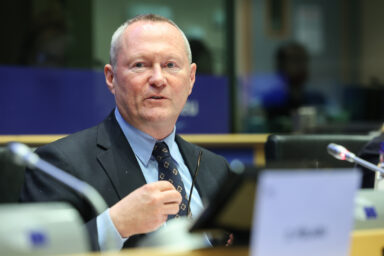
Magnus Brunner, the commissioner for internal affairs and migration, offered numbers and praise. “Cyprus was able to return three out of five people who have no right to stay in the European Union in 2025,” he said, labelling the host country “a role model when it comes to returns”. Union-wide, he noted, the return rate edged up last year, yet “it is still, of course, not enough”.
Mr Brunner listed the missing ingredient: “There’s one missing piece. That’s the return regulation.” The proposal, long stalled in the European Parliament, would sharpen procedures for expelling foreigners deemed to have no right to remain. Work is also under way to update Frontex’s mandate so the agency can “play a very important role when it comes to step-up returns”.
Schengen and smart borders
Costas Fitiris, Cyprus’s deputy minister responsible for internal security, reported that ministers also chewed over Schengen. They agreed that “secondary movements remain a common challenge” and that the zone’s proper functioning depends on “mutual trust, common responsibility and the effective and coherent implementation of the agreed rules and tools”. Large databases—“in particular the updated Eurodac”—must find deployment without delay.
Mr Brunner pointed to technological progress. The Entry-Exit System launched in October had already recorded “over 20 million entries and exits…[and] 10,000 refusals of entry”. Those figures, he argued, show how “smart borders can discourage irregular travel while keeping Schengen intact.“ He predicted that 2026 will be a year of smart borders.
Smart borders can discourage irregular travel while keeping Schengen intact. — Magnus Brunner, EU Commissioner for internal affairs and migration
Asked how returns to Syria and Afghanistan might become easier, Mr Brunner drew distinctions. On Syria, he said, “over three million Syrians have been returned already, not from the European Union but altogether from the surrounding areas”, while Frontex “supported almost 6,000 voluntary returns”. Brussels, he added, is “launching new political partnerships, opening channels for dialogue, lifting all the sanctions…[and] spending about €620m for 2026 and 2027”. On Afghanistan the Union is “co-ordinating with member states to better structure our engagement on readmission with the de facto authorities at a technical level”.
Green lines, red lines
Mr Ioannides highlighted a practical hurdle: “lack of documentation is a common problem”. Nonetheless, “approximately 5,000 Syrian nationals have already either revoked their status or withdrawn their asylum application, and most of them have already returned to Syria from Cyprus”. He said the presidency had invited IOM, Frontex and UNHCR to outline reintegration schemes that member states can tap.
Cyprus’s own Schengen aspirations also surfaced. Mr Brunner said the Commission “fully supports Cyprus” but reminded listeners that enlargement is for the Council to decide. An evaluation report is due “in the next months”. The island’s internal cease-fire line, he admitted, is “one of the challenges”.
Mr Ioannides was categorical: “The Green Line is not a border, will never become a border.” Yet, under the Green Line Regulation, the Republic “is entitled to carry out controls”. He voiced hope that renewed negotiations might one day remove the division altogether.
‘Individualised basis’
Security concerns dominated the final question. What mechanisms exist for removing convicted criminals? Offenders serve their sentences unless a transfer is agreed with the country of origin, Mr Ioannides replied. He added that each case is “examined on an individualised basis”. Mr Brunner kept banging the drum for his stalled bill: “The return regulation focuses on people who pose a security threat, who are criminals, to return them easier than in the past.”
The carrying out of effective and sustainable returns is indispensable for a credible and resilient European migration system. — Nikolas Ioannides, Cyprus’s minister of justice and public order
Whether lawmakers oblige remains uncertain, but the Cypriot presidency has nailed its colours to the mast. As Mr Ioannides put it, Europe’s migration system now hinges on turning return rhetoric into measurable results.