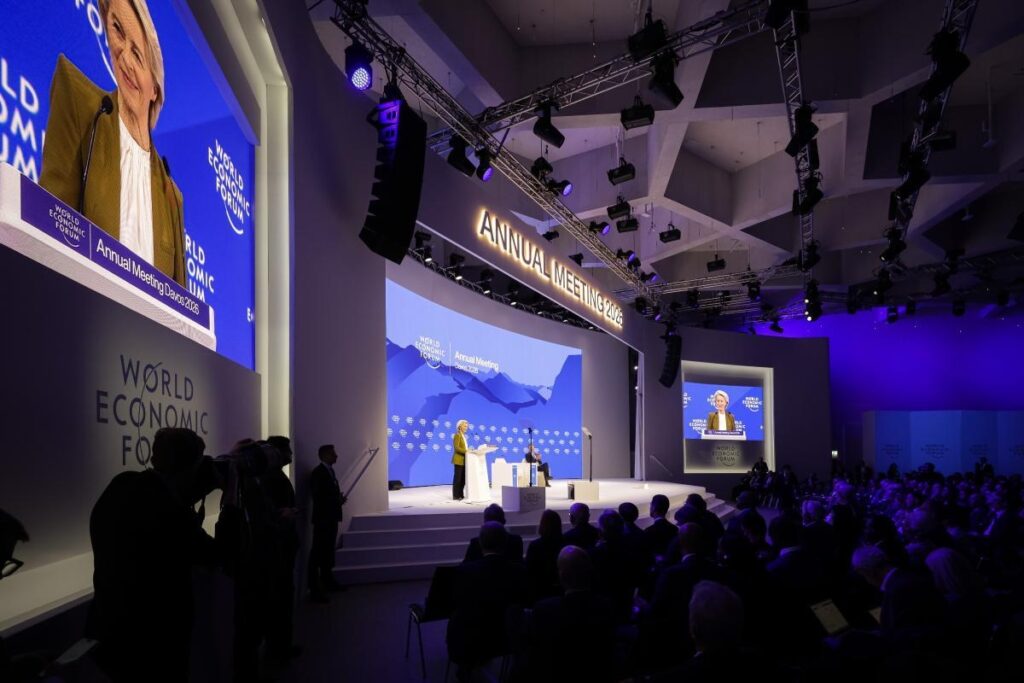

“We are in the midst of a rupture, not a transition.” Canadian Prime Minister Mark Carney’s declaration earned a rare standing ovation, crystallizing what emerged over the week as the defining theme of this year’s World Economic Forum: the American-led international order is over, and European leaders are divided over what comes next. From Trump’s Greenland threats to Lagarde’s dramatic dinner walkout to Macron’s defiant “we prefer respect to bullies,” these were the moments that defined Davos.
Carney channels Havel
Carney’s speech, receiving a standing ovation, channeled Václav Havel’s essay “The Power of the Powerless” to indict global leaders for “living within a lie.” He recounted Havel’s story of the Czech shopkeeper who places a sign reading “Workers of the world unite” in his window—not because he believes it, but to avoid trouble and signal compliance. “Because every shopkeeper on every street does the same, the system persists,” Carney’s call to action: “Friends, it is time for companies and countries to take their signs down.”
The fiction, he argued, is American hegemony. The old order “is not coming back,” and middle powers must stop depending on Washington’s lead. “The middle powers must act together because if we’re not at the table, we’re on the menu.” Wolfgang Ischinger, former German diplomat and doyen of European foreign policy, told the Washington Post the speech was “absolutely admirable,” adding that “some people are now saying, ‘why can’t we invite Canada to be a member of the E.U.?'”
Trump’s opposing view
Trump was briefed on Carney’s speech and wasn’t pleased. “Canada lives because of the United States—remember that, Mark, the next time you make your statements,” he shot back the next day. By Thursday, Trump had rescinded Carney’s invitation to his proposed “Board of Peace” via Truth Social.
Trump’s hour-long Davos address came as an assault on the very order Carney declared in rupture. JD Vance on X said, Trump spoke, “in the heart of the lion’s den.”
“We literally set up bases on Greenland for Denmark. We fought for Denmark,” Trump said, demanding European gratitude. “Without us, right now, you’d all be speaking German and a little Japanese, perhaps.” His ridicule continued: “Until the last few days when I told them about Iceland [Greenland], they loved me. They called me ‘daddy’ right, last time. Very smart man said, ‘He’s our daddy. He’s running it.’”
You might be interested

The “very smart man” Trump referenced was NATO Secretary General Mark Rutte, who has taken the opposite approach to Carney’s call at Davos—insisting on keeping the sign in the window. “I’m not popular with you now because I’m defending Donald Trump, but you can be happy that he is there because he has forced us in Europe to step up,” Rutte said. Critics argue he’s presiding over NATO’s slow death while claiming to preserve it.
American dysfunction on display
For the first time in Davos history, the forum became a stage for open American infighting. “It’s a war [the Russian invasion of Ukraine] that should have never started, and it wouldn’t have started if the 2020 US presidential election weren’t rigged. It was a rigged election. Everybody now knows that. They found out. People will soon be prosecuted for what they did,” Trump said, continuing his claims that Joe Biden was illegally elected.
California Governor Gavin Newsom positioned himself as the face of American democratic opposition at Davos, ridiculing European leaders for their response to Trump: “I should’ve brought a bunch of knee pads for all the world leaders. I hope people understand how pathetic they look on the world stage.”
Later that evening, Newsom said, “California was just denied at the USA House. Last we checked, California is part of USA.” The White House dismissed him. “No one in Davos knows who third-rate governor Newscum is or why he is frolicking around Switzerland.” In response to Carney’s speech declaring the American-led order dead, Newsom insisted “these relationships are in dormancy, they’re not dead.”
Caught in the crosshairs was European Central Bank President Christine Lagarde, who walked out of a private BlackRock dinner after US Commerce Secretary Howard Lutnick belittled European economies, with Lutnick reportedly being heckled until CEO Larry Fink ended the event early. The Americans weren’t just abandoning leadership—they were publicly imploding.
Lutnik came to Davos to represent an abrasive Trump agenda, saying “This year, some people have asked a great question: Why is the Trump administration going to Davos at all? … “The answer is simple: we’re not going to Davos to uphold the status quo. We’re going to confront it head-on,” he wrote.
Europe’s many visions ahead
European leaders articulated competing visions that acknowledged a shifting geopolitical moment. None cohesive enough to fill the void.
French President Macron, sporting viral aviator sunglasses due to a burst blood vessel in his eye, acknowledged the moment with dark humor: “It’s a time of peace, stability and predictability,” he said as laughter filled the room. “We do prefer respect to bullies, and we do prefer rule of law to brutality.”
Commission President Von der Leyen played the reliable partner: “Plunging us into a downward spiral would only aid the very adversaries we are both so committed to keeping out.” She pointed to progress on tech, defense, and energy—”This new Europe is already emerging”—but did not articulate what the new Europe would look like on the world stage.
Germany Chancellor Merz echoed Carney’s concerns—”This new world is being built on power, on strength, and when it comes to it, on force”—while simultaneously urging patience with Washington: “Despite all the frustration and anger, let us not be too quick to write off the transatlantic partnership.”
Ukrainian President Zelenskyy was bluntest about Europe’s dysfunction sparking much criticism: “Just last year here in Davos, I said ‘Europe needs to know how to defend itself.’ A year has passed, and nothing has changed.” Coming days after the EU approved over 90 billion in Ukraine aid, his frustration centered on Europe’s paralysis over using Russian frozen assets and its inability to present a united front on Greenland: “Too often, European leaders turn against each other instead of standing together to stop Russia.”
China the stable bystander
While Americans aired dysfunction and Europeans articulated fragmentation, China promoted calm from the sidelines. “Tariffs and trade wars have no winners,” said Vice-Premier He Lifeng, a notably low-ranked official representing Beijing. “While economic globalization is not perfect, we cannot completely reject it.”
The message was clear: China would position itself as the stable alternative while America tears itself apart and Europe talks itself in circles.
The rupture was on display at Davos
Carney came to Davos with a message that was reflected by the events that unfolded all week. An unprecedented rupture. America demonstrated it can no longer lead—riven by internal dysfunction and actively hostile to the allies it once protected. Europe remains trapped between nostalgia for American hegemony and rhetorical commitments to strategic autonomy it cannot operationalize. China waits patiently for Western collapse to accelerate.
Only Canada articulated a coherent path forward: middle powers take down your signs and come together.