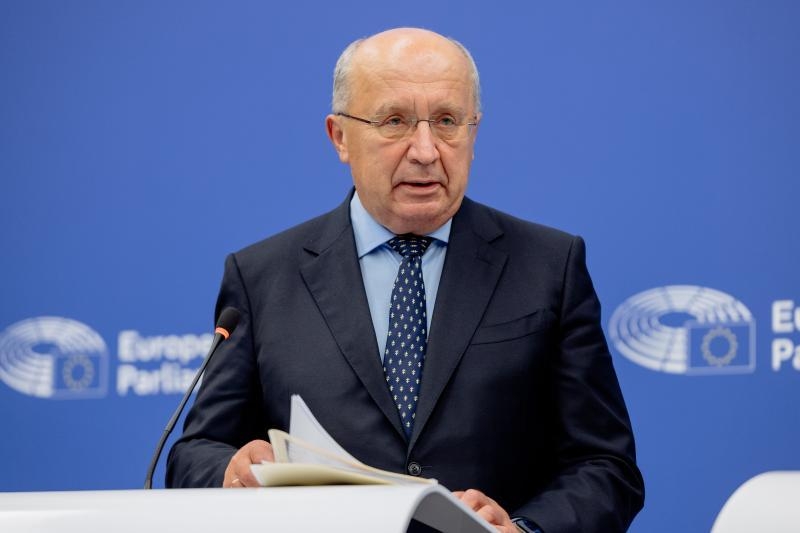

According to Commissioner Andrius Kubilius, the EU should seriously consider creating permanent European military forces of 100,000 troops. The new security council would comprise five permanent members. The United Kingdom should also be involved; the first task for the units would be to defend Ukraine.
Although the idea of a joint European army is not entirely new, Commissioner Kubilius’s remarks at the security conference on Sunday, 11 January, may carry some extra weight. Mr Kubilius presented the idea in considerable detail and directly mentioned the possibility of a breakdown in the European-American security commitment.
Three key pillars
Mr Kubilius menitioned three major pillars to base the ’Defence Readiness of Europe’ on. Money, production, and weapons—i. e., material defence readiness—comes first. Second, the commissioner mentioned the institutional aspects. In other words, how Europeans should organise their defence, particularly if US troops leave the continent.
It is essential to have the will. If needed, the will to fight. — Commissioner Andrius Kubilius on European Army
The third and probably most important and controversial pillar, according to Mr Kubilius, is the political will. “It is essential to have the will to deter and defend. If needed, to fight,” the commissioner said. He also mentioned that the idea of 27 ’bonsai armies’ is clearly outdated in today’s dangerous world. “We must start to invest our money in a way that we would be able to fight as Europe, not just as collection of 27 national armies,” Mr Kubilius underlined.
Step towards a two-tier EU?
Another important aspect of Mr Kubilius’ speech is the so-called European Security Council. Though such an idea is not entirely new—it was proposed and discussed already between 2017 and 2019 by French President Macron and Angela Merkel, the then-Chancellor of Germany—according to Mr Kubilius it is “exactly what we need now”.
As the commissioner has it, the European security council could comprise five key permanent members, along with several rotational members, including the member state holding the Council Presidency. Though he did not elaborate on which countries would form the ’Big Five’, he probably had in mind the most populous and economically strong EU member states including Germany, France, and Italy. London’s engagement is also on the line.
The EU would thus shift—as far as security policy is concerned, anyway—closer towards the long-discussed idea of a ’two-tier Europe’. “The European Security Council would have the task to discuss the most important defence issues (…). And not only discussing, but also swiftly preparing important decisions,” the commissioner stressed before adding that “the first task for such a European Security Council would be Ukraine.”
The coming days will show how member states will respond to Mr Kubilius’ proposal.