
Italy and France are pushing for opening of a direct communication channel with the Russian president by establishing position of a special envoy. Thus, European countries are trying to balance its influence on ending the war in Ukraine, where negotiations have so far been led by US President Trump’s team. Though the Commission says that such discussions are premature, it does not rule it out in future.
At first glance, it may seem like a breakthrough. After many years when the EU kept imposing one sanction package after another on Russia, and political and trade relations with Moscow hit rock bottom, major EU countries now want to start talking directly with Russian President Vladimir Putin. That is, with the man who, by sending troops to Ukraine in February 2022, launched the worst armed conflict in Europe since the end of World War II. The man who is considered war criminal, based on the indictment of International Criminal Court in March 2023.
Counterweight to the United States
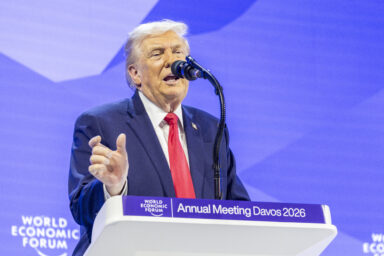
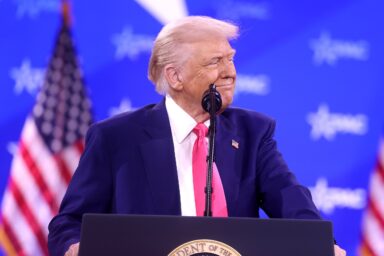
The calls to engage directly with Russia have so far been coming especially from two EU heavyweights, Italy and France. The idea, however, is gradually gaining ground in other capitals as many member states fear that European interests could get lost in the current peace negotiations that are led by US President Donald Trump’s special envoy Steve Witkoff.
In addition to efforts to secure a seat at the negotiating table, the desire to ’talk with Putin’ appears to be motivated by the deteriorating relationship between the EU and the United States. This has been evident in recent months, for example, by the imposition of trade tariffs by the United States, the US ending funding for war supplies to Ukraine, and direct threats to annex Greenland, which is currently administered by Denmark.
Italy, France lead the crowd
“I think that (French President Emmanuel) Macron is right on this. I believe the time has come for Europe to speak with Russia,” Italy’s Prime Minister Giorgia Meloni said at a press conference last week.
I believe the time has come for Europe to speak with Russia. – Giorgia Meloni, Italy’s Prime Minister
The idea of ’speaking with Russia’ is not entirely new. It was first suggested almost a year ago by Finland’s president Alexander Stubb. Mr Stubb, who has the closest relationship with President Trump of any EU leader—both men are passionate golfers—is one candidate whose name has been floated for the role.
Another is Mario Draghi, former European Central Bank President, a man who enjoys an almost unrivalled authority within the European Union. It is Mr Draghi who has long called for fresh thinking about Europe’s place in the world and its international relationships as explained in his famous set of recommendations dubbed ’Draghi report’. Any negotiations with President Putin would have to include the future economic and political relationships between the EU and Russia. That makes Mr Draghi’s background and experience especially useful.
You might be interested
Envoy responsible to whom?
Commission spokesperson Paula Pinho, asked on Monday about starting talks with Russia, replied that “we are not there yet”. Ms Pinho, however, also said that Commission hoped such engagement would be possible in the future.
Obviously, at some point, there will have to be talks also with President Putin. – Paula Pinho, Commission spokesperson
“Peace in Ukraine depends on one single person. That person is, as you know very well, (Russian President) Putin. So obviously, at some point, there will have to be talks also with President Putin. In the meantime, a lot of work is being done,” Ms Pinho added.
Although the position of ’Putin negotiator’ is currently nothing more than an imagination of some politicians, various questions and controversies are already emerging around it. As an example, Kaja Kallas who holds the influential position of High Representative of the EU for Foreign Affairs and Security Policy, opposes talks with Russia. The appointment of a special envoy who would not report directly to her would potentially weaken her position in Brussels’ hierarchy.
The ’Putin negotiator’, whoever that may be, could also kick off a sort of of inter-institutional jostling between Commission and Council. It also remains unclear whether the envoy should represent only the EU or the broader pro-Ukraine “Coalition of the Willing”. The latter also includes some non-EU countries such as Australia, Canada, Norway, Turkey, and the United Kingdom.