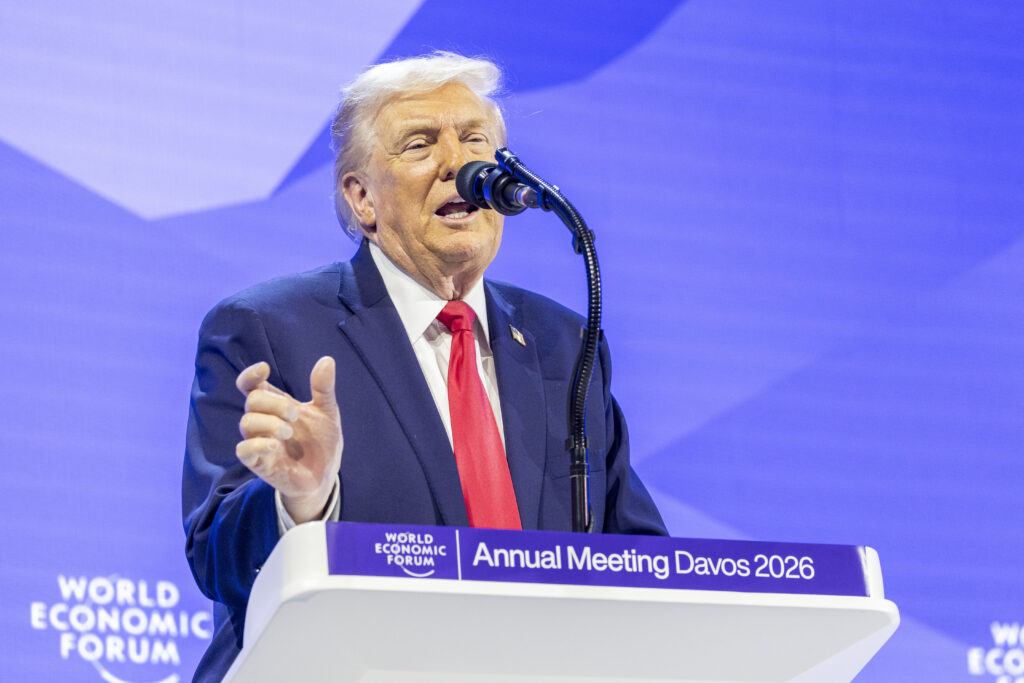

Pay more for medicines, or face tariffs, US President Donald Trump told Europe last week in Davos. He said his “most favoured nation” policy will force countries paying much less than the US to lift their prices. He pointed to a medicine that costs $10 in London but $130 in the US.
Mr Trump said he pushed leaders, including French President Emmanuel Macron, to accept higher prices. He also claimed he used threats such as 100 per cent tariffs on French wines and champagne to secure agreement. Under the plan, he said, the US will pay the lowest price in the world. American drug costs will fall “by up to 90 per cent”. Paris, however, swiftly rejected the claim. In a post on X, the Élysée called the suggestion that Mr Macron raised medicine prices “fake news”. It stressed that it is the social security system what regulates drug prices in France. And those “in fact remained stable”.
What the policy could mean in practice for Europe? To unpack it, EU Perspectives spoke with Diederik Stadig, healthcare economist at ING Research.
US President Trump revived the Most Favoured Nation (MFN) pricing policy this week in Davos. What impact could this have on US companies and on Europe?
We look at all recent policy changes in three buckets: prices, manufacturing and R&D. And there is a connection among all of these. If you think back to February last year, when Donald Trump announced tariffs on pharmaceuticals. That was justified on national security grounds, with the aim of bringing more manufacturing to the US. That then developed into a discussion on prices and innovation. Because many branded pharma companies committed new investments to the US, it is their most profitable market.
You might be interested

Roughly two-thirds of all branded pharmaceutical profits are made in the US. So tariffs have a strong effect on where companies invest. This also triggered a renewed debate about Europe losing ground in innovation, one of the reasons often cited is that Europe pays relatively low prices for medicines.
To provide some context: in 1990, about 49 per cent of global pharmaceutical R&D took place in Europe and 33 per cent in the US. By 2025, only 26 per cent took place in Europe, while 55 per cent was in the US. At the same time, pharmaceutical innovation has been growing rapidly in Asia, particularly in China, which is becoming a major biopharmaceutical hub.
So Europe has diagnosed the problem. We see that reflected in initiatives like the Critical Medicines Act, the Biotech Act and the pharmaceutical package. But the question is whether prices are the right tool to fix this.

Are they the right tool?
Prices can be a short-term response, but they are not the whole story. The US healthcare system is very complex and inefficient, and that contributes to high prices. We are not saying Europe should start paying US prices, that would not benefit anyone.
But Europe also has shallow capital markets, diverging national rules, and different HTA requirements. Even with the EMA, launching in multiple European countries remains complex. All of that makes Europe less attractive as an innovation hub compared with the US, where rewards for innovation are higher and rules are more uniform. So, does this mean prices in Europe need to go up? Not necessarily, but price is now on the table in a way it hasn’t been in the past decade.
How exactly does the current MFN model work, and why do you say there are limits to its impact?
This version of MFN, including what U.S. President Trump referred to in Davos, has two main components. First, there is a Medicaid component, where companies agree to offer additional discounts to Medicaid. But only about 10 per cent of pharmaceutical sales in the US are Medicaid, and many of those drugs already sell at discounted prices. So this relatively limits the additional impact.
Second, there is the direct-to-consumer (DTC) channel, known as “Trump Rx,” where companies have pledged to lower prices, often by about 50 per cent, for drugs sold directly to consumers. We estimate that this could generate around $2bn in savings, excluding GLP-1 drugs, because those will face increased competition anyway this year, including oral versions and new market entrants. But this DTC channel mainly applies to uninsured Americans, around 30 million people. If you have insurance, you still go through the normal healthcare delivery chain.
And it does not apply to many major drugs. For example, Keytruda, the biggest-selling drug in the US, is administered in hospitals, you cannot buy it over the counter. The same is true for many other drug classes. So overall, the direct price impact of this MFN model is limited.
If MFN is not really cutting into pharmaceutical company margins, where do the savings come from, and why were companies willing to sign on?
We believe that much of the savings will not come from pharma company margins. PhRMA has long argued that about 50 cents of every drug dollar in the US goes to intermediaries, not to manufacturers. That is why we describe this as a circumvention of the system rather than a structural reform of how US drug pricing works.
On the deals themselves: the administration sent letters to 17 major pharmaceutical companies to negotiate MFN arrangements, and 16 of those 17 have now concluded deals with the administration. From a market perspective, that is telling: in many cases it removes uncertainty about what MFN could mean, and it sets clear boundaries on where companies expect price concessions.
For the companies involved, including many headquartered in Europe or with major European operations, the inclusion of tariff exemptions tied to manufacturing commitments in the US made the outcome positive from a business perspective. So the MFN reforms as negotiated are not a dramatic blow to the sector, and they leave a very significant part of revenues intact.
Why did pharma stocks go up after the deals were announced?
Because the deals removed uncertainty. There had been uncertainty about what tariffs would mean and what MFN would actually involve. Now companies know that price reductions mainly apply to Medicaid and the DTC channel, and that they are excluded from tariffs if they invest in US manufacturing, which many had already committed to do.
That leaves a very large part of their sales unaffected. So this version of MFN is actually good for branded pharmaceutical companies, including European-based and Swiss-based firms that are part of the agreements.
But if companies are largely protected, where does that leave Europe?
This is where the longer-term consequences may matter more. Even though MFN itself has limited immediate impact, it adds to broader pricing pressure in the US, alongside continued price negotiations under the Inflation Reduction Act (IRA) and growing use of biologics.
If you are a branded pharma company, that is important because the US is your most profitable market. Even if price pressure is not dramatic yet, price is now firmly part of the political agenda. At the same time, Europe already pays lower prices and is becoming less attractive for innovation, with fewer new molecules, fewer clinical trials, and less investment.
There is also a structural difference between systems. In Europe, we use quality-adjusted life years (QALYs) to cap how much we are willing to pay for additional health benefit. The US does not have that. If you have good insurance, you can access very expensive treatments. That is why many rare disease treatments are available in the US but not in Europe. European families sometimes even travel to the US for treatment because certain therapies are not reimbursed in Europe.
Now, companies are increasingly telling European governments: If you want access to new therapies, prices must increase, otherwise we will not launch certain products. This is already happening, particularly in rare diseases.
Do you have data showing that drugs are already not reaching Europe?
Yes. From NCBI data, of about 290 new drugs launched between 2018 and 2022, 17 per cent were only available in the US. And according to IQVIA, between 2020 and 2024, 110 novel active substances were launched in the US that have not yet launched in key European markets. So this is not theoretical, access gaps already exist.
European governments face difficult choices: they can agree to higher prices, or they can refuse and accept that some drugs will not be launched, or they can restrict access to very narrow patient groups.
Are companies now actively pushing for higher prices in Europe?
Yes. The initiative is coming from the companies themselves. They argue that they face growing pressure in the US, and that Europe needs to pay more, not only to sustain innovation capacity, but also to reward risk-taking in drug development.
European governments then face difficult choices: they can agree to higher prices, or they can refuse and accept that some drugs will not be launched, or they can restrict access to very narrow patient groups.
We expect to see greater divergence between European countries, with some approving drugs, and others doing exactly the opposite of what EU institutions are trying to achieve with equal access. But pricing remains a national competence, and the European Commission has no authority over medicine prices, which makes coordinated responses difficult.
Could higher prices in Europe actually lead to more launches and more innovation?
Potentially, yes, but that depends on how countries negotiate and what broader reforms accompany pricing. Higher prices could encourage more launches, but they are only one part of the investment decision. Other factors such as regulatory speed, capital markets, clinical trial infrastructure and research funding matter just as much.
You mentioned that companies are shifting investment to the US. Do you expect the trend to continue?
Yes, we see this as a reallocation of capital from Europe to the US. Capital expenditure in pharma is usually around five per cent of revenue, and we expect that to remain stable. That means when companies invest more in the US, they are likely investing less elsewhere, including in Europe.
But there is also an opportunity for Europe here. If companies become too dependent on one market, and that market becomes more politically unpredictable and price-constrained, they may want to diversify their revenue base.
If Europe can offer faster regulation, strong universities, stable rules and targeted funding, it could become more attractive again. For example, we are seeing cuts to national health institutes funding and budget pressures at the FDA in the US. Roughly $4bn in research funding was cut in 2025. If Europe could replace some of that funding and attract researchers, that could stimulate innovation.
Do you think current EU policy initiatives are moving in the right direction?
Some are steps in the right direction, but Europe still struggles with speed. The pharmaceutical package, for example, shortens EMA timelines, which is positive. But it took seven years to negotiate, and it updates 25-year-old rules. That is not fast enough to respond to rapid global changes.
That said, I was encouraged to hear Ursula von der Leyen talk about EU-Inc. in Davos, and to see growing recognition after the Draghi report that Europe needs to act on competitiveness. The Critical Medicines Act is also promising. It targets around 243 essential medicines to strengthen manufacturing capacity in Europe without oversubsidising the sector. It will not replace Asian imports, but it could rebuild some strategic manufacturing capacity. So there are positive signals, but Europe still needs to move faster and more decisively.
Finally, do you think Europe can realistically regain some of the investment it is losing?
Yes, if the right conditions are created. If companies see increasing uncertainty and price pressure in their most profitable market, they will want to diversify. Europe still has strong universities, scientific talent and infrastructure.
But Europe must fix regulatory speed, funding mechanisms, and investment conditions if it wants to compete for global R&D and manufacturing. So the MFN alone will not reshape the industry, but combined with broader pricing and investment pressures, it could become part of a much larger shift in how companies allocate capital globally.