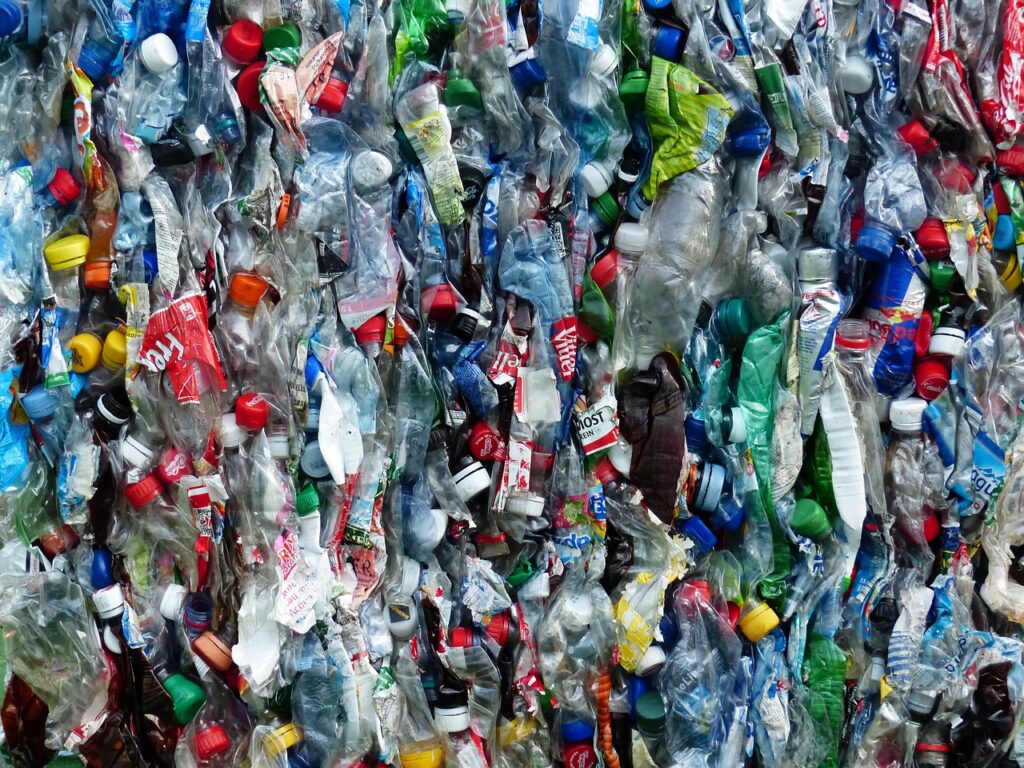

Europe’s recycling sector is in deep trouble. Brussels knows it, yet recycling companies fear the measures have so far fallen far short of what is necessary. A genuine single market for circular materials plus prioritisation of EU-made recycled content should help.
Last year, Plastics Recyclers Europe (PRE) warned that the sector was at a “breaking point”. Drowning in cheap plastics, mainly from the United States and China, and given the persistent lack of unified implementation of plastic levies across member states, plastic recycling has struggled for years to become economically viable. High energy costs in Europe add to the troubles.
2030 recycling target out of reach
Of the roughly 58 million tonnes of plastic produced annually in the EU, only about half is collected and sorted. A mere 13 per cent finds its way into new plastics. Progress towards circularity has been painfully slow. Between 2010 and 2024, the share of recycled materials in the EU has increased by only one per cent, leaving the bloc far behind its target of a 24 per cent circularity rate by 2030.
Europe’s competitiveness and resilience depend on how efficiently we use our resources. — Jessika Roswall, Commissioner for Environment, Water Resilience and a Competitive Circular Economy
And the problem stretches beyond climate strategy. It affects economic security and competitiveness as well. The Commission has acknowledged this crisis, recognising that recycling policy means more than simply supporting the sector itself. “Europe’s competitiveness and resilience depend on how efficiently we use our resources. With today’s measures, we are taking concrete steps to help the struggling plastics recycling sector in Europe and towards building a genuine single market for circular materials,” said Jessika Roswall, Commissioner for Environment, Water Resilience and a Competitive Circular Economy, when the Commission announced its strategy in December.
The Commission had previously introduced measures to stimulate the sector. For example, the Single-Use Plastics Directive requires 25 per cent recycled content in PET bottles by 2025. But that measure has had unintended—and adverse—consequences.
Single market for recycled plastics
While demand for recyclate grew rapidly, EU recyclers alone could not supply it. Instead, recycled content increasingly had to come from imports. At the same time, customs codes failed to distinguish clearly between virgin and recycled plastics, making it difficult to monitor, verify, or control imports. The subsequent flood of virgin plastics further undermined the vitality of Europe’s recycling sector.
To address these challenges, the Commission announced its ’Winter Package’ in late December, arguing that the situation means waiting until the planned 2026 Circular Economy Act would be unwise.
You might be interested

The Commission proposes to create a genuine single market for recycled plastics by introducing Union-wide end-of-waste criteria (making it a product instead of waste under EU law) for mechanically recycled plastics. It aims to do so through an implementing act under the Waste Framework Directive.
Waste? Not any more
As such, those plastics fulfilling harmonised EU criteria would no longer carry the label of waste. Instead, they could circulate more freely across all member states. The measure is to reduce administrative burdens, particularly for small and medium sized companies, facilitate the use of recycled plastics in manufacturing, and ensure a more stable supply chain of recyclables across the EU. According to industry estimates, the lack of EU-wide end-of-waste criteria currently costs the plastics recycling sector around €120m per year.
The Commission also aims to unlock investment in chemical recycling by proposing rules, that will determine how chemical recycling outputs can count towards recycled-content targets. The move responds to industry calls for clearer rules, as the European plastics sector plans up to €8bn in chemical recycling investments in the coming years but has warned that regulatory uncertainty undermines their viability.
Recycling companies demand more action
Yet the so-called ’winter package’ has done little to calm industry nerves. “It fails to include provisions to boost demand and prioritise European-made recycled content,” the European Waste Management Association (FEAD) said.
It is high time to ensure European recyclates, produced under these strict standards, are placed at the forefront of European markets. – Joint letter of EU recycling companies
Together with Plastics Recyclers Europe and Recycling Europe, FEAD had urged the Commission earlier in December to prioritise European-made recycled plastics in mandatory recycled-content targets. “It is high time to ensure European recyclates—produced under these strict standards—are placed at the forefront of European markets. This is not protectionism, but a matter of policy coherence and shared responsibility across the value chain, ensuring that our circular economy vision is realised through domestic industrial capacity that meets the highest environmental standards, rather than being undermined by non-verified imports from third countries,” the joint letter said.
Just a first step
For FEAD, the absence of those concrete demand-side measures is particularly disappointing. Without stronger incentives to use EU-produced recyclates, the association warns that Europe risks regulating its recycling sector into decline—just as global competition intensifies.
Plastics Europe welcomed, in principle, the fact that action had been taken—calling it “a welcome move to cut red tape”, but underlined that it views the package merely as “a first batch of measures and initiatives to help boost our industry’s overall competitiveness”. The association added that other measures will need to follow. Particularly disappointing for the industry was the fact that the end-of-waste criteria are limited to mechanical recycling alone, and do not extend to other recycling techniques, such as chemical recycling.
Recycling Europe echoed that concern, saying that “while the direction is right, the speed and strength of the response remain insufficient”. Its message was clear: “Europe needs decisive, coordinated and comprehensive political and policy action now to unlock investment in circularity and innovation, which is interlinked with the need to reinforce the EU’s industrial base and economic security.”