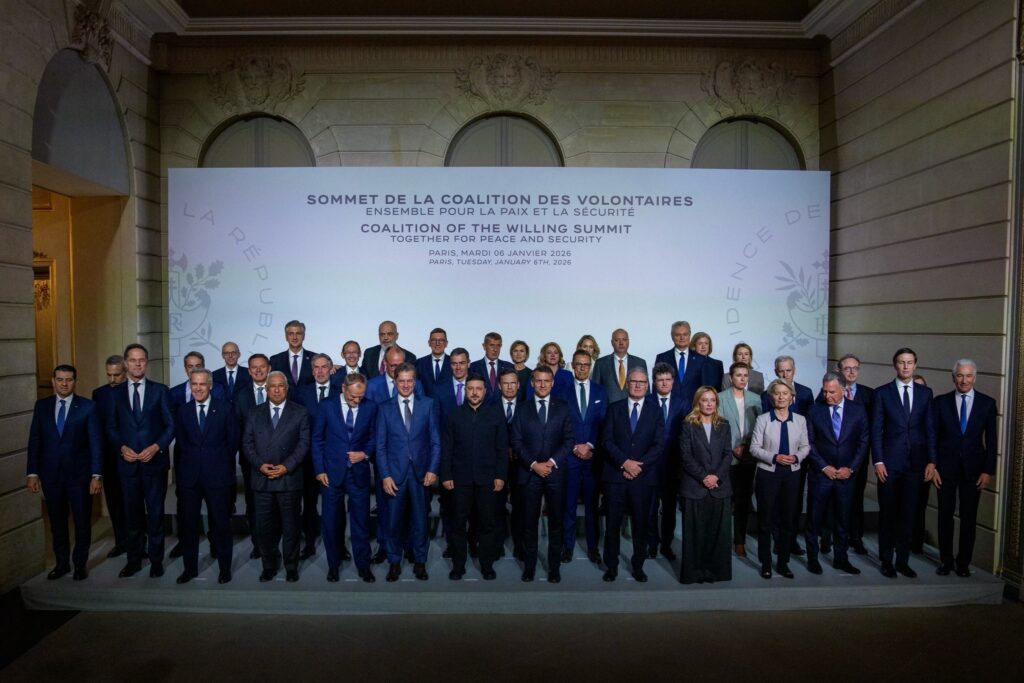

Representatives of countries supporting Ukraine, so-called Coalition of the Willing, agreed on the deployment of troops in Ukraine on Tuesday, 6 January night once a credible ceasefire has taken place. The United States for the first time vowed to provide security guarantees that should include binding commitments to support Ukraine. The declaration goes directly against Moscow’s wishes, which in the past has strongly rejected the presence of foreign troops in Ukraine.
Unlike previous Coalition of the Willing meetings, the summit, held in Paris, was also attended by US envoys Steve Witkoff and Jared Kushner. United States top general in Europe, Alexus Grynkewich, who a day earlier fleshed out details of security guarantees with European army chiefs, also attended.
The security protocols are meant to deter any further attacks in Ukraine (…) They are as strong as anyone has ever seen. – Steve Witkoff, US President Trumps’s envoy
Mr Witkoff, who has led several rounds of talks with Russia over the past months, said after the summit that President Donald Trump “strongly stands behind security protocols”, Reuters reports. “Those security protocols are meant to deter any further attacks in Ukraine (…) They are as strong as anyone has ever seen,” Witkoff said at a joint news conference with the French, German, British and Ukrainian leaders.
Multinational force for Ukraine
In addition to direct American involvement, the most significant outcome of the meeting is undoubtedly the willingness of some countries to send troops to Ukraine after the ceasefire.
The statement of the Coalition of the Willing, issued jointly by European Commission and Council, includes an article titled “Multinational Force for Ukraine”. The statement reads that the Force will be “made up from contributions from willing nations within the framework of the Coalition, to support the rebuilding of Ukraine’s armed forces and support deterrence. Coordinated military planning has been conducted to prepare for reassurance measures in the air, at sea and on land and for the regeneration of the armed forces of Ukraine.”
Commission President Ursula von der Leyen commented on X that “we collectively stand by Ukraine and a safe, secure prosperous future lies ahead.”
You might be interested
In a separate development, UK Prime Minister Keir Starmer has announced that the United Kingdom and France would “establish military hubs across Ukraine” to deter future invasion. “It paves the way for the legal framework under which British, French and partner forces could operate on Ukrainian soil, securing Ukraine’s skies and seas and regenerating Ukraine’s armed forces for the future,” Mr Starmer stressed.
French President Emmanuel Macron later said that “thousands of troops may be deployed”.
Who will join?
It remains to be seen how many countries will be willing to send their troops to Ukraine. Importantly, German Chancellor Friedrich Merz has indicated that Germany could be part of a multinational forces to monitor a ceasefire in Ukraine—however, with troops “based in neighboring territory”. On the contrary, some EU member states, such as Italy and Czechia, have already refused.
Members of the Coalition of the Willing also agreed to finalise binding commitments in order to restore peace and security in the case of a future armed attack by Russia. These commitments “may include the use of military capabilities, intelligence and logistical support, diplomatic initiatives, adoption of additional sanctions,” the declaration reads.
Zelenskyy hails the progress
Ukrainian President Volodymyr Zelenskyy said the agreements were “a signal of how seriously Europe and the entire Coalition of the Willing are ready to work for real security”. He added, however, that it remained to be determined how the monitoring would work and how the Ukrainian army would be supported and financed.
Mr. Zelenskyy thanked the United States “for its readiness to be a backstop in all areas—security guarantees, monitoring a ceasefire and rebuilding.” He said the Ukrainian delegation would continue its talks on key issues on Wednesday.
Key issues remain unclear
Russia has not yet commented on the results of the Paris meeting. President Vladimir Putin, however, has repeatedly warned in the past that any foreign troops in Ukraine would be a “legitimate target”.
It also remains uncertain how future ceasefire line would be drawn and what territory, currently occupied by Russian forces, Ukraine would agree to surrender. The Russian army has been advancing slowly but steadily on the front lines in recent months. Analysts at the US-based Institute for the Study of War say that Russia has taken about 4,700 sq km of Ukrainian territory in 2025. Russia claims to have taken 6,000 sq km.