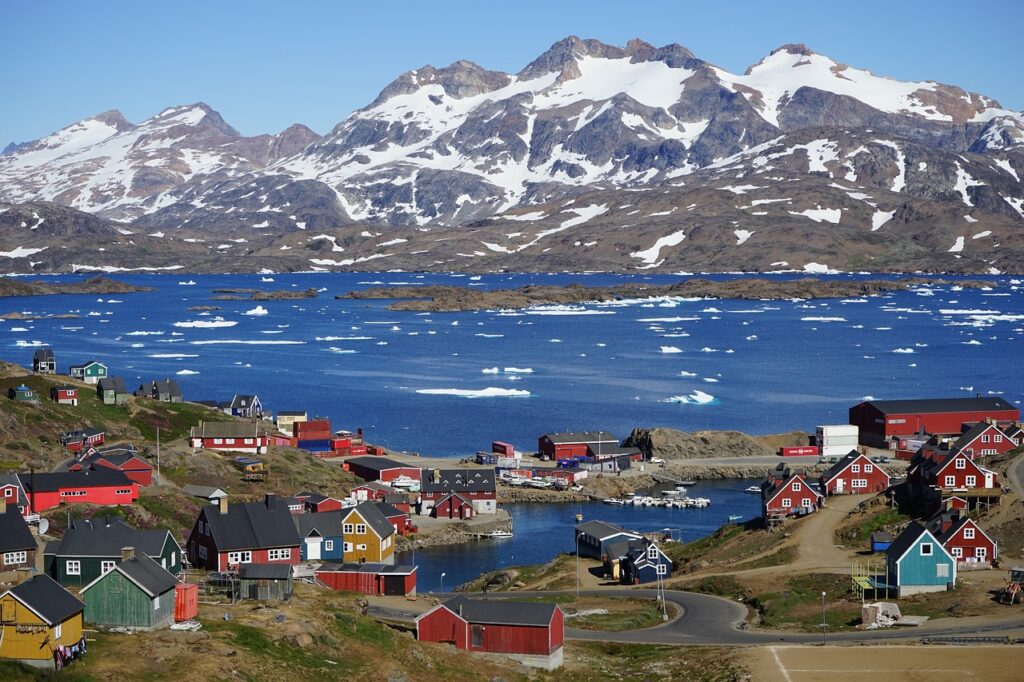

Recent US rhetoric leaves little doubt that Washington sees Greenland through a strategic lens. The European Union, by contrast, has so far taken an approach with greater restraint and has tried to deepen its strategic partnership with the island.
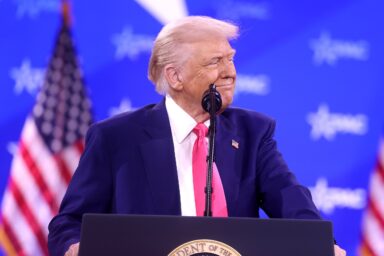
“The United States needs Greenland from the standpoint of national security,” US President Donald Trump said last week. With that, the United States decisively put the Arctic in great-power thinking in a way Europa can no longer ignore.
The Arctic is more than a geopolitical side issue. Greenland sits at the intersection of an arena shaped by climate change, renewed military competition, and a race for raw materials. The island constitutes a critical choke point between the Arctic and the Atlantic, essential for monitoring submarine movements and securing transatlantic air and sea routes. In any high-intensity conflict, the Arctic offers the shortest trajectory between the United States, Russia, and China.
Deepening partnership with the EU
It did not take recent US rhetoric for the EU to recognise Greenland’s strategic importance. Following the Commission’s €94 million investment package in 2024, a delegation from the European Parliament’s Security and Defence Committee visited Greenland in September. Members of the delegation stressed that Greenland’s significance extends well beyond military considerations. “Military security is just one aspect, you also need food security, economic security, and social cohesion. And this is where the European Union can help a lot,” MEP Cristian Terheș (ECR/ROM) told EUPerspectives after the visit.
Military security is just one aspect, Greenland also needs food security, economic security, and social cohesion. And this is where the European Union can help a lot. – MEP Cristian Terheș (ECR/ROM)
In October 2025, Greenland’s Prime Minister Jens-Frederik Nielsen addressed the European Parliament in Strasbourg. “Greenland needs the European Union, and the European Union needs Greenland,” he argued, pointing in particular to opportunities for deepening cooperation in areas such as renewable energy and mining.
Resources underneath the ice
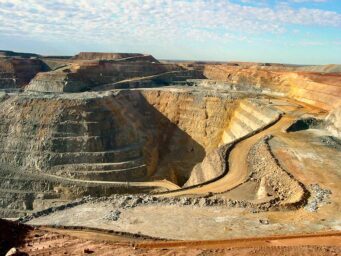
Greenland hosts 24 of the 34 critical raw materials identified by the EU as essential for its green and digital transitions. Rare earth elements—indispensable for wind turbines, electric vehicles, advanced electronics, and military equipment—are of particular interest. At present, the EU depends heavily on China for most of these materials. With relations with Beijing deteriorating and China increasingly weaponising supply chains, Brussels is eager to diversify its partners and reduce strategic dependency.
And as ice melts due to climate change, Greenland is becoming more accessible as a potential source. This explains why the EU announced a strategic partnership with Greenland and a €94m investment package in 2024, covering mineral exploration, education, and sustainable energy. The opening of a permanent EU office in Nuuk symbolises what Commission President Ursula von der Leyen described as “the beginning of a new era of the EU–Greenland partnership.”
You might be interested
Yet expectations should be tempered. Mining in Greenland remains extremely expensive, infrastructure is minimal, and the local workforce limited. Many deposits are linked to uranium, raising serious environmental and health concerns. The shelving of the high-profile Kvanefjeld project has reinforced local scepticism.
Nonetheless, the Australian-listed—and partly Chinese state-owned—company Energy Transition Minerals (ETM) has long planned to develop the Kvanefjeld mine, which it has controlled since 2007, claiming it could become ’the most significant Western producer of critical rare earths’. In 2021, Greenlanders voted for a party that campaigned explicitly against the project due to pollution risks. In response, ETM launched an investor-state dispute settlement (ISDS) case in 2024, seeking exploitation rights or compensation reportedly amounting to €11.5bn.
Space, connectivity, and strategic autonomy
Beyond geography and resources, Greenland plays an important role in space and satellite infrastructure. Reliable satellite coverage in the Arctic is essential for navigation, military command and control, climate monitoring, and civilian communications. Yet Europe’s Arctic satellite architecture has long relied heavily on infrastructure outside the EU, most notably on Norway’s Svalbard archipelago. This concentration has created strategic fragility as satellite signals in the region have become increasingly vulnerable to interference, particularly from Russia.
Against this backdrop, the EU decided in 2023 to establish a new satellite ground site in Greenland. The facility is intended to strengthen the resilience of Galileo, Europe’s satellite navigation system, which includes encrypted services for government and defence use. This contributes to Europe’s ambition for strategic autonomy while turning Greenland into a source of strategic depth for the EU. By diversifying ground infrastructure and embedding it in a politically aligned territory, Europe reduces exposure to disruption and coercion.
If Greenland were to fall under direct US control, however, this logic would fundamentally change. Any satellite infrastructure on the island would inevitably be subordinated to American strategic priorities, and Europe would lose one of the few Arctic locations where it can build and operate critical space infrastructure without relying on either the United States or non-EU partners.
Under an agreement with Denmark, the United States has been operating the Pituffik (formerly Thule) Military Base in northern Greenland since 1950s. It is the largest US base outside the United States in terms of area.
Acceleration essential
“The EU needs a smart strategy to face the Arctic’s growing geopolitical importance,” MEP Urmas Paet (Renew/EST) argued in November 2025, calling for closer integration with Iceland, Norway, and Greenland. For now, the European Commission has launched a call for evidence and a public consultation on its new Arctic Strategy, open until March 2026, with adoption planned by the end of the year.
In light of recent developments, Europe and Greenland may not have the luxury of moving at such a slow pace.