
Europe enters 2026 in a race it can no longer afford to lose. Global biomedical innovation is accelerating, and competitors are widening the gap.
That reality was clear at this week’s JPMorgan Healthcare Conference, biopharma’s early‑year global pulse check, where executives described China’s ability to move from discovery to clinical testing and scale at a pace western systems cannot match.
Large patient pools, compressed regulatory timelines and fierce domestic rivalry have turned speed into China’s defining advantage. Pfizer chief executive Albert Bourla put it bluntly: no one will slow China down. The question now is whether western systems can move fast enough to stay in the race.
For Europe, the stakes are immediate. Investment, trials and manufacturing follow speed and certainty. After years of strategies and draft laws, 2026 is the year Europe must show that reform can translate into faster development, stronger local production and earlier patient access, or accept that innovation will continue to migrate to faster systems.
You might be interested

Biotech Act: can Europe still win the biotech race?
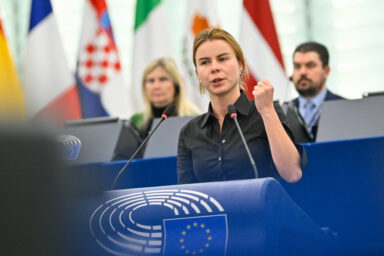
Europe still holds an edge in biotech, but it is thin and eroding. “Europe still has a head start,” said MEP Niels Fleming Hansen of the European Parliament’s industry committee (ITRE) on Thursday. “But it will not last if we hesitate.”
Rainer Becker, Director for Medical Products and Innovation at the European Commission, is equally direct speaking to the committee: Europe’s science base is strong, but companies struggle to scale. The EU Biotech Act, unveiled in December 2025 under Choose Europe for Life Sciences, aims to close the gap. It tackles funding shortfalls, slow and fragmented trials and Europe’s shrinking share of global studies.
2026 will be a defining year. Parliament and Council will decide how far to go on simplification, trial acceleration and market access. In parallel comes a €10bn EIB‑backed pilot for 2026–27 to support scale‑up and manufacturing, plus a second act later in 2026 on industrial biotech and internal‑market barriers.
The central test is trials: Europe needs faster, predictable, multi‑country studies. Cyprus, holding the Council Presidency, will push a European Centre of Clinical Excellence, with a first Presidency‑led meeting on 30 January.
Europe still has a head start, but if will not last if we hesitate. – MEP Niels Fleming Hansen
Pharmaceutical reform: necessary, but not yet a growth strategy
The EU reached a provisional political deal on its pharma overhaul in December 2025, the biggest rewrite in over two decades. In 2026, the file moves through legal‑linguistic checks and formal adoption; transition periods start only after publication. So this year will not shift where companies place their next wave of R&D or manufacturing.
Industry doubts the reforms go far enough. “Our region has lost a quarter of its global share of investment in two decades, while our share of clinical trials has halved,” said EFPIA’s Nathalie Moll. If this is the framework to attract the next generation of medicines, the outcome is “underwhelming.”
Competitiveness now hinges on the combined impact of measures on biotech, trials, data use and industrial finance. US moves toward “most‑favoured nation” pricing add pressure by linking American prices to other rich markets. Novo Nordisk’s Mike Doustdar argues the imbalance between US and European prices forces a broader search for workable solutions.
Critical Medicines Act: Made in Europe
Europe also wants a stronger local supply base. The Critical Medicines Act, entering negotiations in 2026, is the core of a “Made in Europe” push.
It would back EU‑based strategic projects to build and modernise factories for essential medicines and active ingredients, encourage procurement that rewards local manufacturing, promote joint purchasing and tighten coordination of stockpiles, including emergency redistribution powers for the Commission.
Parliament is due to adopt its negotiating mandate on 19 January. The Cyprus Presidency has made progress on the file a priority.
Medical devices: fixing a system that stalled innovation
Medical devices test whether Europe can align regulation with innovation. The EU remains a global leader, with a €170bn market and nearly one million jobs, but current rules have created costly bottlenecks and slower patient access.
The Commission’s December 2025 proposal would simplify procedures, expand digital processes and set firm conformity‑assessment timelines. It would strengthen the EMA’s role on expertise, shortage monitoring and critical‑device identification, and clarify rules for AI‑enabled products. The goal: keep high safety standards while restoring competitiveness. The Commission estimates €3.3bn in annual savings. Negotiations run through 2026.
Data, AI and simplification: will regulation enable scale-up?
Europe’s life sciences competitiveness now depends as much on data infrastructure and regulatory clarity as on lab science. In 2026, the EU’s digital “omnibus” simplification and debates on a voluntary “28th regime” will test whether rules on AI, data protection and cybersecurity can be made workable for clinical research, digital diagnostics and AI‑driven drug development.
Regulators are also aligning internationally: the EMA and US FDA have issued joint principles on AI across the medicines lifecycle, while the Cyprus Presidency pushes real‑world rollout of the European Health Data Space. These files will either cut friction, or add new compliance layers.
Strengthening Europe’s health-threat readiness
The harder truth is that none of this matters if Europe is unprepared. Europe’s next test is its ability to anticipate and respond to health threats. Policy is shifting from ad‑hoc crisis tools to standing capacity that can activate surveillance, research, trials and medical‑countermeasure development the moment a new threat emerges.
In early January, the Health Emergency Preparedness and Response Authority (HERA) published its first Comprehensive Health Threat Prioritisation Assessment, naming the cross‑border risks for 2026: pandemic‑potential respiratory viruses, vector‑borne epidemics, antimicrobial resistance and CBRN scenarios. The goal is to steer research funding, procurement, stockpiling and industrial readiness across EU institutions and member states.
A core pillar is BE READY, the European Partnership for Pandemic Preparedness. Launched on 1 January with €118m in joint EU–national funding and 81 partners in 27 countries, it will keep research platforms and trial networks “ever‑warm” so capacity can scale immediately when a threat emerges. Its first actions, a Joint Transnational Call in January and a formal launch in Paris on 17 February, begin turning strategy into coordinated programmes and infrastructure.
Disease priorities in 2026: heart health and mental health
But preparedness alone will not secure Europe’s resilience. Chronic disease, not outbreaks, consumes most resources, so policymakers are treating it as a strategic priority. In December 2025, the Commission unveiled the first‑ever EU Cardiovascular Health Plan, the Safe Hearts Plan. It aims to cut premature cardiovascular mortality by 25 per cent by 2035 through prevention, screening, treatment, rehabilitation and targeted digital tools. Work with member states to implement core deliverables starts this year.
The Cyprus Presidency has also put mental health at the centre of its agenda. A High‑Level Conference on 26 January opens the discussion, with health ministers set to return to the topic on 25–26 February. On 4 March, the Presidency will host an EU conference on advancing treatments for rare diseases to strengthen collaboration and accelerate innovation.
Ambition without funding will not carry Europe far.
Budget battle: health’s place in the next MFF
Ambition without funding will not carry Europe far. The next fight is over money. Safeguarding resources for health programmes in the next Multiannual Financial Framework is now a core priority for the Cyprus Presidency. Following the Commission’s July 2025 proposal, the long‑term budget will be negotiated through 2026–27, with the new MFF entering into force in 2028. Health will compete directly with defence, climate and industrial transition for limited fiscal space.
Global health
The external dimension matters just as much. Europe cannot build resilience at home without anchoring it in broader health security. President von der Leyen flagged a Global Health Resilience Initiative in her 2025 State of the Union, intended as the EU’s next pillar of external preparedness. Details remain pending, making 2026 a year of design rather than delivery.
The Cyprus Presidency has placed international cooperation at the heart of its agenda. It is coordinating EU preparations for agreements with EEA partners on medical countermeasures and shaping the EU’s position on pathogen access and benefit‑sharing under the WHO Pandemic Convention. The aim is to link Europe’s internal preparedness reforms to a more coherent global architecture, even as key elements of that system remain under negotiation.
Europe’s strategy now runs from the lab to factories, from data platforms to hospitals, and from national stockpiles to global supply chains. That breadth fits the world as it is. The test in 2026 is whether execution can match the speed of the science, and the pace of the competition.