

Fresh figures from the European Border and Coast Guard Agency (Frontex) show that illegal border crossings into the EU fell by 26 per cent in 2025 (compared to previous year) to almost 178,000. The Central Mediterranean remains the most active migration route into the EU, the largest decline occurred on the Western African Route. Despite positive figures, Frontex warns that the situation at EU’s borders remains uncertain and migration pressure can shift quickly.
The number of illegal migrants detected at the external borders of the European Union in 2025 (178,000) is less than half that of 2023. At the same time, it is the lowest figure recorded since 2021, according to Frontex.
“No time to rest”
Though the recorded decrease of illegal migration is a significant development, Frontex still warns that the situation at Europe’s borders remains uncertain. Migration pressure can shift quickly between routes, shaped by conflict, instability and smuggling networks. The EU is also coping with attempts by hostile actors like Russia who try to exploit migration flows to put pressure on the EU’s external borders.
This drop of irregular migration shows that cooperation delivers results. However, it is not an invitation to relax, our responsibility is to stay alert. – Hans Leijtens, Frontex Executive Director
“The trend is moving in the right direction, but risks do not disappear,” said Frontex Executive Director Hans Leijtens. “This drop shows that cooperation delivers results. However, it is not an invitation to relax. Our responsibility is to stay alert, support member states on the ground, and ensure Europe is ready for new challenges at its borders,” Mr Leijtens added.
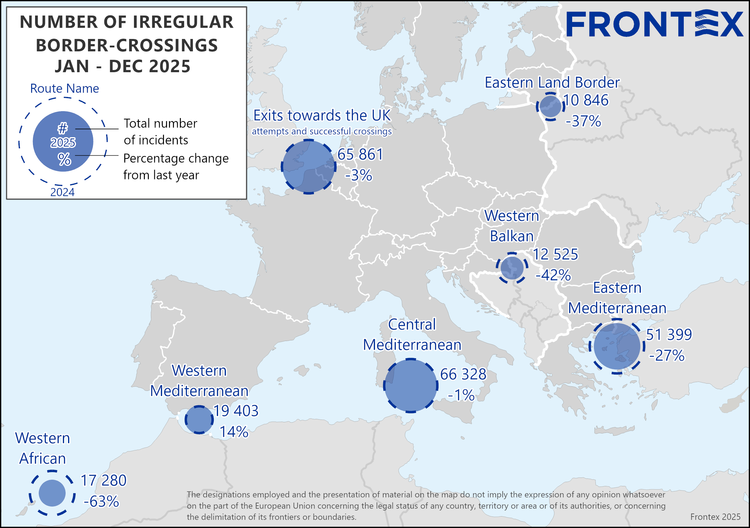
The Central Mediterranean Route remained the most active migration route into the EU in 2025, with detection levels broadly in line with 2024 (roughly 66,300 irregular migrants were detected). Departures from Libya remained a key factor shaping movements towards Italy. Next comes the Eastern Mediterranean Route (51,400), where detections fell significantly, continuing an earlier downward trend. In terms of per cents, the most important decrease was recorded on the Western African Route (17,300 which makes minus 60 per cent compared to 2024).
Will 2026 be pivotal?
Looking ahead, 2026 may become a pivotal year for European border management. The EU Pact on Migration and Asylum will become fully applicable in June, marking the most far-reaching reform of Europe’s migration and asylum system in years. This will coincide with major changes to European border management, including the full rollout of the Entry/Exit System (EES) and the planned launch of the European Travel Information and Authorisation System (ETIAS) later in the year.
If there is no major geopolitical escalation in the EU’s immediate neighbourhood, irregular migration towards Europe across land and sea borders could continue the downward trend seen since 2023. According to Frontex, this will depend on sustained cooperation with countries of origin and transit, and on Europe’s ability to stay ready for sudden shifts.