
Once a largely technical proposal, the digital euro is now being debated in European Parliament as a question of sovereignty, resilience and democratic control. With geopolitical tensions rising and Europe’s reliance on foreign-owned payment systems such as Visa and Mastercard increasingly viewed as a strategic vulnerability, members of the ECON committee on Thursday discussed not only whether a digital euro is needed, but what form it should realistically take.
At its core, the digital euro would be a digital form of central bank money, issued by the European Central Bank and available to citizens alongside cash. In the ECON presentation and debate on Thursday, a broad convergence emerged around a deliberately restrained design: non-programmable, privacy-preserving and device-agnostic, with an offline function intended to mirror key features of physical cash. Rather than a standalone solution to Europe’s payment challenges, the digital euro is increasingly framed as one component of a wider ecosystem that includes private payment providers, common European standards and continued political oversight by the co-legislators.
Overexposed
The discussion was opened by committee chair Aurore Lalucq (S&D/FRA), who explicitly shifted the focus from technical design to political risk. She argued that concerns often raised about data protection or systemic disruption overlooked a more immediate problem: Europe’s exposure to external payment infrastructures.
Referring to recent sanctions imposed by the United States on Europeans like former European Commissioner for Internal Market Thierry Breton and institutions, she warned that Europeans were already experiencing the consequences of that dependence, noting that “these people do not have access to American payment systems and platforms,” and adding that “if we had the digital euro, that would change our lives.”
The offline digital euro should be understood as a digital tokenisation of cash. No more, no less. Cash for the digital age. Not a payment system, not a silver bullet… – Rapporteur Fernando Navarrete (EPP/ESP)

Not a silver bullet
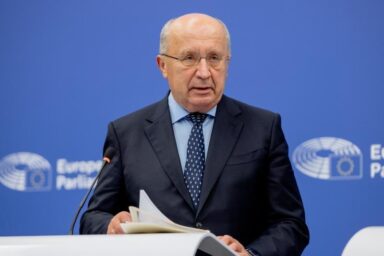
Rapporteur Fernando Navarrete (EPP/ESP) sought to bring structure and restraint to the debate, insisting that the large number of amendments should not be mistaken for a lack of direction. He argued that Parliament already shared a common diagnosis, even if it disagreed on the tools. Setting out his core position, he cautioned strongly against overloading the project:
“Expecting the digital euro to act as a silver bullet for all of Europe’s geostrategic vulnerabilities in payments would be unrealistic and ultimately counterproductive. It would place an excessive burden on a single instrument and expose it to risks it was never meant to absorb, in other words, creating a single point of failure. Framed correctly, however, the digital euro becomes a credible building block within a resilient ecosystem based on complementarity between public and private solutions.”
You might be interested

Clear and concrete
On design, the rapporteur anchored his draft report in a narrow and deliberately conservative conception of the instrument, placing particular emphasis on the offline component. He described this in unusually concrete terms:
“The offline digital euro should be understood as a digital tokenisation of cash. No more, no less. Cash for the digital age. Not a payment system, not a silver bullet, plain and simple digital banknotes that can be used in the digital economy.”
Such a design, he argued, would preserve access to central bank money in a digital economy while limiting risks to financial stability, bank intermediation and the overall structure of the financial system. He also warned against creating a compensation model that would turn the digital euro into “a permanent loss maker” for distributors, stressing that economic sustainability was a precondition for any credible public payment instrument.
Power of simplicity
Among the shadow rapporteurs, Damien Boeselager (Greens/DEU) broadly endorsed this minimalist approach, while drawing a clear distinction between two objectives that he argued should not be conflated: safeguarding cash-like features through an offline digital euro and creating a sovereign option for online payments. Repeatedly, speakers across political groups returned to the same conclusion: simplicity was not a weakness, but a safeguard against both technical failure and political backlash.
Evelyn Regner (S&D/AUT) placed stronger emphasis on public control and democratic accountability, explicitly comparing payment infrastructure to other core public functions. In her view, the question was not whether private payment systems should exist, but whether Europe could afford to leave such a critical layer of its economy entirely outside public control in a volatile geopolitical environment. She also expressed frustration at the time already lost on the file, arguing that Parliament could and should have moved faster.
“For us, the digital euro would mean the end of freedom.” – MEP Siegbert Droese (ESN/DEU)
Risk management
From the Renew group, Ľudovít Ódor (Renew/SVK) framed the debate in pragmatic risk-management terms. He argued that the downside of acting now was limited—higher costs or administrative complexity—while the downside of continued inaction was far greater. Waiting indefinitely for a private-sector solution, he suggested, was no longer realistic given the strategic vulnerabilities repeatedly identified during the discussion.
That dilemma was crystallised most sharply by Luděk Niedermayer (EPP/CZE), who reduced the issue to a single, stark choice:
“We have in Europe effective digital pan-European payment systems, and they are called Visa and Mastercard. Are we happy about it or not? Do we want the situation to continue, especially in current geopolitical circumstances, or not?”
From his perspective, the digital euro was less a revolutionary innovation than an insurance option: a way to ensure Europe retained a fallback public payment instrument without undermining the role of cash.
We have in Europe effective digital pan-European payment systems, and they are called Visa and Mastercard. Are we happy about it or not? – MEP Luděk Niedermayer (EPP/CZE)
Outright against
Outside the mainstream groups, AfD member Siegbert Droese (DEU), rejected the proposal outright, framing the digital euro as an existential threat to personal freedom rather than a response to geopolitical risk. His intervention provided the sharpest counterpoint of the session:
“For us, the digital euro would mean the end of freedom.”
He described the project as “a huge experiment” and argued that his group’s amendments were intended not to improve the proposal but to set firm legal red lines against surveillance, programmability and what he perceived as the erosion of cash. “We basically reject the project,” he stressed.
Time shortage leaves MEP bent out of shape
The intensity of the debate briefly spilled into procedure when MEP Markus Feber (EPP/DEU) challenged the chair Aurore Lalucq over speaking time, arguing that the issue was too important to be constrained by strict limits. The exchange, which saw the Chair firmly reassert control of the agenda while acknowledging the importance of the topic, underlined both the political sensitivity of the file and the pressure to move the discussion forward.
In closing, rapporteur Fernando Navarrete returned to the need for realism and convergence. Dissatisfaction with Europe’s current reliance on Visa and Mastercard, he reiterated, did not imply a single predetermined solution. But he pointed to areas of broad agreement that could form the basis of a compromise: legal tender status, simplicity, low cost, device neutrality and the explicit exclusion of programmability. On that foundation, he argued, Parliament could shape a digital euro that strengthens Europe’s payment sovereignty without overreaching—and without promising more than the instrument can deliver.