Does the EU display a lack of will to act against big online platforms? Or is it about to become the arbiter of acceptable speech? European lawmakers both demand tougher enforcement of EU digital rules against manipulating online debate, and warn against it.
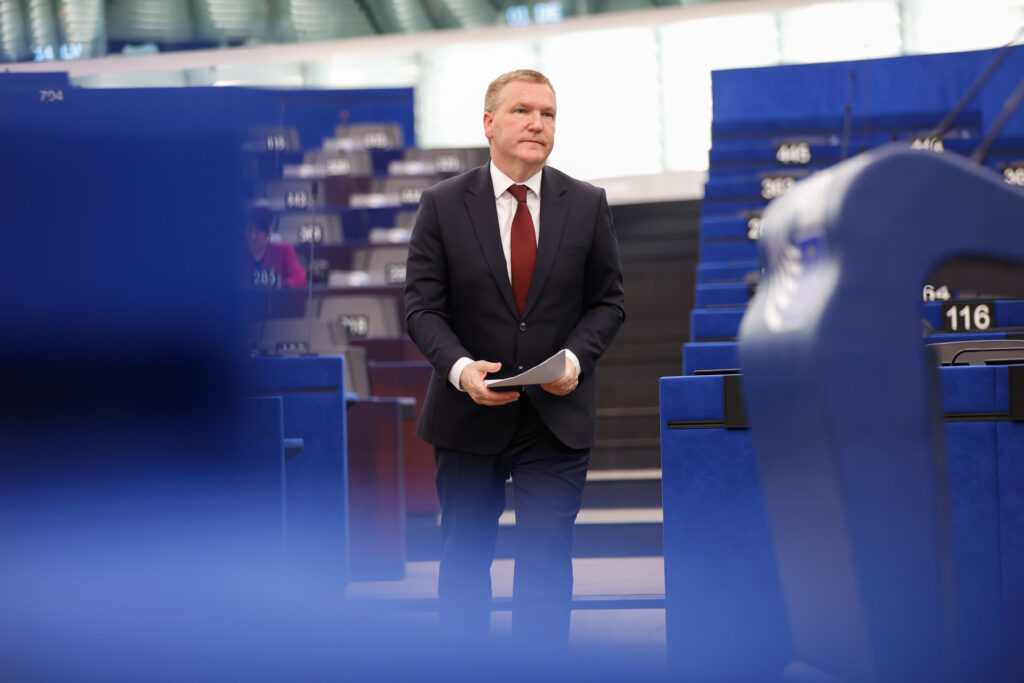
In a charged parliamentary plenary debate on the European Democracy Shield in December, MEPs from across the political spectrum challenged Democracy Commissioner Michael McGrath over whether the EU DSA (Digital Services Act) is being applied with sufficient urgency to counter foreign interference and algorithmic manipulation by very large online platforms, such as X.
Algorithms as political actors
The central debate question, tabled by various political groups—the Greens, Socialists, Renew and the EPP—frames algorithm recommender systems not as neutral infrastructure but as active agents shaping civic discourse. Recent national elections in Romania and the Czech Republic were cited as examples of how coordinated disinformation campaigns can exploit platform incentives that reward outrage, polarisation, and speed over accuracy.
In 2024, Romania’s presidential vote was annulled by the Constitutional Court amid findings that social media algorithms and coordinated digital content had amplified fringe narratives. Also, this year, during the Czech elections, authorities flagged a surge in pro-Russian narratives on TikTok and other social platforms.
Green MEP Alexandra Geese (Greens-EFA/DEU) set the tone of the discussion, accusing platform owners of using algorithmic ranking as a form of political power. She alleged that X systematically downranks content supportive of pro-European parties. At the same time, divisive or authoritarian narratives are amplified. For the lawmaker, such practices amount to a direct challenge to freedom of expression.
The person who could do something today (Henna Virkkunen) is not even in the room. — MEP Alexandra Geese (Greens-EFA/DEU)
Geese also took aim at the Commission’s political leadership for its absence. She told the plenary that “the person who could do something today is not even in the room”, pointing to executive vice-president Henna Virkkunen, and stating that she hoped she was “not leading a big tech company” instead of listening to Parliament’s concerns.
Commission pressured to act
Commissioner McGrath emphasised that the legal framework is already in place. He pointed to the DSA’s systemic risk provisions, alongside the regulation on political advertising, the AI Act and the European Media Freedom Act, as forming a regulatory shield around democratic processes. The Commission, he said, has begun to use its enforcement powers. Referencing recent non-compliance decisions, such as the €120M fine imposed on X, and binding commitments imposed on platforms.
We don’t have a lack of legal instruments. What we have is a lack of a will to act. – MEP Ana Catarina Mendes (S&D/PTO)
But for many MEPs, reassurance was not enough. Ana Catarina Mendes (S&D/PRT) warned that Articles 34 and 35 of the DSA, which require platforms to assess and mitigate risks to elections and civic discourse, risk becoming symbolic if not applied decisively. “We don’t have a lack of legal instruments,” she argued. “What we have is a lack of will to act.”
Free speech or democracy risks?
Not all voices agreed on the criticism pointed to the platform system. Far-right MEPs warned that the European Democracy Shield could slide into overreach, blurring the line between protecting elections and policing opinion. Polish MEP Beata Szydło (ERC/POL) cautioned against allowing the Commission to become an arbiter of acceptable speech. She argued that the fight against foreign interference must not come at the expense of democratic debate itself.
Others went further. MEP Christine Anderson (ESN/DEU) accused Brussels of “seizing editorial control” of online platforms, calling regulation of algorithms “the digital equivalent of confiscating a newspaper printing press” and framing the push against disinformation as an attempt to suppress political opposition.
A test case
The Commission has promised further steps, including an update to the DSA elections toolkit, expanded access to platform data for researchers, and the creation of a European Centre for Democratic Resilience. Yet the debate made clear that the Parliament will judge the Democracy Shield not by frameworks announced, but by real actions.
As MEP Konstantinos Arvanitis (The Left/GRE) put it bluntly, “words are not enough”. The credibility of Europe’s digital rulebook also depends on its enforcement.