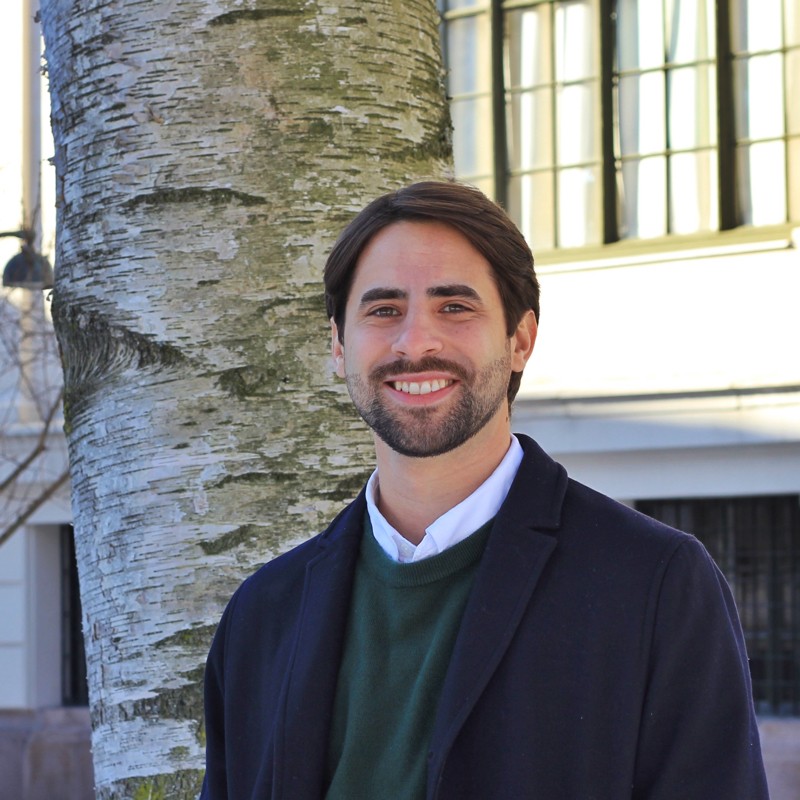

As Venezuela once again finds itself at the center of a geopolitical storm, questions of international law, democracy, and forced migration have resurfaced with renewed urgency. Against this backdrop, Ramón Barreto Pirela – a Venezuelan lawyer and PhD candidate in Social Science specialising in Migration and Refugee Law, based in Oslo – offers EU Perspectives a nuanced view shaped by both academic expertise in migration and refugee law and lived experience as part of the Venezuelan diaspora.
His analysis sheds light on the limits of international law, Europe’s persistent blind spots toward Venezuela, and the potential consequences of the current crisis for democratic transition, asylum policies, and migration flows across Europe.
How predictable was what happened in Venezuela?
I would not put a percentage on it. What I can say is that I had been preparing, in every sense, for this scenario, yet it still feels surreal. On the one hand, Trump has been threatening Maduro since his first term, repeatedly stating that “all options were on the table.” In that sense, this often felt like a cry-wolf situation. On the other hand, previous threats were never accompanied by an actual (and highly costly) military deployment off our coast. This time, therefore, there were plausible reasons to take Trump’s words more seriously.
Mixed feelings over developments
International law: has it been respected? Does it make sense to “violate” it under these circumstances?
This is where my mind and my heart diverge. A large part of the world, especially within academic and journalistic circles, has quickly, and rightly, condemned the violation of Venezuela’s sovereignty following a Trump-led US aggression. As they should. I do too. So yes, Maduro’s actions have undoubtedly violated international law, creating a dangerous precedent at a time when no country (perhaps not even a peaceful territory such as Greenland) can feel entirely safe.#
At the same time, I cannot ignore the silence of many of these same spaces when Hugo Chávez and, increasingly, Nicolás Maduro have arbitrarily detained my people, tortured them, killed them, and forced more than eight million Venezuelans to flee their homes. These are not isolated “situations”; they are sustained violations of international law that amount to State terrorism and crimes against humanity.
You might be interested
Maduro should be facing justice for them, as he is now, albeit for other crimes he also committed. This creates a paradox. I find myself compelled to condemn a violation of international law that “might” lead to a positive outcome for my country—at the risk of being naïve. In parallel, the same international legal framework has failed to address other gross violations that would never have produced a positive outcome for Venezuela. In that sense, if you ask me, international law enforcement is the first thing that needs to be made “great again,” so that we do not come to believe it is morally acceptable to break the law in order to restore it.
Outside traditional ideological lines
As a Venezuelan and a resident of Europe, how do you view what is happening to your country?
I am conflicted. Living in Europe, and especially in Norway, has given me a constant poignant feeling. Venezuela does not fit into traditional ideological or binary lenses. Those on the left, who often only know what appears in headlines—e.g. that Maduro calls himself a socialist who fights US imperialism, or that he allegedly “supports” Palestine—tend to think that the opposition belong to a “radical right” aligned with Trump. This is false.
Those on the right, who also often only know what appears in headlines, tend to support our claims about the consequences of living under a brutal dictatorship, but simultaneously promote anti-immigrant narratives that directly affect forcibly displaced Venezuelans (and many other nationalities). This is tragic. To be honest, I rarely feel understood. I am, of course, generalising, and there are many exceptions, yet not enough to deny that there is a clear European challenge in breaking through conventional ways of interpreting Venezuelan and Latin American politics.
Can the EU make a difference?
Will a democratic transition take place under the new interim president? Will the EU have a role?
There will be no democratic transition with Delcy Rodríguez. She is not only Maduro’s vice president and clearly part of the same criminal system; she is also a hardline chavista who, among other atrocities, has had responsibility over the Helicoide, the largest torture centre in Latin America. She is, in fact, one of the regime officials sanctioned by the EU. There should be no doubt: she is as responsible for crimes against humanity in Venezuela as Maduro himself. Consequently, what deeply concerns us is the possibility that it might suffice for Trump to do “business” with her (since she is perceived as economically “pragmatic”) while abandoning the prospect of a genuine democratic transition involving opposition forces at the negotiating table.
Rubio’s plan?
The latest declarations of Secretary of State Marco Rubio seem, to some degree, to alleviate that concern. He outlined a “three-stage” plan for Venezuela, focusing on stabilisation, recovery, and transition. Meaning that, while collaborating with the regime in those stages, which is painfully necessary for domestic stability, the final goal is to restore the conditions for reestablishing democracy back home. Venezuelans must monitor those developments. As for the EU, I welcome the statement issued by the HRVP Kaja Kallas and supported by 26 member states, in which they not only call for ensuring international law but also mentioned that “respecting the will of the Venezuelan people remains the only way for Venezuela to restore democracy and resolve the current crisis.” That being said, the EU must strengthen its influence and move beyond rhetoric if it wants that position to have real impact.
Fuel for migration
Will the current situation affect asylum applications in Europe? Does the EU have any special migration agreements with Venezuela?
The EU has no special migration agreement with Venezuela; in fact, no one has one. The Venezuelan state ignores forced-migration data and often outright denies it. This highlights a troubling point. Because Europe lacks awareness of the depth of the Venezuelan crisis, officials recognise fewer than 20 per cent of Venezuelan asylum claims.
Once the New Pact on Migration and Asylum takes effect, authorities will channel all asylum applications from Venezuelan nationals into accelerated border procedures for “generally unfounded” claims—procedures that have raised serious due-process concerns. Reality, however, tells a very different story. Venezuelan applicants generally have well-founded claims because of the systematic and generalised human rights violations in their country. No one is safe. Europe therefore needs to align its perceptions and practices with the reality faced by Venezuelan forced migrants.
In migration terms, what consequences will this political shift have for Venezuela and for Europe?
We are on the edge of a turning point. If the abduction of Nicolás Maduro effectively leads to a transition, migration flows may not only slow down, they could even reverse. A significant number of Venezuelans are willing to return home and help rebuild the country, although people have so far assessed these expectations mainly within the Americas.If, on the contrary, the status quo persists, we will see a new mass migration wave driven by the loss of hope and by people feeling compelled to seek dignified living conditions abroad. Recent studies show that more than 20 per cent of the Venezuelan population seriously consider leaving if the crisis does not resolve. With increasing obstacles and stigma in the Americas, Europe may become a more attractive alternative.