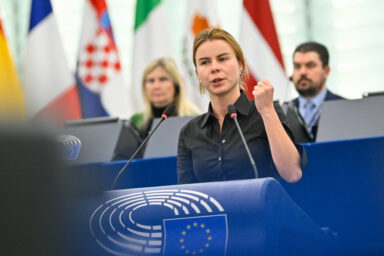

As the EU political advertising regulation entered into force, major social platforms pulled the plug on their related ad activities across the bloc. The legislation is unworkable, Meta and Google argued and discontinued the services. The move has caught many civic organisations off-guard, Sofia Calabrese of the European Partnership for Democracy NGO network told EU Perspectives.
The platforms’ decision to terminate their advertising services has sparked concern among researchers, civil society groups, and policymakers about the future of Europe’s online civic space. While much of the debate has focused on platform compliance and regulatory uncertainty, civil society organisations are now grappling with the practical consequences in their digital communication strategies.
To understand how these shifts are affecting advocacy groups on the ground, EU Perspectives spoke with Sofia Calabrese, Digital Policy Manager at the European Partnership for Democracy (EPD), a global network representing several organisations that work to support and strengthen democratic values in Europe.
How have EPD and its members adapted their online communication strategies since major platforms withdrew from political advertising in the EU?
EPD and its members have not ssuffered direct impact by the latest developments because we don’t promote our content online. To simplify: the activities of civil society organisations online only constitute political ads when they feed into the definition. They also must be promoted content at the same time.
You might be interested

However, I have spoken to civil society organisations that make large use of promoted content—especially for fundraising—and they have seen campaigns shut down that have been running for years. Especially on Meta’s platforms, such as Facebook, because they have a broader definition of political ads and social issue ads.
Since the platform’s policies are new and it is unclear what exactly the enforcement will look like, they have been in contact with national teams from the platforms and received conflicting advice depending on the country. Some very detailed, some more superficial; but in any case, no harmonisation. At the moment, it seems that they are mostly learning by doing, as certain wording constitutes political ads, while very similar wording is not (e.g. “donate to XY” = not political ad; “support our work” = political ad).
Has this shift affected how civil society organisations reach audiences, particularly in terms of fundraising or awareness campaigns?
Yes. For certain organisations, promoted content online is crucial for fundraising. They would have to lay off people if they cannot get funds through those channels. New techniques adopted to continue the promotion of content involve a change of wording, as highlighted above, and also moving towards commercial ads, rather than political ones. They can, for example, advertise merchandising, but not their positions or direct donations.
For certain organisations, promoted content online is crucial for fundraising – they would have to lay off people if they cannot get funds through those channels — Sofia Calabrese, Digital Policy Manager at EPD
In your recent article, you argue that platform decisions may end up shrinking online political debate. How do you see this happening in the EU?
It is too early to see the full results, but shutting down long-running campaigns from civil society is definitely a big initial red flag. Also, NGOs are wasting their resources in trying to find ways to twist their messages so that they do not constitute political advertising, which significantly limits their range of action both in terms of awareness campaigns and fundraising. The move towards commercial ads is also significant as it reduces the political message in favour of purely monetary transactions. So we are already seeing the signs of that.
Do you consider the Transparency and Targeting of Political Advertising Regulation (TTPA) to be fair and balanced for both online platforms and the organisations affected by it? The heart of the TTPA is in the right place: increasing transparency of political ads online. The execution, however, presents some dysfunctions that lead to the current situation.
One element is the definition of political ads, which is quite broad and includes a lot of the activities of civil society organisations online. This is something we had highlighted throughout the legislative procedure and in the implementation phase. In terms of obligations for the platforms, I personally don’t think they are too strict, especially for big platforms that can easily afford compliance costs.
This is, unfortunately, part of a bigger problem of the EU’s dependency on technology platforms which don’t share the same democratic values — Sofia Calabrese
The truth is that this is a power move to show that certain big platforms can easily avoid compliance just by withdrawing from a market that is not particularly profitable. This is, unfortunately, part of a bigger problem of the EU’s dependency on technology platforms which don’t share the same democratic values.
Looking ahead to the regulation’s review, what do you see as most urgent?
I think the definition is still a crucial point, and clarifications around the functioning of the Regulation towards civil society organisations. There are also additional issues related to online political influencers that should be addressed in a review of the regulation — many of them are not transparent about being paid by political entities, so their views are considered personal opinions and not covered by the regulation.
Finally, we need a broader reflection on the EU’s digital sovereignty and how we should be able to have valid alternatives that respect our democratic values, and that cannot just exit a market when they wish to avoid compliance.