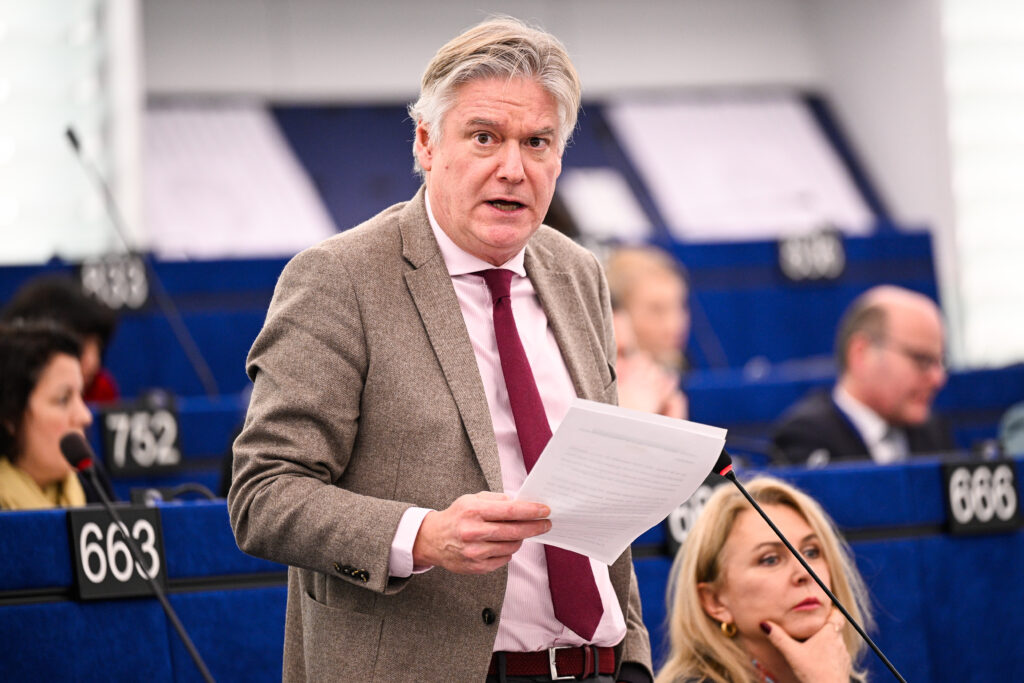

The European Union should make the Magnitsky Act sharper and more credible. Broaden its scope to include systematic corruption and transnational repression, says Spanish Christian democrat Antonio Lopez-Istúriz, the European Parliament’s rapporteur for the so-called EU Magnitsky Act.
The European Parliament has reaffirmed its commitment to the fight against impunity and the defence of human rights. On 21 January, MEPs adopted a report on the EU Global Sanctions Regime, the so-called EU Magnitsky Act, by 440 votes in favour, 127 against and 59 abstentions. Separately, in a broader political debate surrounding this instrument, in 2024 the former EU High Representative for Foreign Affairs and Security Policy, Josep Borrell, proposed renaming it in honour of Alexei Navalny, who died in suspicious circumstances in a Russian penal colony, as a strong political signal against serious human rights violations and impunity.
MEP Antonio Lopez-Istúriz (EPP/ESP) spoke to EU Perspectives after the vote in Strasbourg.
What is the state of play of the EU Magnitsky Act?
From the EPP’s perspective, the EU Magnitsky Act is one of the most important instruments the Union has developed to defend human dignity, freedom, and the rule of law beyond its borders. It is operational and has already produced results, but it is still not being used to its full potential. The framework is solid; what is missing is greater political determination and consistency. For me, sanctions must be a real tool of accountability, not a symbolic gesture. Europe’s credibility depends on its capacity to act firmly against those who commit serious human rights abuses.
You might be interested

How will the EU prepare and strengthen a Magnitsky-style human rights sanctions regime?
Preparation means consolidation and ambition. We must ensure that the regime applies faster, more coherently and with stronger coordination among member states. It also means reinforcing cooperation with our transatlantic and democratic partners, particularly the United States, the United Kingdom and Canada. Joint designations multiply the impact of sanctions and send a powerful message of unity among democracies. A strong Magnitsky regime is a pillar of a values-based foreign policy.
Is there any political development of the Act in light of new geopolitical scenarios?
Absolutely. The geopolitical environment has become more dangerous and more confrontational. Authoritarian regimes are more aggressive, and repression increasingly crosses borders: this makes the Magnitsky Act not only a human rights tool but also a strategic and security instrument. It must respond to new realities such as transnational repression, hybrid threats, and the use of corruption and proxy networks to destabilise democracies. Human rights, security and geopolitical credibility are now inseparable.
What are, in your opinion, the weaknesses at this stage of the act?
The main weakness is the lack of uniform political will. The need for unanimity in the Council can slow down decisions and water down ambition. Another weakness is uneven enforcement. If some member states apply sanctions strictly and others do not, the entire regime loses credibility. Remember what happened in Spain: a Minister of Sanchez’s Government received Delcy Rodriguez, Vice President of Maduro in Venezuela, sanctioned by the EU, at the airport… Finally, the number and scope of listings remain limited. A sanction without enforcement—or one with timid application—becomes an empty symbol.
What happens next?
We should make the Magnitsky Act sharper and more credible. Broaden its scope to include systematic corruption and transnational repression. Ensure strict and uniform enforcement in all member states; strengthen coordination with democratic allies for joint sanctions. And use the regime with courage, not caution. If Europe wants to be serious as a global defender of human rights and democratic values, its sanctions must have real impact. The Magnitsky Act should become a cornerstone of a strong, principled and credible European foreign and security policy.