
Sanofi has reaffirmed its commitment to innovating ‘from France for the world’. The pharma company announced at the recent Choose France Summit that it is consolidating or launching €1bn in new investments across the country in 2025–2026.
The massive figure includes €700m to modernise its industrial network and €300m for new artificial intelligence capabilities in addition to the €2.5bn the company already invests annually in R&D in France, making it the country’s largest private R&D investor across all sectors.
These commitments add to nearly €3.5bn invested since the COVID-19 pandemic to strengthen Europe’s sovereignty in health innovation, including over €1bn to build an end-to-end strategic mRNA capability in France.

With the mRNA Centre of Excellence in Marcy-l’Étoile now operational, the Modulus modular manufacturing facility in Neuville-sur-Saône producing mRNA vaccines and biomedicines, and new lipid-nanoparticle capacity being developed in Val-de-Reuil, Sanofi is positioning Europe at the centre of its global vaccine and biopharmaceutical strategy.
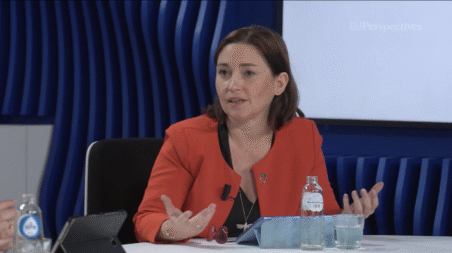
Sanofi’s Florence Baron-Papillon, head of strategic projects in corporate public affairs explained to EU Perspectives how these investments translate into concrete capabilities, and what policymakers must urgently fix if they want Europe to remain globally competitive in life sciences.
You might be interested
Europe must move faster
Why anchor these capabilities in Europe?
It’s a deliberate commitment. We’ve invested more than €1.5bn in our proprietary mRNA platform, and a very large part of that investment is located in Europe, especially in France. Our mRNA Centre of Excellence spans Cambridge in the US and Marcy-l’Étoile in France, with around 500 employees. We added a new lipid-nanoparticle line in Normandy and built Modulus near Lyon, the first modular vaccines and biopharmaceuticals factory in the world, capable of producing four different products simultaneously and switching quickly between them.
We see this as strengthening Europe’s scientific and industrial autonomy. And it reflects our belief that Europe has the science, the talent and the industry to remain a global leader. A month ago Sanofi confirmed new investments in industrial infrastructure, R&D and artificial intelligence in France. Our commitment shows we believe in Europe. Now policymakers need to ensure the environment keeps pace.
Building mRNA 2.0 in Europe
What does “end-to-end strategic mRNA capability” mean?
It means Sanofi can now control every critical step in the design, development and production of an mRNA vaccine, from the plasmid to the final vial. This was not the case in Europe before.
It starts with plasmid production, then the mRNA itself, then the lipid nanoparticle (LNP), formulation, and finally filling and finishing. With our Centre of Excellence in Marcy-l’Étoile, the new LNP capacity in Val-de-Reuil, and the Modulus facility, this entire chain is now operational inside France.
This is the foundation of mRNA 2.0, the next generation of mRNA technology, focusing on two improvements essential for routine vaccination. First thermostability, moving from ultra-cold storage or a one-month fridge shelf life to 9–12 months in liquid or lyophilized form. And second, tolerability, reducing the reactogenicity people accepted only because of the pandemic.
Sanofi can now control every critical step of the mNRA and LNP design, development and production at large scale, all the way from the plasmid to the final vial. This was not the case in Europe before. — Regis Gervier, Head of mRNA Center of Excellence
If mRNA is to become part of normal vaccination schedules, these improvements are necessary. The lipid nanoparticle is central to all of this. LNPs are key elements for both stability and reactogenicity. That’s why we invested in producing our own LNPs in Val-de-Reuil.
To deliver mRNA 2.0, you need full control of LNP chemistry, mRNA engineering, formulation and scale-up. Our platform lets us test thousands of lipid variants using digital tools and AI and move rapidly from lab work into clinical trials.
What this capability means for Europe
How significant is this for Europe?
It is strategically important for Europe. This platform, from plasmid production to mRNA synthesis, lipid nanoparticles, formulation and large-scale manufacturing, strengthens both European and French autonomy in a technology essential for future preparedness. We see it as directly contributing to Europe’s sovereignty in health innovation.
Since the pandemic, we have invested nearly €1bn to build this end-to-end capability in France. Together, the Centre of Excellence, the new LNP capacity and the Modulus facility form the first fully European chain of mRNA development and production. It anchors critical technology and industrial capacity in Europe rather than elsewhere.
If a new pandemic emerged tomorrow, would you be ready?
Yes. Our mRNA platform is now fully operational end-to-end, from plasmid production to final formulation. Since 2021 we’ve submitted more than 20 investigational new vaccine applications or clinical-trial requests.
The Modulus facility is a major part of our readiness. It is the world’s first modular vaccine and biopharmaceuticals factory, summary of Sanofi’s industrial excellence and a tool in the fight against shortages and for French and European health sovereignty. Modulus can be adapted to manufacture up to 4 vaccines or biopharmaceuticals simultaneously, and switch between them rapidly, something unprecedented in vaccines or bioproduction. Together with the mRNA platform, we are in a strong position to respond quickly to a new health threat.
What does your current mRNA pipeline look like?
The most advanced candidate is a combined RSV–hMPV mRNA vaccine for older adults, a group with a high burden from respiratory infections. We already have an RSV product for newborns; this one targets the other major risk group.
More broadly, mRNA makes up a large share of our pipeline. When we last presented figures to investors, around half of our more than ten vaccine candidates were mRNA-based. These include flu candidates, a therapeutic vaccine for acne and an mRNA candidate against chlamydia.
Does the current EU policy environment support innovation?
Europe has everything it needs, the talent, scientific excellence and very strong industrial capacity. Every ingredient is there for Europe to take back the lead in life sciences. But the environment must be agile and competitive. At the moment, it’s not.
Our experience with the first IPCEI in health, Med4Cure, is a clear illustration. It’s a promising tool, but extremely slow. Our project was submitted more than three years ago. The European Commission approved it in May 2024, and then the entire administrative process started again at member state level. That adds more than 18 months of delay. Many partners are in the same situation. With this speed, Europe cannot compete globally.
Europe is also losing clinical trials because the system remains too complex. There is no cross-border recognition. The Clinical Trials Regulation is not implemented as intended, and national procedures remain fragmented and duplicative. Europe does not yet have robust investment or financing tools that match its ambitions.
Visibility is another issue. Health is almost nowhere in the Multiannual Financial Framework. It is hidden across different instruments. You cannot build a health innovation strategy if health is invisible in the budget. And modern science depends on data. Europe lacks interoperable health data systems, which means it cannot fully use modelling, artificial intelligence or digital tools.
Finally, IP protection must be safeguarded. We cannot continue to invest so heavily in R&D and industrial capacity if IP protection is weakened at the same time. Above all, Europe needs unity. Without Europe speaking with one voice, none of these ambitions will materialise. They have done it in energy and defence. Now it is time to do it for life sciences. Otherwise Europe becomes vulnerable.
The global context makes this urgent. China is already number one in early-phase clinical trials and new molecular entities. That means that in five to ten years, many medicines entering European hospitals will come from China. Europe risks dependency in a strategic sector, the same pattern we saw in solar panels and electric vehicles.
We’re trying to avoid that outcome in life sciences. Unlike digital or chips, life sciences is a domain where Europe still starts from strength and can still lead, but only if it chooses to.
How do you see the Biotech Act, Critical Medicines Act, pharma package and Life Sciences Strategy?
These files can help Europe, but only if they stay focused on agility, speed and unity. The Biotech Act can be promising, but it must embed real regulatory agility. A quick win on clinical trials would be helpful, but it’s far from sufficient.
The Critical Medicines Act must support security of supply without undermining competitiveness. Europe cannot add new obligations without considering their cumulative effect on the investment environment.
Europe’s to-do list: simplification, speed, unity
On the pharma package, the discussions on regulatory data protection and IP are central. Everyone in the trilogue knows what is needed to keep an innovative biopharma industry in Europe. The question is whether the final compromise reflects that ambition.
What we expect from the Life Sciences Strategy is a coherent framework that aligns regulation, IP, clinical trials, data, investment tools and competitiveness. It must treat life sciences as a strategic sector requiring unity, political leadership and rapid implementation.
What Europe needs above all is simplification, speed and unity. Clinical trials must become easier to run. Strategic tools such as IPCEI cannot operate on multi-year cycles. We also need health to be visible in the MFF, interoperable health-data systems, and strong, predictable IP protection.