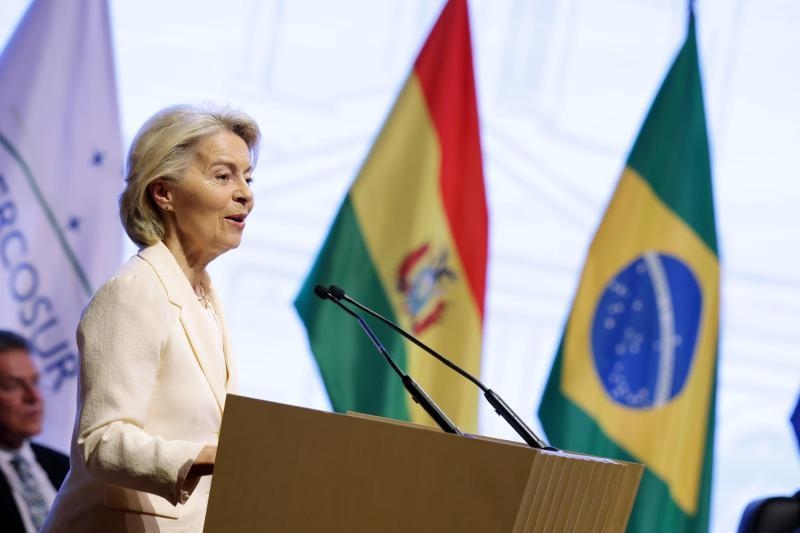

When friends shake hands, it must mean something, the European Commission president told the World Economic Forum in Davos — before warning against nostalgia. Either way, Ursula von der Leyen’s speech sounded less like a lecture on markets and more like a call to arms.
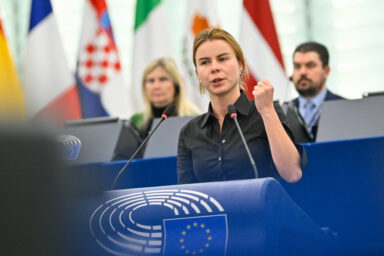
In Davos on Tuesday Ursula von der Leyen, president of the European Commission, delivered a rather dramatic speech. „We consider the people of the United States not just our ally, but also our friends,“ she said. While open to the charge that the belief in the meaning of friendship among countries—handshakes notwithstanding—might be precisely a product of the nostalgia she warned against, she appeared determined to sound as resolute as possible under the circumstances.
The Trump in the room
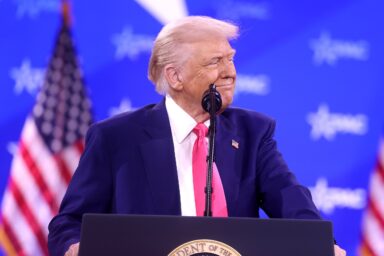
From the opening line, “the world has transformed completely since 1971”, she pressed the assembled grandees to treat security, trade and technology as a single theatre. Though she referred to Donald Trump only once, his threats—protectionist or military—framed almost every paragraph.
The commission chief reached back to the Nixon shock to argue that sudden jolts can sharpen Europe’s resolve. She reminded listeners that cutting the dollar’s tie to gold “provided a sharp lesson for Europe on the need to strengthen its economic and political power”. That warning, she said, echoes today as Russia bombs Ukraine and America toys with tariffs. “Nostalgia will not bring back the old order,” she declared. “Playing for time and hoping for things to revert soon will not fix the structural dependencies we have.”
Her refrain was independence. “If this change is permanent, then Europe must change permanently too,” she insisted. All else in the 5,600-word address served that motif, with defence placed at its centre.
You might be interested
More guns, fewer gaps
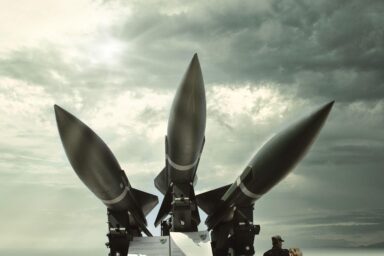
Europe’s rearmament, Ms von der Leyen argued, is finally matching rhetoric. “We have done more on defense in the last year than in decades before,” she said, reminding capitals that the union’s members plan to spend €800 billion on the military by 2030. Investors have noticed: the market value of European defence firms has tripled since Russia’s full-scale invasion of Ukraine in 2022.
Security of supply feeds into the wider point I started with today: that Europe must speed up its push for independence. — Usrula von der Leyen, European Commission President
Technology, she contended, is the hinge. Three European start-ups have reached unicorn status by designing “AI-powered software and systems for battlefield intelligence” and “advanced dual use and surveillance drones”. Such firms need a home market big enough to grow. Hence her forthcoming proposal for “EU Inc”, a corporate regime that would let entrepreneurs register anywhere in the union “within 48 hours, fully online”.
The war next door shapes her sums. “This must end,” she said of Russia’s attacks. To help Kyiv endure, the EU will provide “a loan of 90 billion euros for 2026 and 2027”. She sought to pre-empt American qualms with a nod across the Atlantic: “We recognize President Trump’s role in pushing the peace process forward, and we will work very closely with the United States.” The loan, however, signals that Europe will underwrite Ukraine even if Washington wobbles.
Tariffs on thin ice
Ms von der Leyen turned from Donbas to the Arctic, the scene of Mr Trump’s latest sortie. Proposed American duties on European metals, she argued, stem from the president’s wish to annex Greenland. “The proposed additional tariffs are a mistake, especially between long-standing allies,” she said. Should Mr Trump proceed, “our response will be unflinching, united, and proportional”.
Brussels is drafting a package to shield the island and the kingdom of Denmark. “Above all, that Arctic security can only be achieved together,” she warned, sketching plans for a European icebreaker fleet and fresh investment in Greenland’s infrastructure. Solidarity, not surrender, would define the EU’s stance.
The tariff row, she implied, reinforces her case for strategic autonomy. Controlling raw materials, ships and data lines is no longer optional when allies brandish trade weapons. Security of supply, she said, “feeds into the wider point I started with today: that Europe must speed up its push for independence”.
Single market, single arsenal
The other pillars of her programme—capital-markets union and an energy blueprint—received briefer treatment but the same urgency. Businesses, she complained, “face the new set of rules every time they expand into a new member state”. EU Inc would offer “a single and simple set of rules that will apply seamlessly over our union”. Capital, meanwhile, should flow “to scale-ups, to SMEs, to innovation, to industry” rather than migrate to New York.
Energy, too, is national security. The continent needs “an interconnected and affordable energy market, a true energy union”. By bolstering interconnectors, grids, nuclear stations and renewables, the EU hopes to “put an end to price volatility, manipulation and supply shocks”. Cheap domestic power, she hinted, is as vital to gunmakers as to households.
The world has changed permanently and we need to change with it. — Ursula von der Leyen
In Davos’s corridors bankers swapped notes on how far rhetoric will travel. Many recall last year’s ‘Liberation Day‘ tariffs, which fizzled after markets recoiled. Yet the mood is darker now that Mr Trump has raised the prospect of a full-blown trade war with Europe. Ms von der Leyen’s speech offered a plan but also a warning: Europe will pay to defend itself, and it will retaliate if pushed.
A line in the snow
Critics mutter that Brussels still lacks a joint army, that its capital-markets reforms crawl and that a real energy union remains on the drawing board. Ms von der Leyen admitted none of that. Instead she closed with Greenland again, a snowy symbol of all the fractures she had enumerated. She finished by telling her audience that “the world has changed permanently and we need to change with it”. The implication was clear: Europe will write its own playbook, whether Mr Trump cheers or jeers.