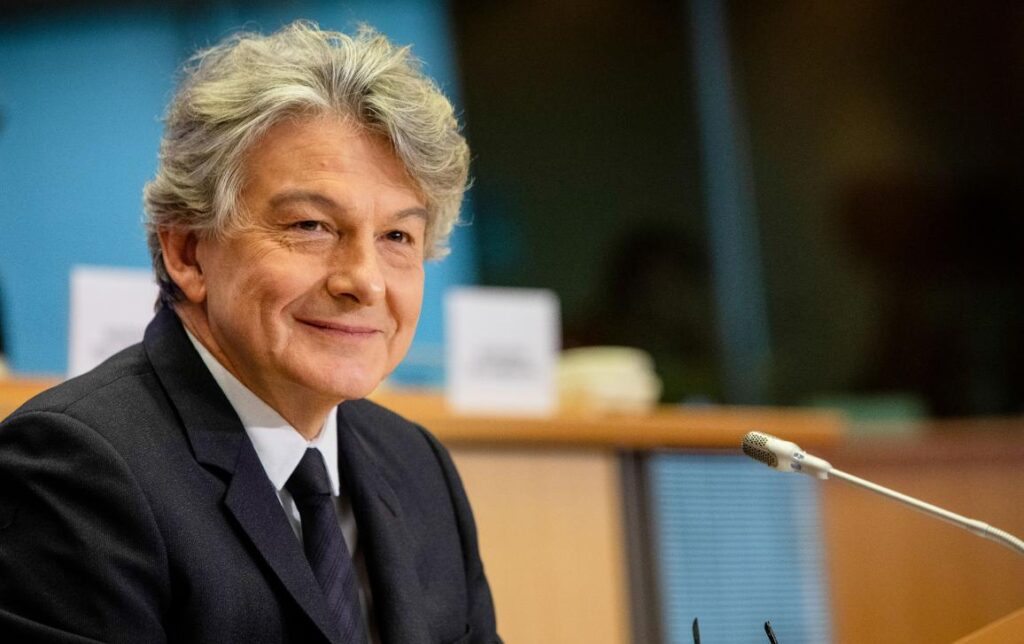

He was not always this popular. Yesterday, former Tech Commissioner—and one of the Europeans barred from the US—Thierry Breton spoke to MEPs and won rare full-throated backing.
Mr Breton joined MEPs in the Internal Market and Consumer Protection Committee (IMCO) via video link on 25 February. They talked about sanctions that US President Donald Trump recently slapped on the former EU digital chief. They include a travel ban.
In December the US imposed a visa ban on Mr Breton, along with three digital rights campaigners. These are Anna-Lena von Hodenberg, a journalist; Josephine Ballon, head of the NGO HateAid; and Clare Melford, founder of the NGO Global Disinformation Index. The reason? Their work on the EU’s landmark Digital Services Act. Mr Breton steered the file through the Brussels lawmaking machine.
Unsurprisingly, MEPs worry about the implications for EU digital sovereignty, and have condemned the sanctions. Some described the US move as “an unacceptable personalisation of EU policy”. They called it “dangerous precedent for the independence of the European institutions and an attack on the EU’s regulatory sovereignty”.
You might be interested

Nothing personal?
Mr Breton characterised the debacle as a “misunderstanding” and said he did not take it personally. “I plead guilty here to have defended our values, our democracy by approving our legislation,” he said. “I am very proud of what we have done together. For having been able to put for the first time in our history a coherent, comprehensive and robust regulation. For a digital single market.”
The US decision saw the light of day on 24 December. Secretary of State Marco Rubio announced that the individuals “led organised efforts to coerce American platforms to censor, demonetise, and suppress American viewpoints.” Section 212(a)(3)(C) of the US Immigration and Nationality Act “renders inadmissible any alien whose entry into the United States the Secretary of State determines would have potentially serious adverse foreign policy consequences for the United States,” he continued.
Should he attempt to travel to the US, Mr Breton—and potentially his family members—could be face detainment and deportation. But the former EU tech head underlined the position that “everyone must follow the rules” if they want to benefit from or operate in the EU’s digital market. He said the sanctions against him and his fellow Europeans were “a question of political attitude” and said that high-level discussions are needed to resolve the situation.
High-level leaders have already weighed in. During the weekend French President Emmanuel Macron called on Trump to lift the “unjustly imposed sanctions” on Mr Breton and fellow French national Nicolas Guillou, an International Criminal Court judge.
EU laws under pressure
The IMCO committee was more concerned about the wider implications for the enforcement of the DSA. The members worried about Europe’s regulatory autonomy overall, including other regulation , e.g., the Digital Markets Act and the AI Act. “We defend these rules together because it’s what links Europe, the freedom of speech and the freedom of citizens to express themselves in whatever way they want, as long as they stay in line with the rules,” said MEP Andreas Schwab (EPP/DEU).
Wednesday’s debate also generated a dose of sarcasm among the MEPs. Sandro Gozi (Renew/FRA) said that the Trump administration should maybe ban all 565 MEPs and commissioners voting for the DSA.
Moving forward, the MEPs called on the Commission and member states to respond firmly to these attacks. They said that “enforcement of the EU’s digital legislation aims to ensure compliance with EU law.” It also seeks the protection of fundamental rights, and is not there to “regulate political opinions”.