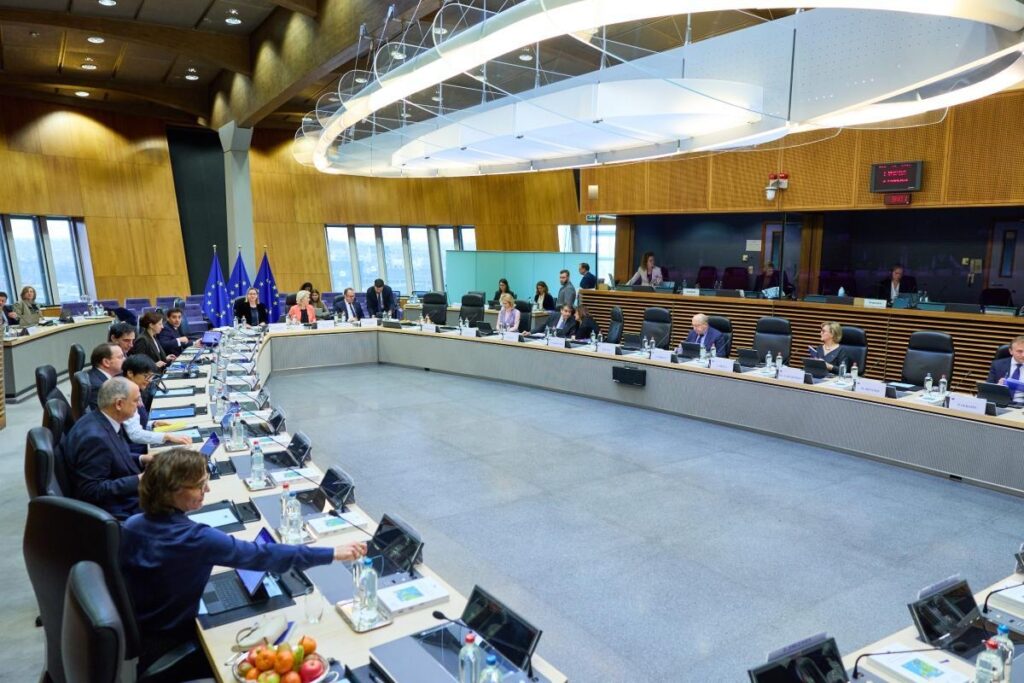

Europe puts its pocketbook at the service of its frontier. On Wednesday, the Commission set out how the European Union will support the war-damaged regions that border Russia, Belarus and Ukraine.
The Commission’s Communication on EU’s Eastern Regions Bordering Russia, Belarus And Ukraine was drafted by the Directorate-General for Regional and Urban Policy. It mentions frontiers which stretch from Lapland to the Black Sea and sit inside nine member states; Finland, Estonia, Latvia, Lithuania, Poland, Slovakia, Hungary, Romania and Bulgaria.
Moscow’s invasion has battered these areas. Cross-border trade has collapsed, investment has stalled and local housing markets sag. Hybrid attacks, disinformation, weaponised migration and sabotage nibble at public safety and confidence.
Defence meets cohesion
Demography compounds economics. Young workers head west, leaving ageing populations and labour shortages in health care, education and manufacturing. Local authorities grapple with depleted budgets and an influx of refugees. Brussels now says the eastern flank must no longer limp along on ad-hoc solidarity.
Five priorities anchor the plan: security and resilience, growth and regional prosperity, building on local strengths, connectivity and supporting people. The showpiece is the EastInvest Facility, a lending and advisory arm that promises €28bn in fresh finance by the end of 2027. Money will flow through the European Investment Bank Group, the World Bank and national promotional banks.
You might be interested

Security tools receive unusual prominence for a cohesion paper. Brussels pledges an Eastern Flank Watch, a European Drone Defence initiative and two air- and space-shield schemes. Dual-use infrastructure—roads, railways and ports built for commerce but strong enough for tanks—moves to the top of investment lists. The Commission argues that quick military mobility is now an economic necessity.
Keeping people in place
Energy and connectivity loom large as well. The Baltic states will finally synchronise their grids with continental Europe. The Nordic-Baltic Hydrogen Corridor, a cross-border pipeline for green gas, graduates from sketch to strategy. Digital corridors will sprout alongside rails to guarantee fibre links every bit as resilient as armour plating.
Eastern border regions are not only national borders. They are European borders. — Raffaele Fitto, European Commission Vice-President for cohesion
Economic gadgets alone do not fix depopulation. Brussels therefore proposes a “community of practitioners” so mayors and business chambers can swap tips on resilience. Education-to-employment pathways will steer youngsters into local firms. The Media Resilience Programme will blunt Russian propaganda that tells graduates their only future lies abroad.
Raffaele Fitto, Commission vice-president for cohesion, insists the initiative sprang from local consultation. “Eastern border regions are not only national borders. They are European borders,” he told reporters during the launch. The message: protect Suwałki or Satu Mare and you protect Stuttgart and Seville as well.
From words to wallets
Mr Fitto added, “This Communication has been developed together with the territories and their communities to ensure they remain vibrant places to live, work, grow and stay competitive. Strengthening the eastern border regions is a strategic investment in Europe’s security, stability, cohesion and competitiveness.” Few cohesion documents speak so bluntly about tanks and drones. Also, few security papers dwell so long on SMEs and bioeconomy hubs.
The Commission will hold an annual high-level dialogue to gauge progress, with the inaugural meeting on 26 February. That gathering will see finance chiefs sign the EastInvest founding declaration. Meanwhile, the 2025 mid-term review of cohesion policy has already steered extra money eastward, and the draft EU budget for 2028-34 earmarks a dedicated envelope for the frontier regions.
Implementation will test everyone’s patience. Project promoters must coax nine very different administrations into common procurement and shared standards. National-regional partnership plans, still in gestation, will decide whether a drone-defence node rises outside Riga or a hydrogen spur is built near Ploieşti. Without brisk permitting and transparent tenders, the €28bn could idle in Luxembourg vaults.