
The European Commission has presented a new six-point agenda for preventing and countering terrorism. It aims to anticipate, prevent, and respond to potential extremist attacks, and to protect Europeans from becoming their victims.
The Commission outlined the agenda at Thursday’s press conference following its weekly college meeting. It shared some serious security concerns. Between 2019 and 2023, the number of terrorist incidents more than doubled (from 57 to 120), before falling back to 58 in 2024.
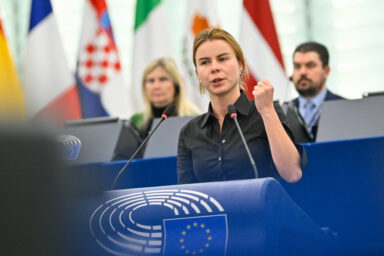
The radicalisation of minors is on the rise, as they are increasingly becoming targets of online campaigns. Most have links to jihadist terrorism, but right-wing violent extremism has gained ground, particularly through “active clubs” and online extremist networks that spread violent content and push vulnerable minors into acts of self-harm and violence. “In 2024, nearly a third of terrorism suspects in the EU were under the age of 20, and the youngest was just 12,” said Henna Virkkunen, European Commission vice-president.
Behind European terrorism
According to the Commission, recent attacks have been predominantly committed by individuals and small cells, rather than by fully-fledged organizations. However, the overall threat level remains high and is driven by a multiplication of triggers.
“While jihadist terrorism remains the most important and lethal terrorist threat, terrorists and violent extremists are driven by a growing range of motivations, not always linked to a specific ideology, including the rejection of European democratic values, anti-Semitism, or anti-Muslim hatred,” said Home Affairs Commissioner Magnus Brunner.
You might be interested
To address this, the agenda consists of six points: anticipating threats, preventing radicalization, protecting people online and in physical environments, actively responding to threats and attacks, and finally, increased cooperation with Europol and Eurojust.
Evil gaming
Online gaming is also used to spread propaganda and recruit new followers, including minors. “We will increase our cooperation between the online gaming sector and law enforcement. The safety aspects of online gaming will also be a key part of the overall strategy on video games that the Commission will present by the end of the year,” Ms Virkkunen said. “We are therefore working and will present by the end of the year an action plan for the protection of minors from crime, which will include measures to counter radicalization and recruitment into crime, both online and offline,” he added.
Furthermore, the war between Russia and Ukraine, which has been going on for over four years, poses “potential security risks” for the EU, “linked to the return of foreign volunteers and former Russian fighters with combat experience,” the European Commission document states.
Russia “has undertaken a growing range of sabotage and hybrid actions against the EU that violate the territorial sovereignty of member states, undermine the integrity of democratic institutions, and pose a direct threat to the security and safety of the civilian population”.
Invasive new technology
The growing misuse of digital and new technologies, from social media and artificial intelligence to 3D-printed weapons and drones, is reshaping terrorist activity. Terrorist actors coordinate their plans on end-to-end encrypted (E2EE) communication platforms and finance their networks and attacks with cryptocurrencies, non-fungible digital assets (NFTs), and “digital hawala” (systems for concealing money transfers). Generative artificial intelligence is being misused to create attack instruction manuals.
In this regard, the European Commission will assess a possible revision of the Regulation on Online Terrorist Content, based on its evaluation in 2026, and will strictly enforce the Digital Services Act. Brussels also announced that it will strengthen voluntary cooperation with online service providers through the EU Internet Forum. The point is “to accelerate the removal of terrorist content and reduce the scope for radicalization and online recruitment”.
This is to transform the EU Crisis Protocol into a European Online Crisis Response Framework to improve cooperation between law enforcement authorities and online service providers from the early stages, before a crisis fully emerges. “We will strengthen the application of the DSA to mitigate the systemic risks associated with the dissemination of terrorist and violent extremist content,” explained Virkkunen.
Public spaces remain still an issue
To protect individuals who pose a terrorist threat to the European Union, the Commission will propose a follow-up to the “post-hit procedure,” in the context of the evaluation of the Schengen Information System, to facilitate the voluntary sharing of information on terrorism-related alerts with member states.
The Commission notes that it will explore options to expand the advance travel information framework to include private flights, maritime, and land transport currently limited to commercial air travel. Furthermore, to strengthen the security of public spaces and critical infrastructure, the Commission will invest €30m in projects aimed at improving the overall security of public spaces.
It will also strengthen, both financially and operationally, the EU Advisory Programme for Protective Security. This aims to meet the growing demand from member states for support in vulnerability assessments of public spaces and critical infrastructure.
Chemical attacks on the horizon
The European Commission will present also an action plan this year to prepare for and respond to chemical, biological, radiological, and nuclear (CBRN) terrorist attacks. These are low-probability but high-impact events, for which EU-level preparedness is essential.
The plan will “propose, among other things, a more robust EU-level training and exercise program, and explore ways to counter the misuse of new technologies, such as nucleic acid synthesis and AI-based biotechnology.” In parallel, the EU Stockpile Strategy and the EU Medical Countermeasures Strategy will promote health preparedness to mitigate the impact of CBRN risks.
What does the six-point agenda do?
Anticipating threats. Expands EU intelligence and Europol analytics and fund research on AI, crypto-assets, drones and other emerging risks so authorities spot new terrorist threats sooner.
Preventing radicalisation. Provides a “Prevention Toolbox” and €5 million for community projects that build youth resilience and intervene early with people most at risk of extremist grooming.
Protecting people online. Enforces and, if needed, tighten EU rules so platforms delete terrorist content faster and launch a standing Online Crisis Response Framework for rapid law-enforcement–platform coordination.
Protecting people in the physical environment. Sharea terror alerts more widely in the Schengen system, collect advance traveller data beyond commercial aviation, invest €30 million and extra advisory teams to harden public spaces and critical infrastructure.
Responding to threats and attacks. Tracks terror financing more effectively (including crypto), widen Europol and Eurojust powers, and streamline police access to digital evidence for quicker investigations and prosecutions.
Cooperation with international partners. Deepens Europol and Eurojust data-sharing and operational links with trusted third countries to tackle cross-border terrorist networks.