
Member states’ ministers responsible for cohesion policies approved conclusions on the EU agenda for cities as outlined by the Commission in December 2025. The Thursday text highlights the importance of cities for economic, social and territorial cohesion. Biggest problem? Housing, surveys say.
Cohesion policy has contributed to strengthening the urban dimension of the EU. Over €24bn from the European Regional Development Fund was dedicated to sustainable urban development in 2021–2027. This trend should contuinue, ministers agreed on 26 February, in order to address a number of areas. These include social, affordable and sustainable housing, energy transition, water resilience, competitiveness, defence and skills development.
76 per cent, i. e. more than three quarters, of EU’s population live in urban areas (data of 2024). This share keeps rising over the time and it is expected to exceed 80 percent by 2050. Figures, however, differ significantly among member states, ranging from just over 50 per cent (Romania, Slovakia) up to 95+ per cent (Luxembourg, Malta, the Netherlands).
Cities as key actors of progress
“I am really pleased that we approved this set of conclusions today. Our cities are key actors in delivering on EU priorities, such as competitiveness, innovation and sustainable development. The urban dimension has to be appropriately taken into account in future policymaking and in shaping Europe’s future,” said Makis Keravnos, Minister of Finance of the Republic of Cyprus.
Our cities are key actors in delivering on EU priorities, such as competitiveness, innovation and sustainable development, and in achieving the EU’s cohesion objectives. — Makis Keravnos, Minister of Finance of the Republic of Cyprus
The text recognises the European Investment Bank’s role in providing financing and advisory services to cities in a number of areas. These include sustainable urban transport, affordable and sustainable housing, decarbonisation, energy efficiency, and development of green infrastructure. Financing will be secured through blending EU, national, and private funding.
Housing crisis looming
A recent Eurobarometer survey has shown that the most urgent problem for European urban population is lack of affordable housing. 51 per cent of respondents consider it to be an immediate and urgent problem.
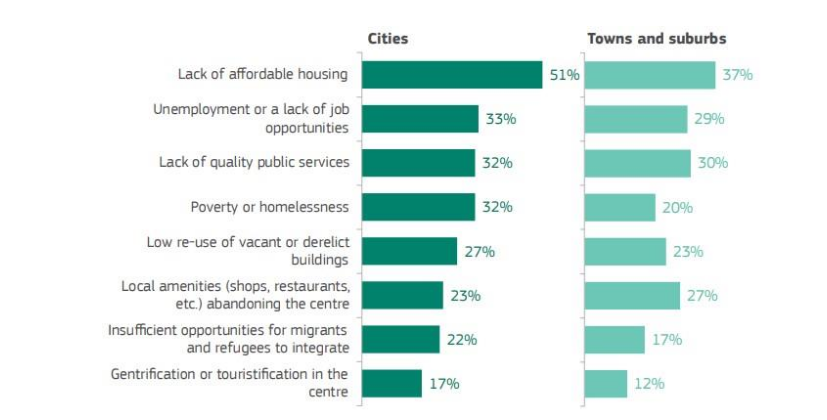
A third of respondents (33 per cent) report that unemployment or lack of job opportunities is an urgent problem in their city. Similar figures are also seen for lack of quality public services (32 per cent) and poverty or homelessness (32 per cent). Respondents in towns and suburbs also rank lack of affordable housing first (37 per cent). This is followed by lack of public services (30 per cent), and unemployment or lack of job opportunities (29 per cent).