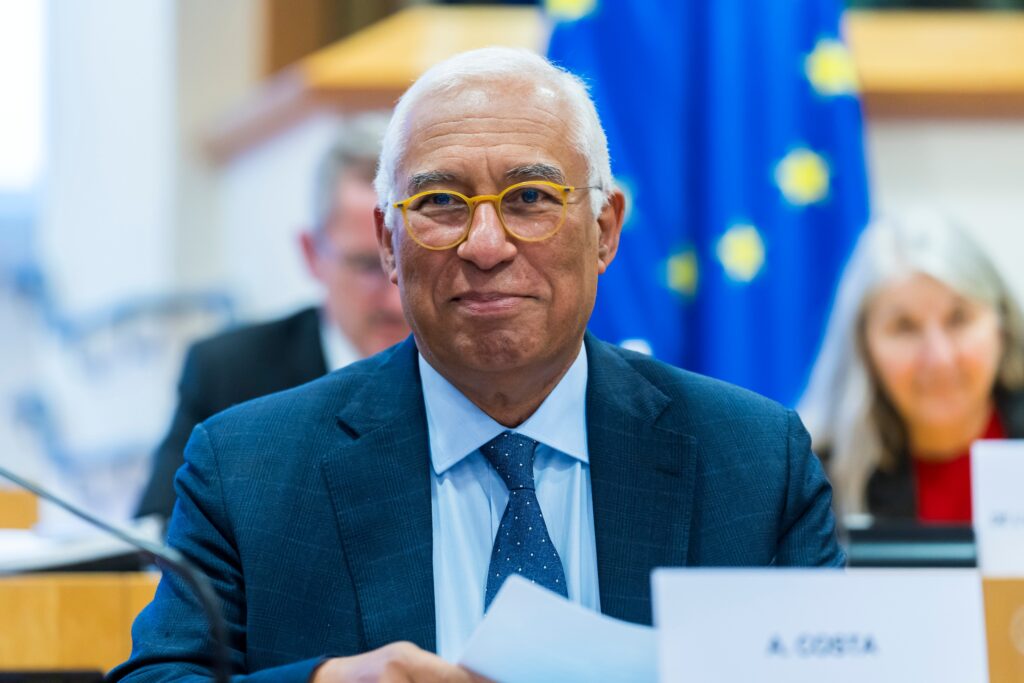

European Council President António Costa will convene EU leaders at Belgium’s Alden Biesen Castle on Thursday 12 February to tackle Europe’s competitiveness crisis. The summit must navigate deep divisions over deregulation and protectionism to determine whether leaders can finally translate ambitious rhetoric into concrete action.
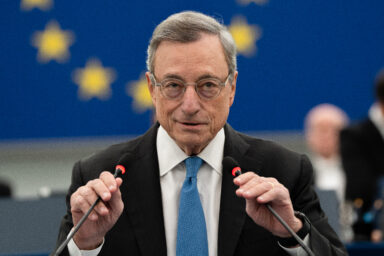
“In the current geopolitical environment, strengthening our single market is, more than ever, an urgent strategic imperative,” said President Costa in the European Council press release ahead of the retreat. Former ECB President Mario Draghi and ex-Italian Prime Minister Enrico Letta, authors of the two landmark competitiveness reports that have dominated Brussels policy discourse, will join leaders for what Mr Costa describes as a “strategic brainstorming session”.
A European Policy Innovation Council report found that only 11 per cent of Mr Draghi’s recommendations had been implemented in the first year after his September 2024 report. It prompted the Commission to announce its Competitiveness Compass roadmap in late January. Leaders have embraced the rhetoric of the competitiveness agenda. However, they have been slow to act on the economic and political costs of the reformsMr Draghi prescribed. Joint borrowing for defense and innovation and capital markets integration, in particular, have fallen short.
The Draghi and Letta agenda
Mr Costa’s retreat format is designed to create political space for difficult conversations without the pressure of immediate decision-making. The pressure led to a lack of deliverables in official summits hosted by Charles Michel, Mr Costa’s predecessor.
The meeting will unfold in two working sessions. Mr Draghi leads the morning session on how the changing geopolitical environment impacts EU competitiveness. Leaders are to discuss how to reduce dependencies in critical raw materials and technology. They will also respond to what Mr Costa calls “not always fair” competition. Mr Letta takes the afternoon session on leveraging the single market, focusing on the proposed “28th regime”. The optional regulatory framework aims to help companies scale up by reducing administrative burdens without requiring full harmonisation across all 27 member states.
You might be interested
Mr Costa’s invitation letter frames the dual challenge. “Europe must both accelerate its ambitious trade agenda and defend its companies from unfair competition through focused protection in strategic sectors,” the Council president wrote.
The Berlin-Rome axis
Beneath the formal agenda, political coalitions are already forming. German Chancellor Friedrich Merz and Italian Prime Minister Giorgia Meloni have organised a pre-summit meeting with approximately ten leaders. They are to coordinate positions before the main retreat. Notably, France has reportedly yet to confirm participation in this preliminary gathering.
The EU’s new ‘power couple’ of Merz-Meloni marks a departure from traditional Franco-German alignment. The two leaders signed an updated German-Italian Action Plan in Rome on 23 January. They announced they would present a joint non-paper at the 12 February retreat focusing on regulatory simplification, single market strengthening, and automotive policy.
Six member states have circulated concerns about European preference rules that would favor EU companies in strategic sectors. Critics characterise them as ‘buy European’ protectionism. This pits advocates of industrial champions against open-market purists.
Competitiveness or deregulation?
Mr Costa’s invitation letter attempts to bridge this divide, declaring that “Openness should not be mistaken for weakness.” He simultaneously calls for “rules that allow for European preference in some strategic areas”.
The competitiveness push has spread unease among dozens of civil society and industry groups. They have warned the Commission in recent weeks that its January simplification proposal would undermine democratic accountability. The Commission on the other hand argues it needs to react more quickly to “an ever-changing and volatile geopolitical environment”.
Openness should not be mistaken for weakness. — António Costa, EU Council President
A large part of the competitiveness push stems from Europe’s desire to emulate and catch up to American tech dominance. US companies command nine of the world’s ten most valuable firms.
The March test
Yet, critics see something more troubling. Alberto Alemanno, a professor of EU law and policy at HEC Paris, charged that Brussels is “weaponising geopolitical threats to dismantle the standards that protect us”. Writing in Project Syndicate last week, Sandeep Vaheesan argued that US tech success relies heavily on harmful practices. Surveillance-based business models, labor exploitation, and anticompetitive consolidation play a larger role than genuine innovation. He contends that “effective competition policy can deliver abundance for everyone, instead of scarcity for the many and mindboggling riches for the few.”
As an informal retreat, the 12 February meeting will produce no formal conclusions or binding decisions. The real test will come next month at the formal March European Council, where Mr Costa intends to “reflect these informal discussions in the preparations and outcome”.
It is an open question if European leaders are able to reach consensus on the competitiveness debate and strategy to combat the implementation gap. The ultimate measure of success is whether this rhetoric will translate into concrete budget commitments in the 2028-2034 Multiannual Financial Framework negotiations and legislative action on completing the single market.