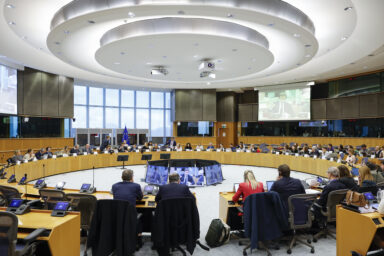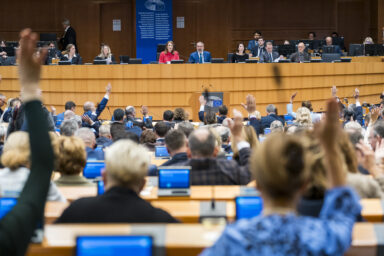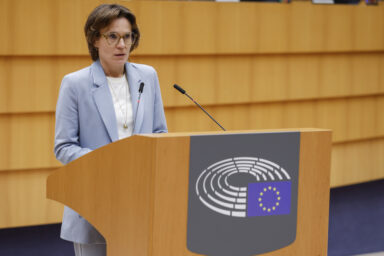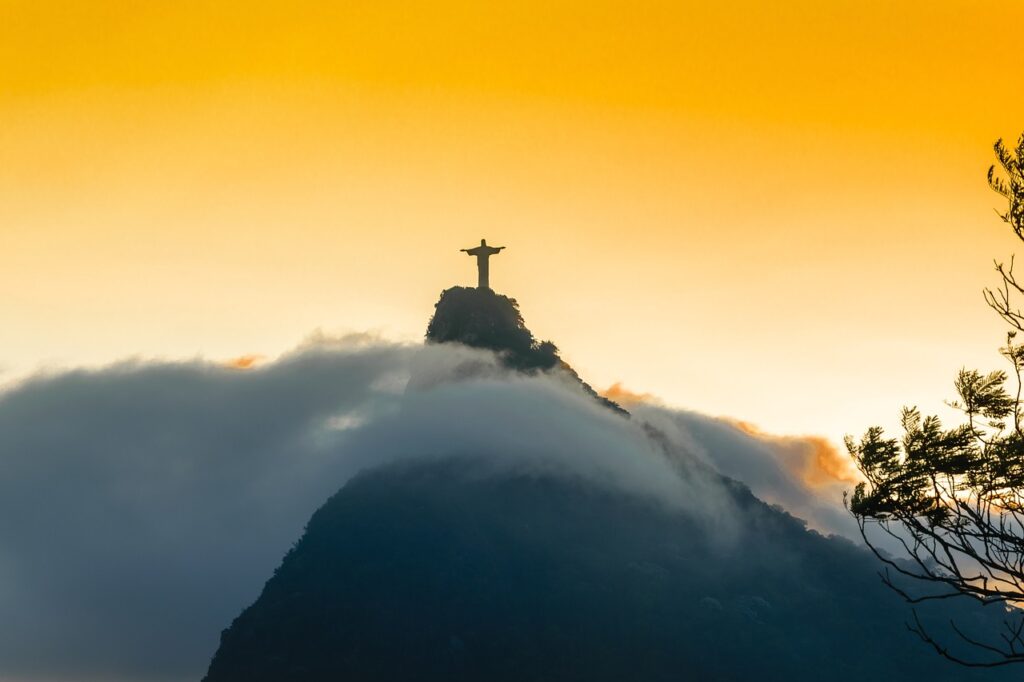

EU Trade Commissioner Maroš Šefčovič faced a series of MEPs‘ petty grievances at the European Parliament‘s trade committee hearing on 24 February. His mission was to revive momentum for the long-deferred free-trade agreement with Mercosur.
“The deal with Mercosur region will create a unique regional block to block free trade area of over 700 million people,” the commissioner reminded deputies. Delay, he warned, already carries a price. “Between 2021 and 2025, the EU would have benefited from an extra €183bn in exports and €291bn in GDP if the agreement had been in force.”
MEP Jörgen Warborn (EPP/SWE) welcomed the arithmetic. “I can only send the message that I hope that it will be provisionally applied as soon as possible, because especially as you said, it is very important that we now get all the wins and the benefits and the growth that we need with this agreement,” he said. Business federations, Mr Warborn added, have waited long enough.
Market share and missed chances
The Commissioner nodded. “Only on tariffs, our exporters will save €4 bn a year,” he replied, citing duties of more than thirty-five per cent on European machinery and agri-food products.
Europe, Mr Šefčovič argued, is already paying for hesitation. “Because we’ve been simply not there present enough, they’re getting it now from China, slowly reducing our share on the market.” Complementarity, he said, runs both ways. Mercosur offers critical raw minerals, while EU firms provide the machines to dig them. Agree now, he urged, and by 2032 European exporters could claw back the ten per cent of market share they have lost.
You might be interested
MEP Enikő Győri (PfE/HUN) countered that haste may break the law. “I would like to ask the Commission to be the guardian of the treaties, not only in theory, but also in practice,” she said. Parliament, Ms Győri reminded him, had referred the agreement to the European Court of Justice and expected Brussels to wait for the verdict. Anything else, she warned, would be “a major political faux pas”.
MEP Manon Aubry (The Left/FRA) pressed the same point more sharply. “Are you not trying to get rid of the Parliament?” she asked. Provisionally applying the pact before a vote, she argued, would be “a political mistake” and “a legal mistake”. Quoting Article 218 of the EU treaty, Ms Aubry insisted that both national chambers and Strasbourg must give consent before free-trade deals bite.
Procedure v prosperity
Mr Šefčovič pushed back. “It was not us who sent it to the European Court of Justice,” he retorted. “You could have voted on this agreement. You decided to send it to the European Court of Justice, which I fully respect.” Past precedents—Singapore chief among them—suggest the judges will side with the pact, he added. A fresh two-year pause would pile “hundreds of billions of euros of lost opportunities” on top of those already counted.
We cannot let this chance slip through our fingers anymore. — Maroš Šefčovič, EU Trade Commissioner
Timing now partly rests in Latin hands. “Indeed, Argentina most probably will be the first one to conclude the ratification,” the Commissioner noted. “Other Mercosur countries are coming next.” When they finish, he said, “we will be ready as well.” Consultations with capitals and lawmakers would continue, yet “we cannot let this chance slip through our fingers anymore.”
MEP Kathleen van Brempt (S&D/BEL) urged the Commission to send final texts to Parliament quickly once signatures dry. Mr Šefčovič agreed that post-negotiation slippage was chronic. Legal scrubbing and translation into twenty-four languages often stretch beyond two years, he admitted. His proposal: begin scrutiny in English immediately, then publish official versions in every tongue later. Ministers, he said, show “support for this approach”, though linguistic purists remain to be convinced.
Farmers and food
MEP Norbert Lins (EPP/DEU), chair of the agriculture committee, voiced the cattle lobby’s fear that cheap South-American beef will swamp EU markets. Mr Šefčovič answered with export figures. “European Union is agri-food export superpower,” he said. Sales abroad hit €235 bn last year, with a surplus of €64 bn. Demand abroad is vital, he argued, because “Three million jobs…depend on the agri-food exports.”
Stringent quotas in the treaty shield the most vulnerable sectors, he insisted, and Mercosur countries have accepted full alignment with EU food-safety rules. The agreement also locks in protection for European geographic-indication brands. “The United States do not like our GI system,” he warned; securing Latin signatures now would make it harder for Washington to erode those labels in any future US–Mercosur talks.
When Mercosur countries are ready, we will be ready as well. — Maroš Šefčovič
Ms Aubry remained unmoved, calling the pact “the worst possible free trade agreement” and predicting a flood of unsustainable meat. The Commissioner countered that revised texts include tougher forest-protection clauses demanded by France and Germany and a standalone sustainability instrument—“a first for any EU trade deal.” Latin negotiators accepted these “very, very, very strict quotas” even after years of stop-and-go politics in Brussels.
Underlying calculus
Mr Warborn welcomed that discipline. Businesses, he repeated, back provisional application because uncertainty costs money. Ms Győri, by contrast, accused bigger states of bullying Cyprus, the Council presidency, into shelving a vote on the deal’s mandate earlier this month. Such manoeuvres, she said, erode institutional trust. Mr Šefčovič took note but insisted that the Commission would not use “workarounds” that violate treaty law.
Geopolitics sharpen the economic case, the Commissioner concluded. As relations with China turn chillier, securing friendly sources of lithium, copper and rare earths matters more. Mercosur countries, he said, “have what we need: critical raw minerals and of course the access to the big market.” Europe’s firms, for their part, can help Latin partners decarbonise farming and mining. That is something Beijing is unlikely to offer.
Whether those arguments sway Parliament remains to be seen. Ms Aubry vowed to fight on; Ms Győri wants judges to speak first; Mr Warborn threatens to keep counting lost euros. The Commissioner left the room repeating a single line: “When Mercosur countries are ready, we will be ready as well.” For now, South America’s prize remains tantalisingly close yet still out of reach. It serves as a reminder that Brussels’ trade power rests as much on its own quarrelsome democracy as on the lure of its market.