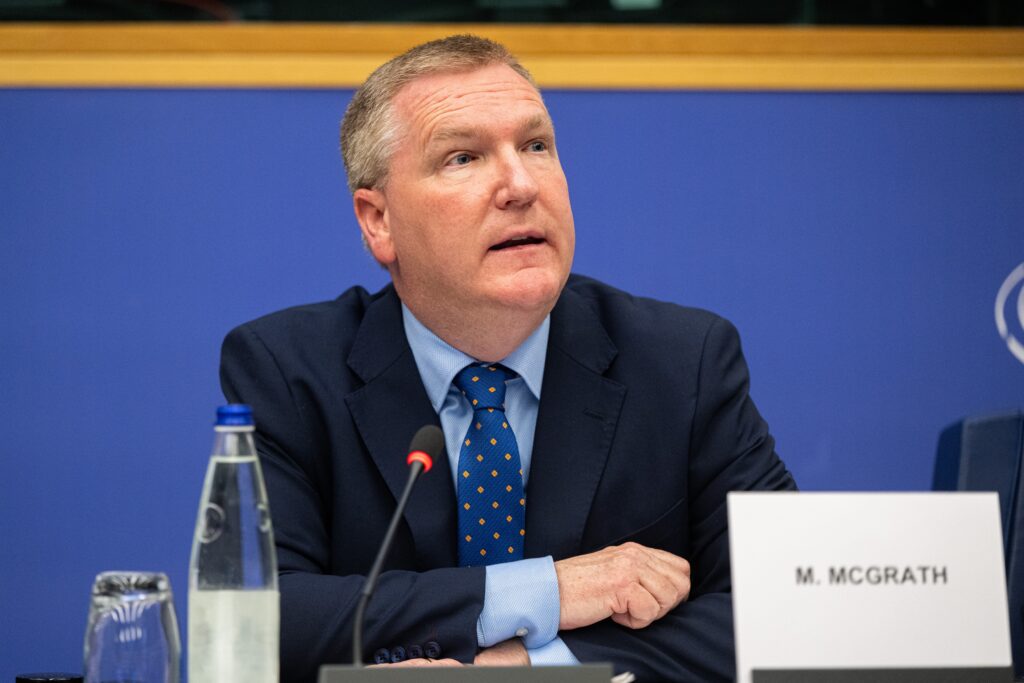

The European Commission believes Hungary’s blocking the €90bn Ukraine loan after it had consented to it constitutes a good reason to proceed with Article 7 of the Treaty of the European Union, Commissioner Michael McGrath said on Tuesday. The process could take away voting rights away from Hungary.
Hungarian policy pörkölt finds few friends in Brussels. European Commissioner for Democracy, Justice, the Rule of Law, and Consumer Protection Michael McGrath divulged as much, in more diplomatic terms, to reporters on 24 February. The press briefing took place after the General Affairs Council signed off two of the three laws that unlock a €90 billion loan for Ukraine. But Hungary still threatened to stop the money. Journalists asked whether “it was time to strip Budapest of its EU voting rights“.
“We believe that the original basis of the triggering of Article 7 by the Parliament back in 2018 remains valid and therefore the process should continue. But the question of whether or not to take a next step and to conclude on Article 7, as you know, requires a four-fifths majority is at the discretion of the member states,” the Irish commissioner. His unassuming presence took nothing away from the gravity of the announcement.
Disappointed? An understatement
“To say we are disappointed at the current juncture would be an understatement, particularly given the sensitivity of this day marking the fourth anniversary of the full-scale Russian invasion of Ukraine,” Mr McGrath continued. “We expect all leaders within the European Union to honour the commitments that they have made and the position here is clear.”
“The European Council agreed to a loan support package for Ukraine under the only condition that three member states will not participate financially in the programme. And as everybody knows, this condition has been met,” he added. “And we do believe that not respecting and honouring commitments is indeed tantamount to a breach of loyal cooperation,” the commisisoner cited the legal wording of Budapest’s perceived misconduct.
You might be interested

The commissioner acknowledged that the potentially explosive decision lies with the Council, not the Commission. Nevertheless, Hungary’s behaviour made Article 7 the unavoidable topic. “Article 7 is a live process. It is to preserve of the Council,” Mr McGrath said. “There have been a number of Article 7 discussions even in this current mandate over the last 15 months.” He reminded capitals why the file remains open.
A live process
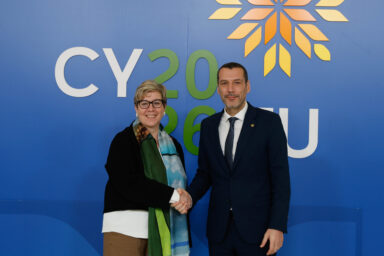
Deputy Minister for European Affairs of Cyprus Marilena Raouna, chairing Council business, set out what had already moved. “As Commissioner reiterated, back in December at the European Council, there was an agreement reached by the leaders,” she recalled. “This was an agreement that was reached by consensus.”
Cyprus then raced to translate that promise into law. “And following that, the Cyprus Presidency took work forward as a matter of urgency, delivering on all three legislative proposals that were submitted by the Commission.”
“In particular, on the 4 of February, at core upper level, the Council agreed its position unanimously on the basis of these proposals, which was in fact no small feat, given that this was a very delicate balance that had to be struck,” Ms Raouna said.
Step by step
Parliament moved just as briskly. “And then, of course, on the 11 of February, the Parliament adopted the package in a swift manner, and we very much thank the Parliament and the Commission for the excellent cooperation on this.”
“The General Affairs Council, as I mentioned, adopted as non-discussion items today the regulations on the Ukraine support loan and the facility, as was planned,” she noted. “And I think it’s also, while of course there is frustration, it’s also important to note that these are significant steps which bring us closer to the aim of the first tranches of support to be dispersed to Ukraine by April.”
We do believe that not respecting and honouring commitments is indeed tantamount to a breach of loyal cooperation. — Michael McGrath, EU Commissioner for democracy and the rule of law
Ms Raouna said work on the last piece continues. “We continue working on the third element that would allow the financing to move forward in line with this timeline.” She promised persistence. “As Presidency, we will continue our engagement with institutions, with all member states, with the aim of adopting all three regulations.” She underlined the schedule. “I repeat, in time for the disbursement to Ukraine to take place.” And she pledged neutrality. “And we will continue doing so in a constructive manner, as on as brokers.”
Clock ticking
Mr McGrath signalled that dialogue would run in parallel with pressure. “I think as Marilena has said, we have to continue to engage,” he stated. He pointed to earlier breakthroughs. “We have had difficult moments in the past over the last four years as we work together to support Ukraine achieving agreement on 19 packages of sanctions, achieving agreement through various instruments whereby the EU and member states have so far provided over €193bn to Ukraine, making us the largest and the most stable provider of financial support to Ukraine since the full-scale Russian invasion.”
“We’re not going to hide our unhappiness because we recognise this is a very sensitive moment marking the fourth anniversary of the full-scale invasion,” Mr McGrath warned. “The important thing is that we can find a way through this in time for Ukraine to benefit from the funding when it most needs it.”