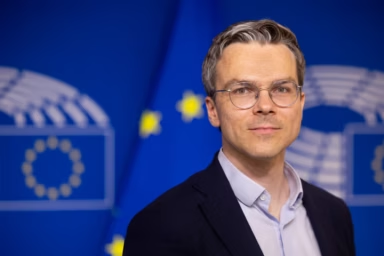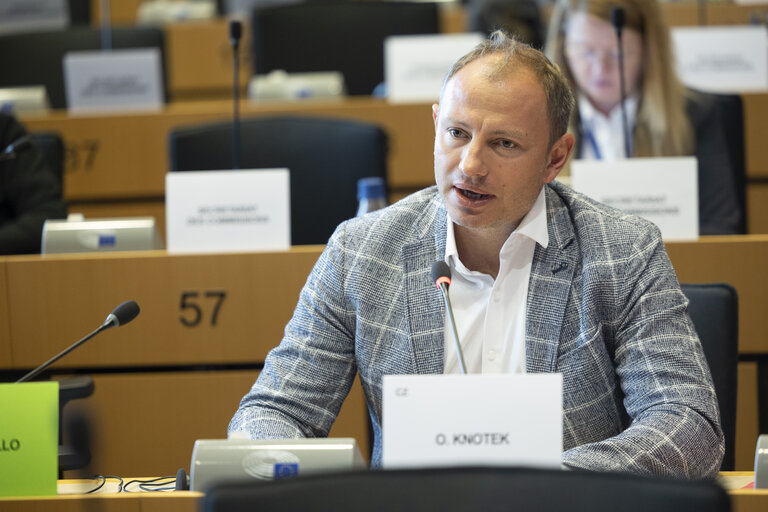

The EU’s climate legislation has already been revised and softened in the past, and this will continue to happen, says MEP Ondřej Knotek (PfE/CZE) in an interview with EU Perspectives. Regarding the Emissions Trading System for Transport and Buildings (ETS2), in Mr Knotek’s view it is essential that the price of carbon allowances remains at an acceptable level. The Union’s 2040 Climate Target will have a drastic impact on industry, MEP Knotek thinks
ETS2 has been postponed by twelve months to 2028. You consider it fundamentally flawed. Do you think it is realistic that the system will be further softened or completely abolished?
It is possible, but it depends very much on time. Every month plays a big role. During the negotiations on the Climate Law, this compromise was reached, i.e., a one-year postponement. In my opinion, even a one-year postponement is good; it is good news, for example, for the Italian and Polish governments, where elections will be held in 2027. This was also the main reason why agreement was finally reached on the 2040 Climate Target.
My colleague MEP Danuše Nerudová is the rapporteur for the so-called Market Reserve, and it is possible to make adjustments there that would allow more emission allowances to be transferred from the reserve to the system in the early years, thereby counteracting pressure on prices. However, there are certain limitations, such as a maximum of 600 million allowances in the ETS2 system. What may happen is that the Reserve would be exhausted in 2029 and 2030, and not much would be left for the coming years. That say, carbon allowances prices could rise sharply.
The year 2029 will decide on ETS2
Looking at the balance of power in the Parliament and the Council, however, there does not seem to be any will to fundamentally amend ETS2…
Not now. But that may change over time, and European Parliament elections will be held in 2029. I expect that the factions that are, let us say, more economically realistic, such as Patriots for Europe (PfE) and European Conservatives and Reformists (ECR), will gain strength. After the previous European Parliament elections (2024) there was greater willingness to revise certain green targets. I expect even greater shift in 2029. By 2029, the price of ETS2 may already be so high that it could significantly influence election results in a number of member states.
How do you view the possible capping of ETS2 allowances? Some politicians keep calling for that. Do you think this is realistic?
Technically, it is realistic. Politically, however, it is more complicated. I believe that it will also become realistic over time. The first few years after the system is launched will be decisive. At present, there is a discussion on a maximum price of €45 per allowance. That could perhaps be achieved with the help of the aforementioned Reserve. However, no one can guarantee this at the moment.
Capping ETS2 allowances is technically realistic. Politically it is more complicated. – MEP Ondřej Knotek, Patriots for Europe
If these modest improvements fail, allowances will become a hot topic. Their high price would significantly increase the citizens’ cost of living. Petrol, heating, and more. Let us not forget that sooner or later there will be elections in all member states and politicians will simply have to deal with it. ETS2 may become a major election issue in many EU countries, as it happenned in Czechia before the last national elections (2025).
CBAM ’a poorly designed tool’
How do you view the Carbon Border Adjustment Mechanism (CBAM) at the EU’s borders, which entered into force on January 1, 2026? Is this a step in the right direction to protect European industry?
I wouldn’t talk about CBAM ’entering into force’ from January 1. CBAM has several major shortcomings. First, it only covers raw materials and semi-finished products. Let me give you an example: if someone imports steel into the EU, CBAM applies to it. But if someone imports, for example, an excavator bucket, i. e. a finished product, it is not subject to the CBAM system….
Commission wants to extend CBAM to finished products…
Discussions are ongoing, but it can not be confirmed yet. The main discussion is about how to mitigate CBAM. Another problem is that CBAM will theoretically protect the European market for raw materials (steel, fertilizers, glass), that is is true. But it obviously does not help European manufacturers who want to compete on the global market in third countries. Such companies compete, for example, with Indian or Chinese steelmakers, and European manufacturers will obviously be at a disadvantage because they will have to include the ETS price into their production costs. Rebates for exporters have been discussed, but it remains unresolved.
Many European companies operating in energy-intensive branches are currently reducing or curtailing production. – MEP Ondřej Knotek, Patriots for Europe
Many European companies operating in heavy and energy-intensive branches—steelmakers, fertilizer producers, glassmakers, and more—are currently reducing or curtailing production. Some have already closed down or postponed investments, including strategic sectors. If this goes on, there will be no other choice than to import such raw materials. CBAM surcharge will have to be paid for such imports, which will be reflected in the final price. That is, the whole thing will make life more expensive for ordinary people.
Another major problem is that it will be rather difficult to prove that the imported raw materials are of „green“ origin. How can you ensure that a raw material originating from India or China, for example, has been produced in an environmentally friendly manner?
Too easy to circumvent
What are these doubts based on?
On my own experience when I worked as a quality manager in a large industrial company. At one moment, we replaced our original raw material supplier with a cheaper one, a company from India. They presented all the necessary permits, certificates, and so on. But when we first started using their materials in real production, I had to stop the production line within half an hour because it was cracking.
So quality issues?
Yes. On some non-EU markets, there is a clear tendency to deal with European climate requirements by simply circumventing them. They create paperwork to make it appear to comply with European standards, but the reality may be quite different.
How do you intend to prove in a country like China, where, for example, three steel mills are built in one region, that the imported steel comes from the environmentally friendly one?
You might be interested
When you take all this into account, you realize that the whole CBAM is a poorly designed tool. I was constantly stressing this issue during my previous term, but I always heard responses such as „We are fighting to save the planet, and we must believe that it will work“.
How do you view the possibility of linking CBAM with the ETS system?
Positively, and I will give a specific example. Fertilizers are imported into the EU on a large scale, including from Russia. Unlike Russian gas, this does not bother anyone much, although I consider it a certain hypocrisy. And because farmers simply have to use fertilizers to grow crops, and more expensive imported fertilizers mean more expensive food, the Commission came up with the idea of at least temporarily exempting fertilizers from the CBAM system.
That is fine in my opinion, provided that European producers of the commodity in question would not pay ETS1 emission allowances. This could also be applied temporarily, for example in crisis situations, in strategic areas, and so on. However, the Commission has not yet given a clear opinion on this.
Accelerating Green Deal is wrong
You acted as parliamentary rapporteur of the interim 2040 Climate Target and you proposed to reject that target. Last week, however, the 2040 Climate Target has been approved by the European Parliament Plenary and it is going to be a mere formality in the Council. Do you intend to do anything else in this matter?
Yes, I proposed to reject the 2040 Climate Target outright. This is the type of legislation that can only make the situation worse. In my opinion, it is wrong to try to further accelerate the Green Deal. We already have two binding targets (the interim target for 2030 and climate neutrality in 2050, EUP) and we do not need another one.
However, rejecting the 2040 Climate Target as set by the Commission is not entirely rebellious, as some have interpreted it. Basically, I said that the Commission should come up with a better proposal at some other time—there is no binding requirement that the 2040 target must be set right now.
I hoped that it would be possible to gain majority support for what I considered to be a more constructive proposal, namely that we should not have any further interim targets at this stage. In addition to the Patriots for Europe, also European Conservatives and Reformists (ECR) and Europe of Sovereign Nations (ESN) factions agreed with this. However, we still needed to get the European People’s Party (EPP) to our side. There was a chance to persuade about half of their MEPs—as confirmed by the plenary vote you mentioned—but in the end of the day it did not work out.
I tried to negotiate a compromise proposal based on that we should start discussing the 2040 Target only in 2029, shortly before it becomes clear whether the 2030 target (to reduce greenhouse gas emissions by 55 percent compared to 1990, EUP) will be met. And only if it turns out that the 2030 target will be met (but not in such a way that factories would close or go bankrupt) should we continue the discussion. In the end, however, despite all my efforts, I did not gain enough support.
So you admit defeat…
I wouldn’t say that. Looking at many of the so-called green laws of recent years, such as the ban on the production of combustion engines from 2035, green reporting, or the ETS system we talked about, you can see that they are undergoing extensive revisions or are even being abolished. And I think that the amendment to the Climate Law in the form of adding a 2040 Climate Target will also be revised in two or three years.
The whole thing made sense in such a way that the Patriots of Europe showed unity and demonstrated that the faction can stand up for the interests of ordinary citizens. And thanks to that, we are growing stronger and will continue to do so. Even though we do not have enough votes yet to achieve a majority.
High tech industry may benefit
Time will tell. You really do not see anything positive in the 2040 Climate Target?
Based on studies predicting the impact of the 2040 Target on the economy and industry, the impact will be drastic. Really drastic, and we will all pay for it. But to be fair, yes, there are some small economic segments that will benefit from it. Certain high-tech industries and the like, for example. But that is just a tiny portion of the market. We have to look at the economy as a whole.
Technologically, it is possible to produce everything in a „green“ way, but the price is not competitive. – MEP Ondřej Knotek, Patriots for Europe
Technologically, it is certainly possible to produce everything in a „green“ way, but the price is not competitive at all.
You mentioned that you are glad that, at least, the final version of the 2040 Climate Target is slightly better than the Commission’s original proposal. By that, I assume you mean the so-called international carbon credits, i.e. the possibility to partially outsource emissions reductions to third countries. Do you agree with this principle?
I disagree and consider it a form of climate colonialism. It is the possibility of exporting 5 percent of emissions abroad. However, it can be interpreted in such a way that the domestic emissions reduction by 2040 is actually 85 percent. Many people perceive it this way. Even with 85 per cent reduction, however, the arithmetic does not work if we take it linearly between 2030 (55 percent) and 2050 (100 percent).
If I, as the rapporteur, had gone down this route, I might have achieved 84 percent through international credits. Maybe 83 percent. Still, I could not consider such a result as a victory. We, as Patriots of Europe, promised out voters that we would say a clear „no“ to such ideas. And that is what we did.