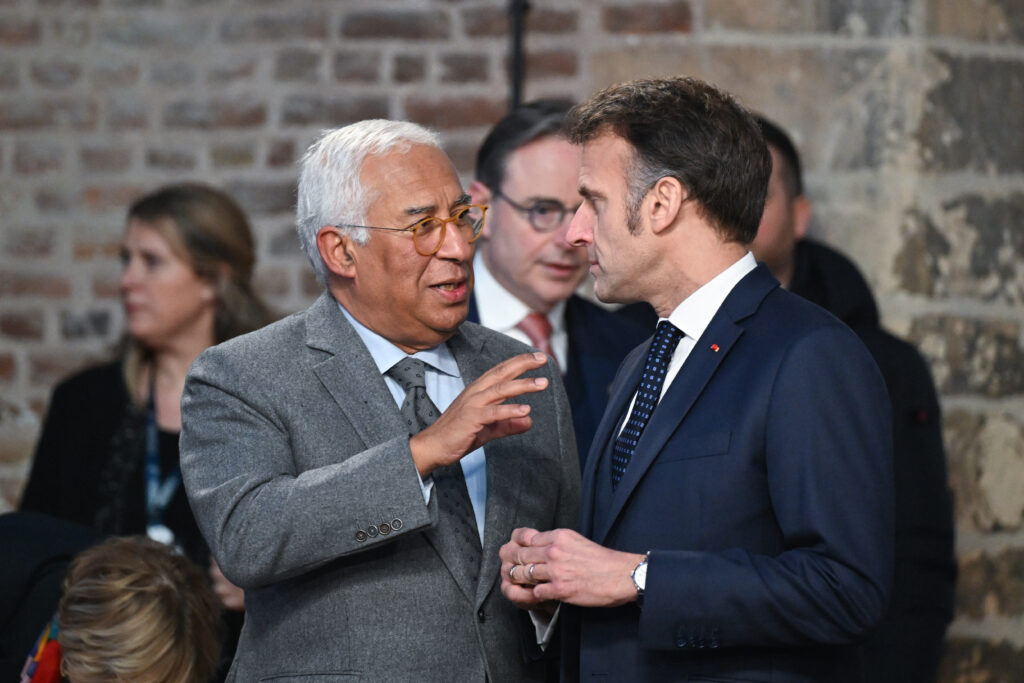

EU leaders met for an informal retreat in Belgium on Thursday, 12 February, to discuss how to boost competitiveness on the global stage. According to experts, the meeting signaled unity on at least one point: national capitals want to reclaim power from the Commission—and they agree that what should replace it is the ability to keep moving forward, even if they continue to disagree on how.
“We have a clear priority—to strengthen economic growth in Europe. This is essential for our prosperity, to create quality jobs, and to sustain our economic social model,” said European Council President António Costa in his statement after the event. A clear priority with no clear strategy.
The EUCO meeting marked a great divide among national leaders on the mechanisms they intend to put forward to make Europe more competitive. Whether Merz and Meloni, Macron, or Sánchez, where the visions differed, according to experts, all showed up with an intention to bring power back to the capitals.
Capitals push back against Commission power
“The capitals tried to strike back,” said Dimitar Lilkov, Senior Research Officer at the Wilfried Martens Centre for European Studies, after years of an increasingly centralized Commission.
Alberto Alemanno, Jean Monnet Professor in European Union Law at HEC Paris put it in more stark terms: “This is a power grab. What the Italian and the German government wants here, it’s a hidden agenda. They want to seize the opportunity provided by the geopolitical transformations to reclaim power over the European machinery.”
You might be interested
According to Alemanno, Italy and Germany arrived with four proposals that would fundamentally restructure EU decision-making in favor of their respective national power: an “emergency brake” allowing member states to block Commission proposals, rights to withdraw legislation already under negotiation, controls over parliamentary amendments, and mandatory reporting on administrative burdens. A transformative agenda that “is extremely revolutionary,” Professor Alemanno argues: “This is a de facto rewriting of the treaties without saying so,” he said.
Such pressure led to Commission President von der Leyen together with Council President Costa to push back and attribute internal market fragmentation at the feet of national leaders, not the EU. Alemanno sees this as von der Leyen partially reclaiming her role as Commission President rather than “the Secretariat of the European Council—with which the European Commission has de facto become,” he said.
Merz-Meloni and deregulation
President Costa reported after the event of “unanimous agreement among EU leaders to continue to push ahead with the EU’s ambitious simplification agenda.” The deregulation push, led by Germany’s Friedrich Merz and Italy’s Giorgia Meloni, reflects widespread frustration.
“90 per cent of member states, even 100 per cent of member states agree we’re not on the right track,” Lilkov says. “Something is really, really wrong. And I think it’s kind of a wake-up call,” he described. Continuing, it is as “a knee jerk reaction to the previous mandate’s ethos, which was about how to regulate ourselves to grow.”
Scepticism
While the problem of growth is universally agreed upon, the deregulation rhetoric faces scepticism in its intentions and its execution. “When Italy and Germany talk about deregulating, they know this is going to create a strong reaction on the other side of the table,” says Judith Arnal, Associate Senior Research Fellow at Centre for European Policy Studies (CEPS) and Senior Research Fellow at the Elcano Royal Institute. “Using big words that are going to be divisive is not a good way forward,” she said.
Alberto Alemanno sees a more bleak political calculation behind the push: “Deregulation has become very fancy, also because it largely overlaps with the demand of the US administration when it comes to relaxed standards to allow market access to the EU. And finally, it’s a very easy slogan—so in a way, it’s also very populist to use.”
The scholar’s highlight of the connection to the US agenda is far from overblown. It is reported that Vice President JD Vance, one of the most senior conduits for US tech influence on US foreign policy wrote the forward for Meloni’s upcoming book, “Giorgia’s Vision,” set for release in late April.
But Ms Arnal argues the deregulation debate itself misses a fundamental problem: “Even if you simplify a lot of existing EU regulations, many times the problem that we have with EU regulation is how it’s the governance… if this is to be implemented by national competent authorities, you already get an unlevel playing field.”
Macron’s protectionist vision
French President Emmanuel Macron arrived with his own national agenda: economic protectionism. After the event, Costa in a statement reported “broad agreement” on a “proportional and targeted” European preference principle for “selected strategic sectors”—a partial backing of Macron’s “buy European” push.
As POLITICO’s correspondents reported, this represented “a wary truce between France and Germany in their age-old debate over whether protectionism or market forces should power Europe’s economic revival.”
But experts warn of risks. “If you go all in on buy European, you might make the whole process more expensive and more slow,” Lilkov cautions. “Given how closely integrated European companies are in global supply chains, this might backfire,” he said. More troubling, he continued “in many of these industries and supply chains, these are very well-established partnerships with the likes of Japan, South Korea. So instead of limiting the Chinese, we might actually find ourselves in trouble with some international allies.”
“I think there’s a clear risk of making them less competitive globally,” Arnal adds, though she acknowledges Costa’s case-by-case, detailed analysis approach is “probably a reasonable way forward.”
Sánchez preaching from the sidelines
Spain’s Pedro Sánchez who has gained clout in recent weeks for being “Europe’s political conscience” as Alemanno put it, came with his own affordability agenda, which in the end, left him isolated from the rest of the European leaders. He did not receive an invite to Merz and Meloni’s unofficial breakfast working group, prompting according to Euractiv “pointed off-the-record sniping between Madrid and Rome.”
His exclusion reflects growing isolation in his challenging of Europe’s present direction. “I actually think this signals how far away the Sánchez government right now is from the European mainstream on certain topics,” Lilkov says, pointing to Spain’s divergent positions on Ukraine, China, and migration. “Spain is on its own little island there in the Iberian Peninsula. This is kind of worrying, but it’s the state of play right now. Sánchez is kind of sidelined,” he said.
Yet Sánchez’s emphasis on affordability—making life better for everyday Europeans rather than just businesses—has strategic merit that is playing well to public audiences across Europe. “Politically speaking, that’s a very smart move,” Arnal argues. “If we keep on talking about businesses, about ease of doing business, then we will simply lose part of the population who are employees or other parts of the population, even the younger part of the population,” she said.
Draghi and Letta’s attempt to include them all
Former Italian Prime Minister Mario Draghi and Enrico Letta arrived with what appeared to be a comprehensive solution in an attempt to include all the visions on the table. Letta framed the stakes dramatically: “This retreat will show whether Europe can turn around and become truly united, fully mature and independent,” he told Politico.
Draghi, advocating for “pragmatic federalism,” discussed reducing single market barriers, energy costs, targeted European preference, and enhanced cooperation to move faster. Macron said at the event, “Europe needs a complete package. And financing for it. No taboos on Eurobonds.” Aiming for consensus by June either as the 27 or enhanced cooperation.
Leaders, with little specifics, agreed on moving forward with a “28th regime”—allowing companies to operate across borders under a single set of corporate rules rather than navigating 27 national systems.
But experts were underwhelmed. “It’s a great idea, of course, on paper. Who’s going to say no to less red tape?” Lilkov says. “But why hasn’t this been done in the last 20 years?” The answer is uncomfortable: “If we are actually so focused on a 28th regime, this means the institutions are basically surrendering that the whole single market proposal and harmonization doesn’t really work.”
An air of recognizing the faults in the workings of the EU was felt all around. Alemanno detected a tone shift in Draghi: “I found Draghi’s presentation significantly more cautious than his previous public statements. He was not clearly pleading for political integration. He was really landing on the ground and trying to find compromise.”
The opportunities, Alemanno notes, lie “where the Letta report is, hence the insistence on energy market, telecom market, and in particular, the integration of financial services.”
Consensus on disagreement: A two-speed Europe
The retreat’s concrete outcome was growing momentum behind enhanced cooperation—allowing smaller groups of countries to move forward without unanimity. Von der Leyen, Germany, France, Spain, Belgium, Denmark, and Ireland voiced support for Draghi’s two-speed Europe proposal.
“It can be a positive development and can codify or confirm things which are already happening in certain policy areas,” Lilkov says, particularly, he stressed, on defense. But he warns: “On energy, I fear that two-speed Europe is actually unwanted because when it comes to energy, we need more cooperation, integration and scale.”
Alemanno sees the momentum as an acceptance that the EU can’t and won’t achieve the structural changes to act united: “Enhanced cooperation is a fig leaf for showing that there is no agreement whatsoever, but there is an agreement to perhaps go ahead on certain specific issues.” What he is most concerned about is that “they dress enhanced cooperation up as a sort of expression of pragmatic federalism, as though pragmatism and federalism are not in tension when the federal institutions are precisely what’s being sidestepped,” he said.
“In a way, enhanced cooperation is really antithetical to what the Union should do these days, which is to come together on common political interests that are still today not clearly identified,” he argues. “It seems that each government is pursuing its own political agenda,” said Alemanno.
Leaders now have until June to translate competing visions into concrete proposals. They agree Europe needs to act. They agree national capitals should have more power in deciding how. What they cannot agree on is what comes next—leaving enhanced cooperation as the only consensus: permission to disagree, and move forward anyway.