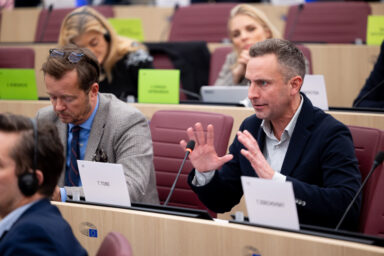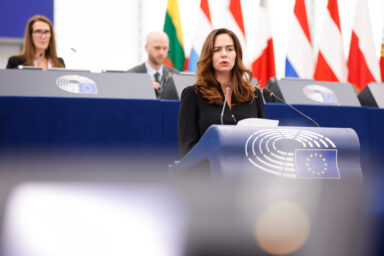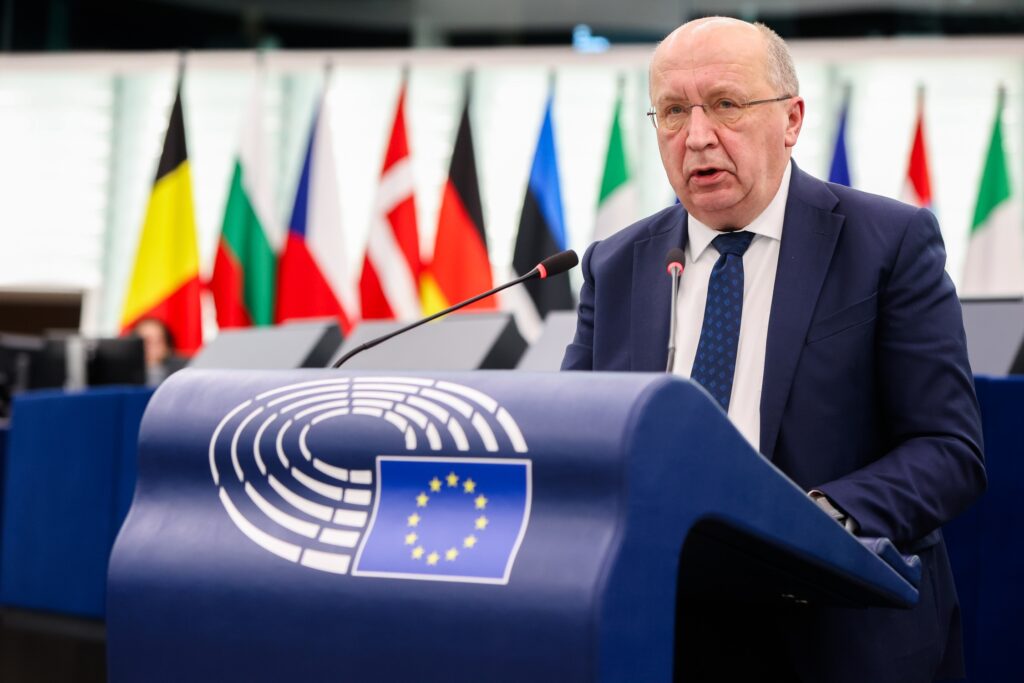

Commissioner Andrius Kubilius demands an industrial blitz—“produce, produce, produce”—while budgets, sovereignty and strategy remain unresolved. But most MEPs agreed in Strasbourg on 10 February that the clock is ticking louder than artillery today.
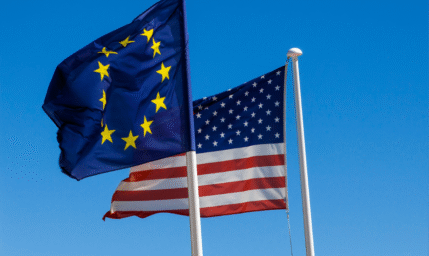
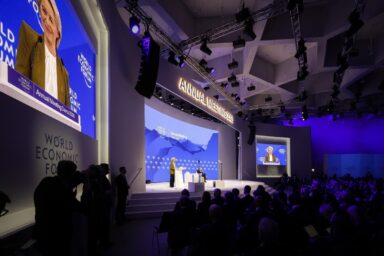
Mr Kubilius, the Union’s defence supremo, set the debate’s pace. “European responsibility does not mean without NATO,” he began, insisting that the alliance “is a foundation of our collective defence”. But he added a blunt caveat: Europe must be ready “to replace American strategic enablers with our own European ones”. His prescription was equally blunt. “Ramp up defence production…produce, produce, produce.”
Across the hemicycle heads nodded. Polls show voters now fret about fuel bills and fighter jets in equal measure. Mr Kubilius prodded industry and ministers alike. “Inform us if you experience delays in delivery,” he urged. And he dangled eye-watering numbers. Member states, he said, will “spend €6.8tn on defence by 2035 if they fulfil their NATO pledges”. Whether that promise survives peacetime politics is another matter.
Pressure, partners and production
MEP Nicolás Pascual de la Parte (EPP/ESP), a former diplomat, sketched the strategic bind. “We have to set up a credible deterrence against Russia…so far the transatlantic link with the US has been a relationship of dependency and it is not possible anymore.” Europe therefore needs “a single market for defence” and, eventually, “a European headquarters”. Mr Pascual de la Parte’s call for equality with Washington resonated across the floor.
MEP Yannis Maniatis (S&D/GRC) took up the autonomy theme. The Union must be “in a position to protect all of its citizens from Greenland, Finland and Estonia down to Greece and Cyprus”. That demanded “an autonomous, united and sovereign European defence”. The words reminded many that, for the first time since NATO’s birth, alliance planners are thinking seriously about an American absence.
You might be interested

MEP Jordan Bardella (PfE/FRA) tried to spike the federalist punch. War in Ukraine and the election of Donald Trump, he said, had revealed “your naivety when it comes to defence”. Yet he scorned talk of an EU army. Such a force “would mean the watering down of France’s sovereignty in a federalist project which our people reject.” His answer: a “European preference” in procurement and less “red tape of the Commission”.
Fragmented fire-power
MEP Reinis Pozņaks (ECR/LAT) steered the debate away from grand design to simple arithmetic. “Every manufacturing sector, every welding machine, soldering iron is part of [defence],” he said. Europe must remove “barriers that limit civilian industry’s contribution” and remember that independence in raw materials is illusory. If some inputs can only be found abroad, Europe needs partners, not just factories.
All EU countries must provide at least half a percent of their GDP in support of Ukraine. Everybody needs to contribute now. — MEP Heléne Fritzon (S&D/SWE)
MEP Nathalie Loiseau (Renew/FRA) scolded both nationalists and pacifists. “Russia doesn’t want peace in Europe or Ukraine…we can only be secure if we’re united,” she said, before lambasting those who claim that “by refusing to defend ourselves, we wouldn’t be attacked”. Her barbed aside that “the NATO secretary-general talked about dreamers” earned cheers from the centre and frowns elsewhere.
MEP Mārtiņš Staķis (Greens-EFA/LAT) said dependence on 80,000 American troops amounted to strategic charity. Europe needed “what I call F.U. defence—the ability to stand on its own”. His proposal: a 100,000-strong European rapid-reaction force, “fully aligned with NATO”. Not because the alliance was finished, he stressed, “but because we must be ready”.
Who pays, who profits?
MEP Marc Botenga (The Left/BEL) added class warfare to actual warfare. Military spending “has exploded, doubled” in a decade, yet Europe somehow “cannot defend ourselves”. He fulminated against dividends at Rheinmetall and “taxpayers’ money financing shareholders”, concluding that the union’s duty was “to deal with this, not to profit shareholders”.
MEP Hans Neuhoff (ESN/DEU) insisted that “a true common defence policy was never necessary because all relied on NATO”. If Brussels wanted to help, it should create “an alliance of states that are prepared to deliver”, separate from the EU’s institutions. Otherwise, he warned, defence would become “a much bigger task than protecting external borders”—and look how badly that had gone.
MEP David McAllister (EPP/DEU) preferred stick-to-it pragmatism. Tools such as PESCO, the European Defence Fund and SAFE “have put us in a stronger position”, he argued, but “now is the time to deliver on the promises”. Member states must “close their capability gaps, improve their coordination and significantly increase their defence investments”. Sunshine speeches, he said, are no longer enough.
The money mountain
MEP Sven Mikser (S&D/EST) reminded colleagues that “external threats…are not theoretical or hypothetical”. Alliances once allowed Europeans to “underspend on our own defence”. Those alliances “appear less reliable today”. The prescription: “operational autonomy” and “defence industrial sovereignty”—backed by hard cash from both national and EU budgets.
MEP Anna Bryłka (PfE/POL) bridled at the idea of Brussels taking “away yet more competencies”. Defence, she said, “cannot be the subject matter of experiments such as a common European army”. Funds “cannot be blocked for ideological or political reasons”, a sideways swipe at frozen Hungarian dossiers. Her bottom line: every government must meet “the planned commitment of 5% of GDP”, a figure far above NATO’s own two per cent guideline.
We have to set up a credible deterrence against Russia…so far the transatlantic link with the US has been a relationship of dependency and it is not possible anymore. — MEP Nicolás Pascual de la Parte (EPP/ESP)
MEP Michał Dworczyk (ECR/POL) echoed the caution. Talk of an EU army, he said, “is something very dangerous due to duplication of structures with NATO and undermining security structures which is crucial for countries of my region”. Easterners want American armour on their soil now, not theoretical brigades in twenty years.
Capability gaps, decision traps
MEP Marie-Agnes Strack-Zimmermann (Renew/DEU) returned to first principles. Ukrainians “don’t want to be praised because of their courage…they want support”. Europe therefore “must be faster together, more coordinated” and ignore “the nationalists”. Her demand: “a security-relevant defence single market” that makes the union “independent, in particular, from the US”.
MEP Reinier van Lanschot (Greens-EFA/NLD) ridiculed sceptics. “Keep dreaming, Mark Rutte said, if you think Europe can ever defend itself without the US,” he recalled. Yet centuries ago seven Dutch provinces “created the Dutch army”. Call it “the European soldier sorority for all I care, as long as we get it done.”
MEP Petras Gražulis (ESN/LTU) offered a ledger of shame. Only five member states, he said, spend more than five per cent of GDP on defence; eleven hover at two per cent. “It is highly difficult to wake up a giant,” he sighed, “and Europe lacks solidarity.” The union, he hinted, risks lecturing America while doing “even less”.
Keep calm and standardise
MEP Salvatore De Meo (EPP/ITA) warned that war is now “hybrid…striking at data and essential communication services”. Defence must include “investing in security, in protecting our systems”. MEP Tonino Picula (S&D/HRV) saw a lesson in waning American aid to Kyiv. “Regardless of the outcome of the upcoming US midterm elections, we must anticipate future developments in transatlantic relations and plan accordingly.”
MEP Pierre-Romain Thionnet (PfE/FRA) argued that “the structures and the capacities won’t be enough if they are not put at the service of a conceptual service”. Europe, he implied, needs ideas as well as kit. MEP Alberico Gambino (ECR/ITA) urged “industrial programming for defence” and a “solid manufacturing basis” before anyone dreamt of federal armies.
Every manufacturing sector, every welding machine, soldering iron is part of defence. — MEP Reinis Pozņaks (ECR/LAT)
MEP Petras Auštrevičius (Renew/LTU) placed numbers above notions. If NATO’s European allies hit five per cent now, “we will have more than €1.2tn defence spending”. That money must be “spent wisely”. MEP Riho Terras (EPP/EST) agreed. Europe must “gain respect and not be laughable”. Endless institutional debates, he snarled, would not dig trenches.
Between Trump and Putin
MEP Alexandr Vondra (ECR/CZE) countered that only “a stronger part of NATO on the European soil” can answer Mr Trump’s rhetorical challenges. MEP Anna-Maja Henriksson (Renew/SUO) urged speed. “All member states have to do more. There is no time to lose.” MEP Juan Ignacio Zoido Álvarez (EPP/ESP) shifted the focus to space and cyberspace. Russia, he warned, had already “intercepted at least 12 European satellites” and mounted “mass cyber-attacks”. Cybersecurity “has to be our first line of defence.”
MEP Tobias Cremer (S&D/DEU) offered a ledger of waste. Fragmented procurement means Europeans “are paying 30 per cent too high prices” even as families struggle with inflation. “Europe deserves better,” he said, calling for “maximum security at maximum value for money”. MEP Petra Steger (PfE/AUT) dismissed the entire project as “a burden for the European citizens” and “a power rush” in Brussels.
MEP Nicolas Bay (ECR/FRA) said any serious defence must “respect…the continent, fight drug trafficking, terrorists, cyber security, and protect critical infrastructure”. MEP Engin Eroglu (Renew/DEU) said reforming the internal market for arms is indispensable: “member states have to understand that we have to have a modern defence system.”
Choices and consequences
MEP Željana Zovko (EPP/HRV) linked defence to enlargement. Europe must prove it can protect its borders before promising them to others. MEP José Cepeda (S&D/ESP) asked the hardest question: “If tomorrow there weren’t to be a threat but an actual attack on European soil, who would respond and how?”
His fellow Spaniard MEP Jorge Buxadé Villalba (PfE/ESP) dismissed Brussels’ ambitions. “The European Union has never been, cannot be, should never be a military alliance. That’s why we have NATO.” MEP Beata Szydło (ECR/POL) preferred action to argument: “We have to act now…and start by protecting and defending the eastern flank.”
Europe must be ready to replace American strategic enablers with our own European ones. — Andrius Kubilius, EU defence commissioner
MEP Christophe Gomart (EPP/FRA), once head of French military intelligence, delivered the industrial punch-line. “How can we build a credible European defence if we turn our back on our own defence industry?” America sometimes “delivers less quickly. Sometimes they don’t deliver at all.” Europe, he claimed, could field kit in three years if only it tried.
Wake the giant
MEP Heléne Fritzon (S&D/SWE) rejected any deal over Ukraine that trades territory for peace. “All EU countries [must] provide at least half a percent of their GDP in support of Ukraine…everybody needs to contribute now.” MEP Claudiu-Richard Târziu (ECR/ROU) added local perspective. The eastern flank wants “no…transfers of sovereignty” yet also insists that common plans “be complementary to NATO”. MEP Marta Wcisło (EPP/POL) reminded colleagues of Russian cyber-sabotage. Real deterrence, she said, begins with resilience at home. MEP Vasile Dîncu (S&D/ROU) summed up: Europe must “invest in our defence and increase military readiness”.
In closing Mr Kubilius returned to Jean Monnet’s dictum that Europe is “born out of crisis”. The union, he conceded, “is also a giant, but a sleeping giant”. The task is simple to state, hard to execute: “Let us together wake up the sleeping giant of Europe.” Parliament applauded, the gavel fell and members scurried to other business.
Whether the giant opens its eyes before Moscow next rolls the dice—or Washington next shrugs—is the €6.8 trn question. Europe now knows what it must do. It must decide whether to do it.