
European leaders have repeatedly declared their ambition to field an EU-level force capable of conducting high-intensity operations of up to 100,000 troops by the early 2030s. Apart from other obstacles, four mutually reinforcing technical pillars—communications, logistics, training, and advanced technology—still contain stubborn gaps.
Russia’s full-scale invasion of Ukraine has generated an enormous empirical data-set on modern war, proving that these pillars determine operational success or failure. Yet European military structures remain technically fragmented and depend heavily on American strategic enablers. The gaps must be closed if the force is to be more than a political slogan, and if it is to remain credible from the Donbas to Greenland.
The first pillar, secure and interoperable communications, suffers from profound legacy fragmentation. Twenty-seven armies still rely on a patchwork of national radios, crypto devices, and Battlefield Management Systems that are only partially compatible with NATO’s Link-16 backbone. The ominous-sounding term denotes a tactical data link system, providing the Alliance with a secure, high-speed, and jam-resistant network that enables military aircraft, ships, and ground forces to exchange real-time tactical information. It acts as the primary, standardised digital communication channel for sharing situational awareness, surveillance data, weapons coordination, and air control information across diverse, multinational platforms.
Speed matters
During recent German-Dutch exercises, separate crypto and frequency plans had to be uploaded for every battalion handover. This process added hours to time-critical fire-support requests. Tom Dyson, a British researcher, notes for the Journal of Transatlantic Studies that organisational learning at tactical and operational levels is vital for the capacity of NATO and its member states to cope with contemporary security challenges.
The technical cost of this fragmentation is felt most acutely at the ‘edge‘ of the battlefield. In Ukraine, NATO radios must bridge to remaining Soviet-era equipment until re-equipping is complete. This requires translator gateways and fast crypto-release procedures to ensure that intelligence and fire-orders move faster than the enemy can react.
You might be interested
The geography of the high north adds further difficulty. Above 70° N, geostationary satellite communications have poor look-angles. The force needs dual-constellation low-earth-orbit terminals and fibre access via new seabed cables planned for Greenland. Europe currently lacks its own resilient, high-capacity military satellite constellation.
Signals in the snow
Electronic-warfare attrition on both sides of the Ukrainian frontline demonstrated that unencrypted legacy radios are rapidly geolocated and jammed. To counter this, the European Secure Software-Defined Radio (ESSOR) programme is delivering a common wide-band waveform and software architecture. Nine member states are already equipping pilot units.
The 2025–27 European Defence Fund (EDF) work-programme funds a pan-European command-and-control suite. This system includes next-generation information distribution with low-probability-of-intercept features. Such technology is crucial against Russian electronic-warfare jamming in Ukraine and the Arctic.
The ideal of a ‘military Schengen zone’ remains far off, with border crossings requiring up to a month’s notice and non-standardised rail systems forcing engine changes at every border. — The Atlantic Council
The second pillar, logistics and mobility, remains equally neglected after decades of peace-time complacency. Europe’s military mobility infrastructure shows the effects of 30 years of underinvestment since the cold war. Bridge operations, rail transport, and air defence are unprepared for moving heavy armour to the front lines.
The Atlantic Council, a think-tank, reports that “the ideal of a ‘military Schengen zone’ remains far off, with border crossings requiring up to a month’s notice and non-standardised rail systems forcing engine changes at every border.” Rail gauges, bridge load limits and border paperwork can still delay an armoured brigade by five to seven days.
Moving the metal
The Council’s Military-Mobility Action Plan demands clearances within three days, but average times remain above ten days. Technical mismatches are common. The rail loading-gauge P400 is too small for Leopard 2 or Challenger 3 tanks. The Atlantic Council further observes that “ground military mobility relies on five core capabilities: road transportation, road traffic management, bridge operations, railroad operations, and air defence.”
These essential capabilities were gradually scaled back. The overall performance levels of the largest European armies in logistics have become insufficient, especially in the ratio of available vehicle-launched bridges for wet-gap crossings.
Contested logistics lessons from Ukraine are now driving EU sustainment doctrine updates. These focus on signature control, drone threats, dispersed ammunition dumps, and disciplined movement. In the Arctic, port infrastructure north of the Arctic Circle is sparse. Denmark plans a dual-use deep-water pier at Nuuk, but ice-strengthened roll-on/roll-off capacity is still insufficient.
Strategic enablers are also missing. Europe still leases most heavy air-lift. The majority of NATO’s strategic airlift capacity comes from the American Air Force. European allies remain reliant on these assets, especially for oversized cargo.
Hollowed out
The European Policy Centre notes that “European armed forces had shrunk to their smallest since the 19th century. Stocks of munitions were as low as three days’ wartime usage in major allies such as Germany.” This hollowed-out state means that even if the infrastructure were perfect, there would be little to move.
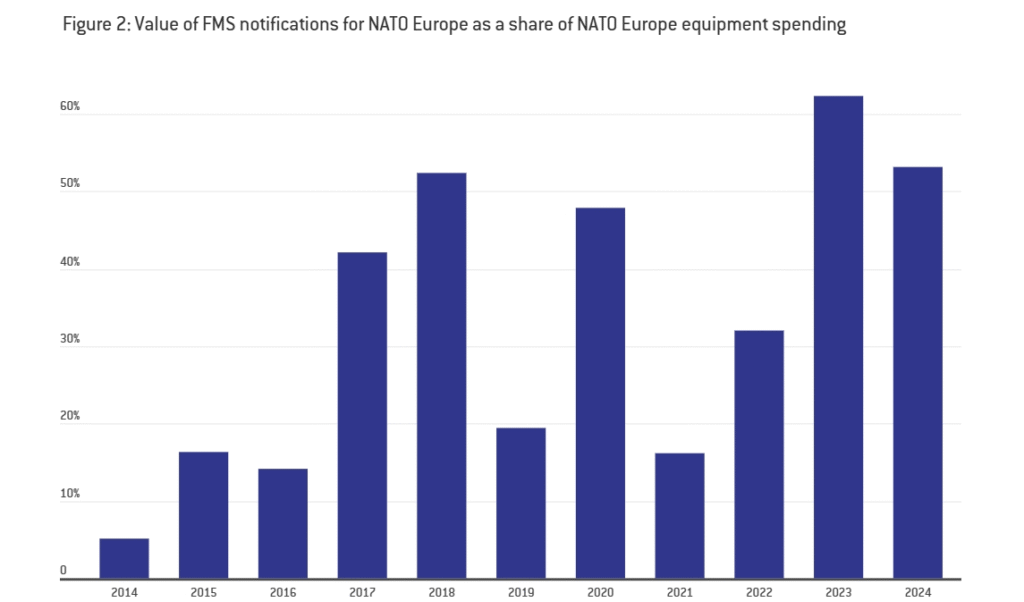
Many warships, helicopters, tanks and vehicles are currently out of action or requiring lengthy refurbishment. Road, rail, and port infrastructure is no longer fit to handle a military mobilisation on the scale required to deter a peer adversary like Russia.
The third pillar is multinational training and doctrine. Existing integration models, such as the Dutch 11 Airmobile Brigade under German command since 2014, demonstrate that plug-and-play subordinate units work. Success depends on enforcing common digital fires procedures and English language standards.
However, persistent hurdles remain. Different national rules of engagement, medical certification, and clearance procedures consumed up to 40 per cent of preparation time for recent EU Battlegroup rotations. This administrative friction is as deadly as a lack of ammunition.
Curricula and combat
A report by the European External Action Service highlights the difficulty of establishing a Rapid Deployment Capacity (RDC). Member states must commit capabilities through a comprehensive database, although challenges remain in fully committing forces.
Russia’s defence industry is expected to outproduce Europe’s in the coming years. — Danish Defence Intelligence Service
Ton van Osch, a retired Lieutenant General of the Royal Netherlands Army who served as the Director General of the European Union Military Staff (EUMS) from 2010 to 2013, wrote an article titled EU RDC on Track While Geopolitics Develop Fast for the European Union External Action Service (EEAS) Military Forum. He asserts that the concept must remain adaptable to diverse scenarios and possibly increase the envisioned force size to effectively cover various threats. A common EU warfighting curriculum at the tactical level is now required. This must align to NATO standards to ensure that an EU force can slot into a larger alliance structure.
Effective training requires standardisation that goes beyond the superficial. The European Policy Centre notes that “despite the existence of voluntary NATO standardisation agreements (STANAGs) for equipment and ammunition, the war in Ukraine exposed widespread divergence in the implementation by European allies of those technical standards.”
This divergence complicates logistics for Kyiv and would do the same for a joint EU force. Mr Dyson finds that routinised practitioner behaviours significantly enable or hinder the effectiveness of formal lessons-learned processes. NATO recognises that improving alliance-wide interoperability requires more than initial formal adoption.
High-end headaches
Training must also move into the digital age. Expansion of live-virtual-constructive (LVC) networks would allow Ukrainian and Arctic scenarios to be trained simultaneously from national simulators. This is essential for a force that must be ready for two very different theatres.
Ukraine shows that units must fight under constant electronic warfare, cyber and precision-strike pressure. Western exercises rarely replicate this environment. Without instrumented ranges for live drone-versus-jamming events, European troops will enter the next conflict with a disadvantage.
The final pillar is advanced technology. Intelligence, surveillance, reconnaissance (ISR), air and missile defence, and long-range fires remain the costliest deficits. Bruegel, a Brussels-based think-tank, estimates that Europe must add the equivalent combat power of 50 armoured brigades to replace American enablers in a high-end fight.
The Russian army and general staff now possess invaluable battlefield experience unmatched by any other military, except Ukraine‘s. Bruegel points out that “the combat power of 300,000 US troops is substantially greater than the equivalent number of European troops distributed over 29 national armies.”
The Donbas lessons
American troops come in large, cohesive, corps-sized units with a unified command and control tighter even than NATO joint command. They are backed by the full might of American strategic enablers, including strategic aviation and space assets, which European militaries lack.
Credible European deterrence would require a minimum of 1,400 tanks, 2,000 infantry fighting vehicles, and 700 artillery pieces. This is more combat power than currently exists in the French, German, Italian, and British land forces combined. Providing these forces with sufficient munitions is the next technical mountain to climb.
EU defence industries are hollowed out and fragmented after three decades of underinvestment, with limited output potential and little spare capacity. — European Policy Centre
Drone-saturated battlescapes are the new reality, as are counter-drone swarms and AI-enabled sensor fusion. These reflect lessons from the Donbas front lines. Arctic-ready equipment is another gap. Extreme-cold batteries, ice-rated lubricants, and snow-resilient drones are not yet in standard EU inventories.
The Danish Defence Intelligence Service warns in its Intelligence Outlook 2025 (Arctic security) that permafrost degradation will increase maintenance cycles by up to 30 per cent. Russia’s military build-up focuses especially on ships and missiles capable of challenging Western sea and air supremacy in the high north.
The road to 2036
Denmark’s spies further warn that “Russia’s defence industry is expected to outproduce Europe’s in the coming years.” To counter this, a recommended roadmap for the next decade has been established.
In the first two years, the EU must mandate ESSOR waveforms as the default tactical standard. It must also fast-track bridge upgrades on priority corridors like Suwałki-Odessa. A permanent Arctic logistics cell should be established within the EU Military Planning and Conduct Capability (MPCC) to manage the unique requirements of the high north.
Between 2028 and 2030, the goal is to field an initial ‘Euro Division’ of 20,000 troops with a common command suite. This phase should complete rail-gauge upgrades and move to a three-day clearance reality. Bi-annual large-scale exercises should alternate between eastern-front and Greenland scenarios.
This allows for the testing of the “plug-and-play” concept in real-world conditions. By the early 2030s, the force should scale to its 100,000-strong modular target. This requires achieving 80 per cent commonality in soldier radios, battle-management software, and counter-drone kits.
The Arctic frontier
Special integration considerations remain for Ukraine and Greenland. For Ukraine, rapid ammunition interchangeability between 152mm and 155mm shells is a top priority. For Greenland, the EU force must include maritime patrol detachments with long-range drones and pre-positioned cold-weather gear at Thule. Gabriella Gricius, in a report for the Centre for Strategic and International Studies (CSIS), argues that military exercises in the European Arctic serve as a means for stability and predictability. They allow states to demonstrate capabilities and maintain deterrence without escalating to conflict.
Elizabeth Buchanan, a prominent expert on Arctic and Antarctic geopolitics and a senior fellow at the Australian Strategic Policy Institute, explores the implications of American interest in Greenland, presenting scenarios ranging from independence to de facto annexation. This underscores the need for European strategic autonomy in the region.
The Atlantic Council emphasises that “Europe’s military mobility infrastructure is showing the effects of 30 years of underinvestment since the Cold War, with bridge operations, rail transport, and air defence unprepared for moving NATO troops to the front lines.” Closing this gap is not just a military necessity but a political one.
European-scale procurement will be crucial to achieve military production at lower costs. — Bruegel
The European Policy Centre suggests that “EU defence industries are hollowed out and fragmented after three decades of underinvestment, with limited output potential and little spare capacity.” They often use bespoke production methods and a cost-plus pricing system designed to serve a single government customer.
A bigger bang
The industrial fragmentation is the ultimate technical blocker. Without a unified industrial base, the 100,000-strong force will remain a collection of incompatible machines. A ‘big bang’ in capabilities is feasible only if Europeans spend their budgets in a smarter, more collaborative way.
Building this joint force is less about raising additional battalions—Europe already fields 1.47m soldiers—and more about knitting them into a single, agile organism. Addressing the concrete communication, logistics, training, and technology deficits is the decisive step from rhetoric to reality.
The track record of European arms cooperation is mixed, with successes like the Eurofighter consortium often offset by delays in programmes like the A400M military transport. These inefficiencies can no longer be tolerated in the face of a rising Russian threat.
One of the most stubborn technical blockers is the refusal of nations to share sensitive data, such as crypto keys or maintenance and repair data. This is often driven by sovereignty fears. To mitigate this by 2036, a decision on “tiered sovereignty” is needed. This would allow for national control of fire-orders while sharing control of ISR and communication relays.
Sovereignty and software
Fragmented command and control must be replaced by a federated mission network with common data ontologies. Industrial duplication, where Europe produces 20 different drone programmes and three different tanks, must be adjudicated by a central board.
If the roadmap is followed, these measures would close the most dangerous gaps. They would allow Europe to deter high-end threats even under a reduced American footprint. The Danish Defence Intelligence Service notes that China and the United States are competing to lead in technological fields like artificial intelligence.
Europe cannot afford to fall behind in these dual-use technologies. Quantum technologies, which China is developing, could eventually enable secure communication and break existing encryptions within the next 10-15 years. This adds a ticking clock to Europe’s communication modernisation.
Who are you to lecture me? — US Senator Lindsey Graham to European lawmakers
The war in Ukraine is a warning shot. Communications, logistics, training and advanced technology are indivisible pillars. Europe already possesses the industrial and scientific capacity to stand them up on its own.
Openly contemptuous
What is missing is unified technical governance and sustained investment at scale. A focused 10-year programme can transform today’s patchwork of national forces into a truly joint European military. It would ensure that the continent is no longer a collection of vulnerable parts, but a single, tech-enabled deterrent force capable of defending its interests from the Donbas to the deep Arctic.
Ultimately, the birth of a ‘military Schengen’ depends on whether technical integration can overcome national inertia. As Bruegel argues, “rapidly generating such increases requires an extraordinary effort. European-scale procurement will be crucial to achieve military production at lower costs.”
If Europe fails to bundle its orders and introduce competition, the 100,000-strong force will remain a paper tiger. But if the four pillars are secured, the rhetoric of European strategic autonomy will finally find its foundation in reality.
It is not a day too soon, as a bitter anecdote shows. Senator Lindsey Graham, a close ally of President Donald Trump, was openly contemptuous of Europe last week at the Munich security conference, Bloomberg reports. “Who are you to lecture me?” Mr Graham snapped when a European lawmaker quizzed him about (the lack of) US pressure on Russia. Europe must be able to to come up with a reply to such insults. Not only to put Mr Graham in his place, but simply to survive.