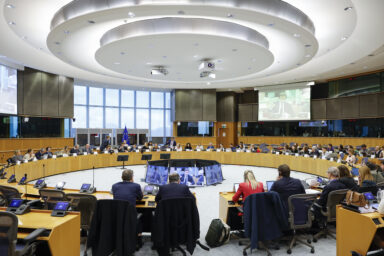

Europe’s research future took centre stage on Thursday, 26 February, as the European Parliament’s Committee on Industry, Research and Energy (ITRE) debated the direction of the programme due to follow Horizon Europe. Bringing together leaders from frontier science, industry, universities and EU policy, the hearing exposed a central tension shaping the next framework programme: Europe’s research system is strong — but is it funded and organised strongly enough? Not really, suggested one of the invited speakers.
Horizon Europe remains the European Union’s flagship research and innovation programme, supporting universities, research institutes, companies and cross-border partnerships across member states. The ambitious programme underpins everything from frontier science and industrial collaboration to research infrastructure and mobility schemes. At its core sits the European Research Council (ERC), widely regarded as one of the EU’s most successful funding instruments, backing investigator-driven research solely on the basis of scientific excellence.
Investment and global competition
Opening the discussion, Professor Maria Leptin, President of the European Research Council, framed the debate around scale and ambition. In her assessment, the Commission’s proposal for the next EU budget represents progress — but not enough. “The Commission’s proposal for the next MFF includes a substantial increase for the ERC. That matters. It signals that research and innovation are being taken seriously… But I need to say clearly that what’s on the table should be seen as a minimum, not as a final ambition.”
For Professor Leptin, the problem is not a lack of ideas but a shortage of sustained investment. The ERC, she explained, “consistently receives more proposals of excellent quality than it can fund… a significant share of projects that pass our highest scientific threshold remain unfunded simply because we don’t have the money… these aren’t just marginal proposals… they’re internationally competitive ideas that we simply can’t afford.”
The message was unmistakable: Europe’s research ecosystem is generating excellence, but budgetary constraints are limiting its potential impact.
You might be interested

[The European Research Council] consistently receives more proposals of excellent quality than it can fund… a significant share of projects that pass our highest scientific threshold remain unfunded simply because we don’t have the money… – Maria Leptin, President of the European Research Council
Professor Maria Leptin also challenged assumptions about Europe’s global position, pushing back on the idea that China still primarily imitates European innovation. As she put it, “That may have been true 15 or 20 years ago, but it is not true anymore… They’re not copying from us. We need to copy from them, if anything.”
From research to deployment
From the industrial side, Dr Miriam Storim, Head of Strategy and Technology Relations at Siemens, shifted the focus to deployment and speed. Europe, she suggested, must do more to ensure that research translates into tangible innovation. “Target industrial adoption… Are we really inventing something and do we put innovation here in Europe at the table?”
Her concern centred on the pace of funding processes compared to modern innovation cycles. “These are too many days between application and then the grant… innovation cycles are much shorter… we test something, we prototype it, we learn, we change and this is how innovation is happening now.” In fast-moving sectors such as digital technologies and AI, slow administrative timelines risk undermining competitiveness.
Please try to put more eggs in one basket and strengthen what you have. – Miriam Storim, Head of Strategy and Technology Relations at Siemens
Dr Storim also urged greater strategic focus, encouraging policymakers to concentrate resources rather than disperse them across multiple initiatives. Europe should “please try to put more eggs in one basket and strengthen what you have. Don’t get disturbed by too many different approaches and too many different headlines.”
The role of universities
The role of universities was highlighted by Dr Maria Indrikova, Vice-Rector for Research at Riga Technical University. She reminded Members that “As you can see… in Horizon Europe the largest share of funding is allocated precisely to research institutes and universities.” That distribution reflects the structural importance of higher education institutions within the European innovation ecosystem. Universities train talent, provide infrastructure, sustain long-term research and anchor regional development. Their work often lays the scientific foundations on which later industrial applications depend.
Professor Manuel Heitor, former Portuguese Minister for Science and a key figure in EU research policy evaluation, emphasised the importance of governance and coordination across funding levels, and the role of research and innovation in Europe’s long-term resilience. He argued that “this can only be done by aligning national, regional and European funding… and particularly accelerate research and innovation.”
Balancing competitiveness and societal research
The exchange also touched on widening participation across Member States, evaluation reform and the balance between competitiveness-driven funding and societal research. Concerns were raised that social sciences and humanities could be sidelined in a more geopolitically oriented programme. Professor Leptin responded that the ERC’s bottom-up model itself safeguards diversity, noting that “the mechanisms by which the ERC functions, namely bottom-up excellence only, is the best protection for all research areas… more than one third of our funding goes to the social sciences and humanities.”
Taken together, the ITRE debate made clear that Horizon Europe is far more than a funding scheme. It shapes Europe’s scientific capacity, industrial transformation, talent pipeline and global standing. The recurring question throughout the hearing was not whether Europe has the intellectual resources to lead — it clearly does — but whether it will match those strengths with sustained investment, faster processes, clearer prioritisation and protection of independent scientific governance.
As Parliament continues shaping its position on the next framework programme, one point from Thursday’s hearing stands out: Europe’s research system remains one of its greatest strategic assets. The unresolved issue is whether the 27-member union will fund and organise it at the scale required to compete in an increasingly demanding global environment.