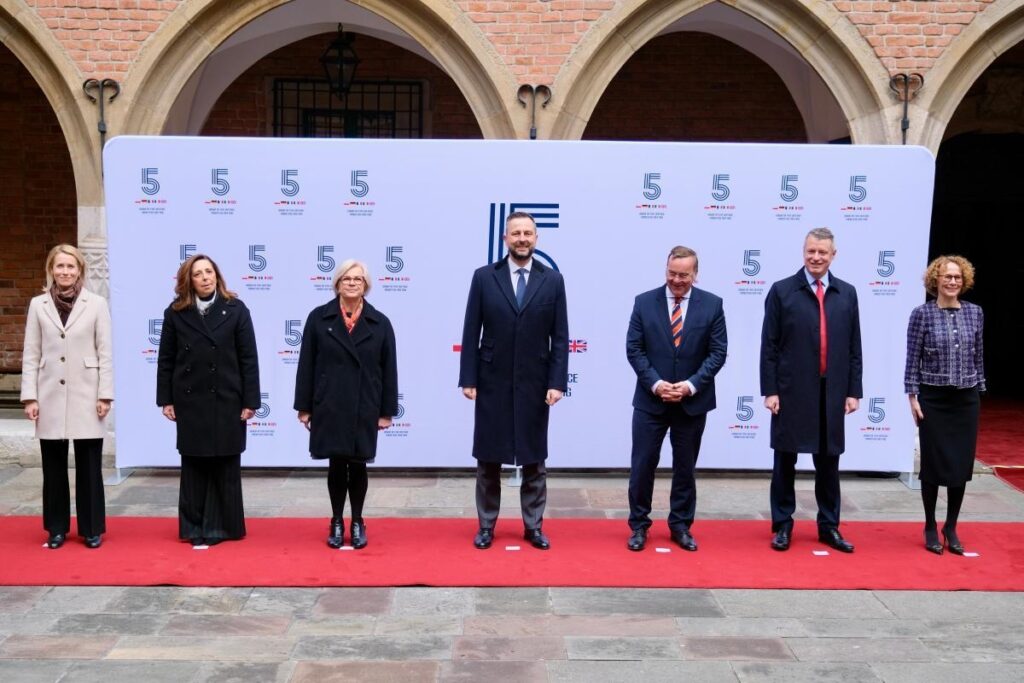

Meeting in Kraków, Europe’s five largest military powers signalled a structural shift in security policy — accelerating arms production, deepening intelligence cooperation and reinforcing deterrence while warning that NATO would respond collectively to any Russian aggression. France, Germany, Italy, Poland and the United Kingdom convened as the war in Ukraine entered its fourth year and as governments acknowledged that confrontation with Russia has become a long-term strategic reality.
The meeting underscored that Europe is moving from reactive crisis management to sustained defence preparedness. Central to that shift is industrial capacity. Ministers stressed that deterrence in modern warfare depends not only on troop numbers or political declarations, but on the ability to produce, replenish and innovate at scale — particularly in air defence, drones, counter-drone systems and long-range fires.
Industrial shift and defence responsibility
Poland’s defence minister, Władysław Kosiniak-Kamysz, framed the transformation as historic.
“So building independent defence sector in Europe, we couldn’t see anything like that for the last 30 years. That’s a great breakthrough that happens in Europe in terms of defence, in terms of responsibility for our territory…”
He emphasised that European states are now doing more than at any point since the Cold War and that responsibility for territorial defence must be matched by industrial and technological capability.
You might be interested
Germany’s defence minister Boris Pistorius placed the debate within the broader strategic confrontation with Moscow. He described Russia’s campaign in Ukraine as more than a traditional conflict and argued that sustained pressure and strengthened capabilities are the only path to deterrence.
Nuclear deterrence and alliance foundations
Addressing renewed discussion about European nuclear deterrence, Minister Pistorius was explicit about Germany’s position.
“The nuclear deterrence is achieved and is provided and will be provided by the United States at least for the foreseeable future.”
He made clear that Berlin remains legally bound not to acquire nuclear weapons and that Europe’s task is to strengthen its conventional capabilities within NATO.
“We have to take more responsibility in Europe for our conventional deterrence and defence, that is quite clear… but not in terms of nuclear participation, and I think it is quite clear.”
The message was twofold: Europe must build hard power, but the transatlantic nuclear umbrella remains intact.
Intelligence cooperation and capability development
Alongside nuclear reassurance, Mr Pistorius also floated deeper European intelligence cooperation, including the possibility of creating a European version of the Five Eyes intelligence-sharing framework. The proposal reflects a recognition that hybrid threats, cyber activity and information warfare require faster intelligence pooling and coordinated response mechanisms across European capitals.
The United Kingdom focused its contribution on operational capability and rapid technological development. Luke Pollard, the UK Minister for Defence Readiness and Industry, highlighted the LEAP initiative — the Low-Cost Effectors and Autonomous Platforms programme — aimed at delivering affordable surface-to-air weapons, counter-drone systems and autonomous defence platforms at speed and scale.
“It’s actions, not words, that will deter Putin.”
Minister Pollard described LEAP as the starting point for a broader series of collaborative initiatives.
“This is the very first step of what we hope will be a series of initiatives under LEAP to look at how we can have ground to air and other capabilities that pulls our collective experience.”
Ukraine at the centre of European strategy
The emphasis on low-cost, high-volume systems reflects a wider strategic shift. The war in Ukraine has demonstrated that scalable, adaptable technologies can alter battlefield dynamics faster than traditional procurement cycles. European defence planning is therefore pivoting towards speed, interoperability and industrial flexibility.
It’s actions, not words, that will deter Putin. — Luke Pollard, UK minister for Defence Readiness
Support for Ukraine remained a central pillar of the discussions. Ministers reiterated that Ukraine’s defence is inseparable from Europe’s own security. Continued military assistance, sanctions and political backing are viewed not as optional measures but as structural components of European deterrence.
EU High Representative Kaja Kallas reinforced the economic dimension of that strategy.
“Sanctions are working. They are severely hurting Russia’s economy, and each new measure further limits its ability to wage the war. Moscow is not invincible. Its army is suffering record casualties, and its economy is under heavy strain.”
She added that pressure must continue.
“But Putin won’t end this war until the costs are higher than the benefits, and that is the point we must reach.”
Her remarks underscored the link between military support and economic coercion as dual pillars of European strategy.
Resilience, readiness and the eastern flank
Another important theme was resilience. Participant discussed strengthening early warning systems, protecting infrastructure and improving societal preparedness. Modern conflict extends beyond conventional battlefields into energy networks, communications systems and information space, requiring a more integrated European response.
Poland placed its broader defence posture at the centre of the discussion, framing investments in drone systems, long-range fires and territorial defence as measures to protect NATO’s eastern flank and raise the cost of potential aggression. The underlying strategic logic is deterrence by denial — making any incursion prohibitively difficult.
Sanctions are working. They are severely hurting Russia’s economy… Moscow is not invincible.
— Kaja Kallas, EU high representative for foreign affairs and security policy
NATO reinforcement and collective resolve
Throughout the meeting, NATO’s collective defence commitment remained central. European capability-building was framed not as strategic autonomy from the United States, but as reinforcement of the alliance. Ministers repeatedly stressed that stronger European conventional forces enhance NATO’s credibility rather than dilute it.
Minister Pollard reinforced that message during the closing exchange as did Pistoirius:
“We will be able to defend ourselves and be sure about it.”
The closing exchanges captured the tone of resolve. When asked to quantify Europe’s readiness, ministers rejected numerical scoring in favour of political determination and alliance unity. The essential message was that deterrence rests on capability, cohesion and will, and that any aggression would be met collectively.
Rearmament with purpose
Taken together, the Kraków meeting signals a Europe that is rearming with intent, coordinating more tightly across industry and intelligence, and preparing for sustained strategic competition with Russia. Industrial resilience, conventional capability and alliance solidarity are now treated as interlocking elements of European security policy. While nuclear deterrence remains anchored in the United States, Europe is positioning itself to shoulder a greater share of conventional defence — and to respond collectively should aggression test NATO’s resolve.
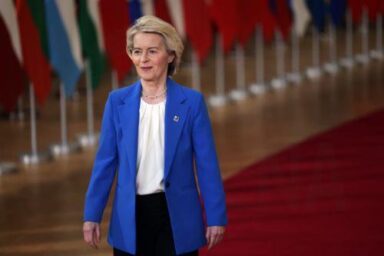
European Commission president Ursula von der Leyen will underscore that strategic shift next week when she travels to Kyiv to mark the fourth anniversary of Russia’s full-scale invasion, reinforcing that Ukraine remains at the centre of Europe’s security agenda.