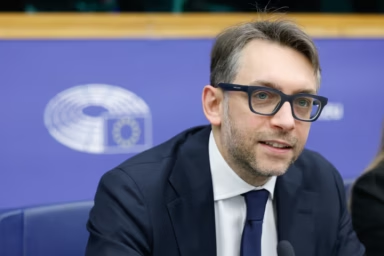

Against the backdrop of recent European Union sanctions targeting Iran’s Revolutionary Guard Corps and Iranian officials over the violent repression of protesters and human rights violations — and Iran’s retaliatory declaration labeling EU armies as “terrorist groups” — Michele Brunelli, Director of the MA in Prevention and Fight against Radicalization and Terrorism at the University of Bergamo, assesses the implications of this escalation.
He examines what these developments mean for Tehran, Brussels, and the wider region for EU Perspectives. In particular, Mr. Brunelli offers a detailed perspective on why Iran, historically a deeply revolutionary country, continues to experience waves of protests and social upheaval.
Was what is happening in Iran predictable?
Historically, I have always considered Iran a deeply revolutionary country. If we were to make a parallel with a European country, Iran is very similar to France, which has experienced a series of revolutions – not only in 1789, but also in 1830, 1848, the Three Glories of 1830, and so on. Iran is similar because, if we analyse its recent history, the 20th century in Iran begins in 1900 with the Constitutional Revolution and continues through a series of revolutions that are not easily categorised from a political science perspective.
For example, there was a top-down revolution in the 1930s under Mohammad Reza Khan, aimed at modernising customs and Westernising the country. Then, in the early 1950s, there was a nationalist-style revolution under Mossadegh. Another top-down revolution occurred with the White Revolution under Ahmad Reza, leading up to the 1978–79 revolution, which was an Iranian revolution, and then the Islamic revolution, the Islamisation of society, which began in 1980. By 1980, it was assumed that this phase of unrest and revolutions had ended. In reality, it hadn’t. Since then, I define these not as revolutions but as revolts – a kind of subterranean phenomenon, like rivers that sink out of sight but continue flowing underground.
They often resurface, and this is typical of Iranian society. Especially since 2000, there have been recurring protests and revolts, starting with the Green Wave during Mahmoud Ahmadinejad’s re-election campaign, and continuing through other protests, often violently suppressed. I witnessed both the moments just before the uprising and its aftermath. Since then, there were revolts in 2011, 2019, the Massa Minì protests of 2022, and the current ones.
You might be interested
This is not a new phenomenon. It is long-term and influenced by several factors. The first is economic: sanctions weighing on Iran, especially US sanctions, since the early revolutionary phase in 1979, when Iranians stormed the U.S. embassy in Taleghani Square. These sanctions have had a significant impact on the economy, making it a key factor. The second is lack of freedom and increasing repression, often crystallized around the symbol of the veil. It is important to remember that Iranian women are not against the veil itself, but against its imposition.
They are fighting for the freedom to choose, not to abolish it. The veil is a symbol of freedom for women; for the Islamic Republic, it is one of the ideological pillars of the revolution. The latest revolts have been particularly significant and have alarmed the Islamic Republic’s establishment because they combine several elements: the economic crisis, which is partly due to the embargo, but mainly the result of a few bankers’ mismanagement with government collusion, affecting the middle-class bazarì, the traditional supporters of the establishment.
The bazarì are not just economically influential; they also represent significant voting power. When they are affected by bank failures, they protest, joined by young men and women. It’s a class that has traditionally supported the regime. Second, the protests are starting to take on ethnic dimensions in regions like Arabistan, Baluchistan, and Kurdish areas. The establishment is concerned because these revolts oppose the bazarì, certain ethnic groups, and young people. Remember, the majority of the Iranian population is young and did not experience the Islamic Revolution. This explains the extremely harsh repression that followed.
The EU announced sanctions on the Revolutionary Guards, while Iran sanctioned the armies of European member states as terrorist organizations. Does this exchange of diplomatic sanctions make sense? And if so, who is more affected?
Sanctions are a failed instrument. This is true from Napoleonic times, when France’s blockade against Britain backfired economically, to 50 years of the embargo against Cuba. Sanctions are a political tool disguised as an economic measure — they impact the population significantly but rarely destabilize the regime.
In Iran, sanctions have had a major impact on both the economy and living standards. Initially, from 1979 until Ahmadinejad’s presidency, sanctions were primarily American. Europeans did not fully comply, allowing trade with Iran to flourish. For example, Italy’s trade with Iran peaked at $7bn in 2011, with exports of $4.7bn. Today, exports are just over €500m. That drop is a serious economic blow. The sanctions affected multiple sectors: oil and gas, banking, military, transport, and medical. When I was in Iran, colleagues at universities complained they did not even have influenza vaccines. The population was hit hard, yet they still revolted.
Sanctioning the Revolutionary Guards is different: this body, the Sepah-e Pasdaran, was created by Khomeini as an ideologically indoctrinated militia to prevent counter-revolution. Over the years, they grew powerful not just militarily, but economically, controlling banks and other assets. Hitting them is a direct blow to a key pillar of Iran’s economy. The sanctions aim to weaken the regime politically and economically. However, there are global alternatives outside Europe — China, India, Russia — so the impact is mitigated. Iran’s sanctions on the EU are mostly propaganda, symbolic actions like visa restrictions and freezing assets. In reality, they hurt Iran more than Europe.
Could this turmoil lead to radicalisation or terrorism?
I tend to exclude that. Most terrorist acts in Europe have been Islamic in nature, predominantly Shia Arabs. Iran has supported groups like Hamas, Hezbollah, the Houthis, and Shia militias in Iraq. However, these groups are unlikely to target Europe directly now. Internationally, there is potential pressure: for example, Trump deployed the USS Lincoln to the Persian Gulf. A carrier like that represents immense military power. Such moves are political pressure, especially in light of talks in Muscat, Oman, following earlier meetings in Rome.
Negotiations do not aim to change the regime. This is similar to Trump’s approach with the Taliban in Afghanistan: negotiating with a government installed by the US, without involving the legitimate authorities, effectively a kind of betrayal. Currently, two countries do not want conflict with Iran: Saudi Arabia and, paradoxically, Israel. Saudi Arabia seeks stability for economic diversification, such as the NEOM project, and has re-engaged with Iran through Chinese mediation. Israel is militarily exhausted from recent conflicts and cannot afford escalation. The Iran-Israel dynamic is delicate: Israel’s missile defense is reduced, and any U.S. attack could provoke a significant Iranian response. Past Iranian attacks on Israel saw predictable, propagandistic Israeli retaliation. This time, the situation is more complex and harder to contain.