The first lady of EU diplomacy came to Tromsø with a story to tell: Russia wants no peace, America vacillates, China eyes minerals, and Europe must step up. She also has a plan: a revised EU Arctic strategy, new defence partnerships and money for infrastructure.
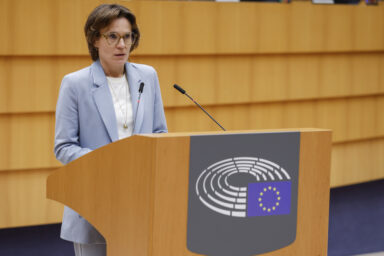
Kaja Kallas, High Representative of the Union for Foreign Affairs and Security Policy and Vice-President of the European Commission, stood centre-stage at the Arctic Frontiers conference in Tromsø on 3 February. “The Arctic is critical for transatlantic security. It will require more attention, more resources, and yes, more hard power,” she declared during her keynote.
Behind her warning lay a simple anecdote. As a newly liberated Estonian teenager, she once drove north, “even crossed the border to Norway, a NATO nation,” without visas. “Espen knows this story and has pardoned me already,” she laughed, glancing at Norway’s foreign minister, Espen Barth Eide. “It is very great to be back here, so legally this time.” The giddy freedom of the 1990s, she implied, has yielded to a grimmer age of missile tests and military build-ups.
Message of resolve
Russia explains the change. “Moscow has reopened and modernised Soviet-era military bases in the High North,” Ms Kallas said. She noted that “one of the world’s largest concentrations of nuclear weapons is located on the Kola Peninsula, right across the Norwegian border.”
Next month’s Cold Response exercise, bringing 25,000 troops to Norway, would, she insisted, “send the clear and unmistakable message of resolve.” Yet hardware alone will not suffice. “A safe, secure, liveable and prosperous Arctic is a global common good. It’s up to us to make it happen. And that is what the EU will work for together with and in support of the Arctic nations.”
You might be interested

Her remedy is a revamp of Brussels’s thinking. “It is time for a fresh EU Arctic policy, one that reflects the times we live in and the world we want to see, including a secure Arctic.” Older EU papers dwelt on climate, fisheries and research. The next version, she promised, will treat security as the missing dimension. For that she thanked Norway, Canada and Iceland as indispensable partners and reminded listeners that “NATO and the EU have 23 members in common.”
Shifting plates
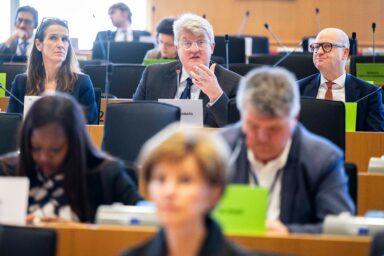
Europe’s effort, she argued, must also account for “the radical change in the US thinking that marks a structural shift in transatlantic relations.” That line hung over the later panel debate, where Ms Kallas joined Mr Barth Eide; Vivian Motzfeldt, Greenland’s foreign minister; Christian Danielsson, Sweden’s state secretary for EU affairs; and Åsa Rennermalm, Professor of Geography at Rutgers University.
Ms Motzfeldt added procedural reassurances. Ms Rennermalm, by contrast, dismissed the security drumbeat. “The long-term security issue in the Arctic is not what’s happening right now. The long-term security issue of the Arctic is climate change and environmental degradation and pollution,” she said. “We may know on a big picture level what is going on, but there’s so much still to uncover because we don’t know exactly how climate change is going to unfold.”
The US geographer then deplored “the changes we’ve seen in the last year with the attacks on science in America,” adding that “we see similar things happening in Europe too with funds being diverted to military buildup and production of weapons,” seemingly oblivious to the world at large beyond the context of scientific efforts. What precisely would the scientists‘ work look like if it were not for the guns guarding their freedom, she did not bother to explain.
We need to put more pressure on Russia so that they would go from pretending to negotiate to actually negotiate. — Kaja Kallas, the EU’s top diplomat
Minister Barth Eide opposed her courteously. “Although I feel that the world is flat, the scientists tell me that it’s round,” he observed, citing the Enlightenment as proof that facts survive feelings. Still, he conceded that the eight-member Arctic Council is merely “a holding operation to keep the apparatus alive as we’re waiting for better times,” and that “status quo is not tenable.”
Questions of trust
Mr Danielsson used fewer words. Sweden, he said, will push hard for greater EU-NATO synchrony once its own alliance accession is complete. Ms Kallas seized on that: European defence spending, she reminded, has already risen, and EU instruments such as the European Defence Fund are now open to Norwegian firms. “These examples show how mutually beneficial our partnership is,” she told reporters later.
When asked about his faith in Washington, however, Mr Barth Eide prevaricated, tiptoeing around the question if the U.S. still was a reliable ally. “The U.S. is a very important ally, and we are just looking in a region where we have a significant and increasing American participation,” he replied, before noting that Norway has worked with different American presidents over 77 years. The evasion earned gentle laughter; the questioner, unconvinced, said “I see you dodged my question.” Ms Kallas, standing nearby, let the exchange hang without rescue. Her earlier remark about structural shifts had made the point already.
At a later press conference, a reporter pressed Ms Kallas for her view of peace talks among Ukraine, Russia and the United States. She did not soften her line. “We haven’t heard about any concessions on the Russian side, the opposite actually,” she said. Russia, she continued, had agreed not to bomb energy infrastructure yet still strikes “maternity wards, the trains, you know, everything else to cause as much pain and suffering for the people in minus 20 degrees cold.” Therefore, “We need to put more pressure on Russia so that they would go from pretending to negotiate to actually negotiate.”
Partnerships and paperwork
Ms Kallas used the same press session to sketch a broader map. “Security is not just soldiers, but trusted institutions, stable societies, safe infrastructure and sustainable livelihoods,” she said. Updating the EU Arctic strategy will place Greenland as “a core pillar”. Financial support already flows to Nuuk, and the EU will “make them also stronger” through new packages.
Cooperation with Norway is “moving from paper to action” in fields such as cybersecurity, maritime awareness and protection of critical infrastructure. Iceland, which lacks a military, will soon sign its own security-and-defence partnership with Brussels. That deal, Ms Kallas said, will focus on “maritime domain awareness…critical infrastructure under sea and protection of those, but also fighting foreign malign influence and disinformation campaigns.”
You simply don’t take other people’s land by force. — Espen Barth Eide, Norway’s foreign minister
Mr Barth Eide applauded the Icelandic move. For NATO countries in the High North, he said, “it’s very good also to have this anchor in the European Union with this clear delineation of tasks.” Collective defence remains a NATO duty, but many other “aspects of security are now increasingly being done in Brussels by the EU, and that’s a good thing.”
Beijing’s shadow
An enquiry from The Economist turned to China. Ms Kallas responded first. “We don’t see the presence of China here just yet, but it’s clear that they are showing growing interest in the Arctic ports, transport hubs,” she said.
Intelligence services warn that such interest “creates security risks, because the leverage over the supply chain is something that we have already experienced if those supply chains or trade routes are weaponised.” Rare-earth dominance, she noted, gives Beijing ample leverage elsewhere; Greenland’s critical minerals make vigilance essential here too.
Mr Barth Eide offered a second opinion. “There is much less of [Chinese activity] than is sometimes reported,” he maintained. Most investment is in Russia, whose rules allow it. Any project in a NATO Arctic country, he assured, would need approval, and “if we don’t like it, they will not get that permission.” Nonetheless, China’s economic support for Russia in the Ukraine war “helps the war economies”. Europe therefore pursues “de-risking, which is not decoupling,” combining cooperation on research with scrutiny of technology transfers.
Greenland’s place
Greenland itself, meanwhile, remains at the centre of diplomatic triangles. Ms Kallas reminded the conference that “The future of Greenland is for the Greenlanders and Denmark to decide,” and that Brussels “stands with our member state, Denmark, and we stand by UN Charter.” A working group of Denmark, Greenland and the United States, she said, has already lowered tensions. Financial help from the EU will continue, but any change in sovereignty must respect “sovereignty, territorial integrity and also the right of self-determination.”
Mr Barth Eide repeated the same principle with Nordic bluntness: “You simply don’t take other people’s land by force.” Allies, he said, have sent “a very explicit” message to Washington: they will discuss genuine security concerns, but borders are non-negotiable. That twin stance—support Denmark’s realm, yet co-operate on defence—defines Nordic diplomacy today.
The changes we’ve seen in the last year with the attacks on science in America (are deplorable). Yet we see similar things happening in Europe too with funds being diverted to military buildup and production of weapons. — Åsa Rennermalm, Professor of Geography at Rutgers University
Professor Rennermalm then offered one more chance to rebut the military focus, stuck to her point. “To understand what’s going on, we need science,” she said, warning that cuts to research budgets would leave the Arctic blind. Her plea for thermometers over thermobarics met polite nods. Yet even she conceded that “there’s so much still to uncover” about the way climate will unfold—an uncertainty, Ms Kallas later argued, that only heightens the need for resilient infrastructure and shared situational awareness.
Science versus soldiers
Mr Barth Eide warned darkly that democratic societies risk “very, very serious trouble” if they abandon evidence-based policy. “Scientists never agree on everything,” he said, yet rulers must still accept “that there is truth and false” and “stand up for that.” In a part of the world where satellite data inform submarine patrol routes, epistemology quickly becomes strategy.
As the day closed, Ms Kallas distilled her message to three blunt points. First, Russia’s remilitarisation demands an answer. Second, America’s future role cannot be taken for granted. Third, the European Union must fill gaps through money, partnerships and a rewritten strategy. “We remain in close contact,” she said of Norway, “and we are ready to take this partnership even further.” Her teenage story of visa-less wanderings made a final reappearance: borders once ignored must now be guarded, yet the urge to cross them—in science, trade and security co-operation—endures. Ms Kallas the reiterated the leading idea: security uppermost. “They can count on us. You can count on us.” In a region where nuclear warheads sit across a thinning border, that promise will soon be tested.