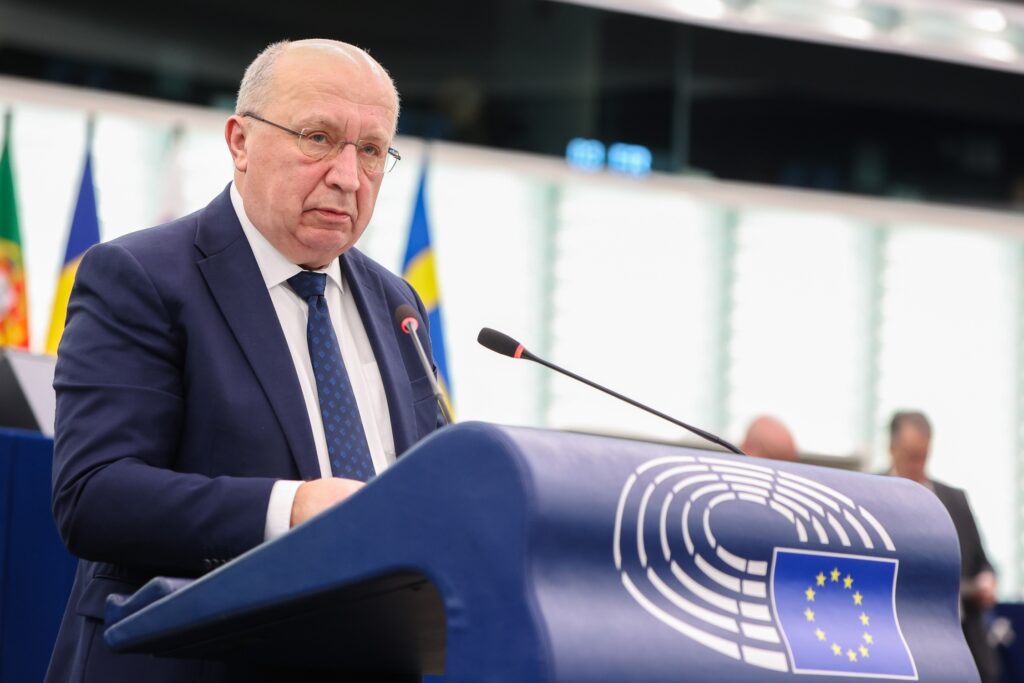

EU defence commissioner Andrius Kubilius‘ Thursday hearing at the Spanish parliament stopped just short of open conflict between Madrid and Brussels. The commissioner chastised his hosts as defence-spending laggards. The lawmakers paid back in kind.
What would it feel like to meet dozens of Viktor Orbáns simultaneously in one room? We might never know but Andrius Kubilius‘ 19 February hearing at the Cortes Generales was as close as it gets. Flanked by stern-faced ushers, the commissioner faced a joint sitting of the lower chamber’s EU and defence committees—an unruly mix of Atlanticists, pacifists and populists. The lawmakers, too disinterested in, aloof about, or ignorant of the imminent peril at EU borders, found many a fault with Brussels‘ current defence policies.
The commissioner said he hopes all EU member states will find a way to increase their defence spending to NATO-agreed levels. Spain’s Socialist government, led by Pedro Sánchez, has pencilled in a rise to two per cent of GDP by the end of the decade—a target that already strains domestic politics. Mr Kubilius, along with the Alliance, wants more. He reminded his hosts that NATO leaders last year endorsed a notional goal of 3.5 per cent and that some eastern members speak openly of five per cent.
Ten days
Speaking to reporters only minutes after the meeting, he reiterated his position in starker terms. “Well, I can tell you what I’m repeating everywhere,” he told journalists after meeting lawmakers. “What will happen if Russia is attacking Lithuania? Our calculation brought a very clear outcome,” he continued.
“In order for us to defend Lithuania for the first 10 days, we need to spend more than five per cent of GDP on our defense. And the government started to do that. But after 10 days, definitely the country is expecting that NATO troops will come,“ said the man who, as former Lithuanian prime minister, knows a thing or two about Russian threats.
You might be interested

“And what does it mean, NATO troops? It means American troops, German troops, Latvian troops, Spanish troops, and so on, and so on. And if some of those countries are not investing into the development of their capabilities, it means that they will not come. So that is killing the whole collective defense principle,“ the commissioner concluded the tirade. It did not go down well.
Counting the pennies
A Basque deputy asked the killer question: “Is there really a common European security and defence policy?” She doubted it. “Do you believe that this coordination is taking place?” The commissioner, unflappable, insisted a new European defence industrial programme and a proposed €130bn budget line prove that Europe, at last, means business.
It is a little difficult to understand why there is a defence commissioner when the European Union has no defence powers. — A Vox party member of the Cortes Generales
Another Basque parliamentarian widened the target to Washington. “We are facing a situation that is not even provided for in the treaties, such as a military threat against an ally within the North Atlantic alliance,” he warned, demanding clarity on how strategic autonomy can coexist with NATO. A bigger purse, he argued, should fund climate security, not artillery.
A representative of the small Republican group took up the industrial cudgel. “The question is not how much to spend, but how and for what.” He fretted that defence subsidies will fatten Franco-German conglomerates while starving Spanish small firms. Mr Kubilius, juggling data rather than sentiment, spoke of European defence projects of common interest designed to spread contracts beyond the usual suspects.
Inflation, vassalage and Vox
A deputy from the Sumar party rejected the commissioner’s threat assessment outright. “It is not our feeling in Spain, among our strategic interests, that the fundamental threat is an imminent attack by Russia on European territory,” he said, lumping Mr Kubilius’s warnings with the dodgy American intelligence that once paved the road to Baghdad. He blasted what he called “European vassalage” to Mr Trump’s whims and asked whether Brussels secretly wants “a tactical nuclear missile capability in the centre of Europe”.
It is not our feeling in Spain, among our strategic interests, that the fundamental threat is an imminent attack by Russia on European territory. — A Sumar party member of the Cortes Generales
A deputy from the Vox party then delivered a nationalist broadside. “It is a little difficult to understand why there is a defence commissioner when the European Union has no defence powers,” he scoffed, waving a printed copy of the commissioner’s earlier speech. Vox cheers greeted his demand that Brussels stop hiding behind “shoddy technocracy”.
The Socialist benches, traditionally Atlanticist, tried to steer the debate back to pragmatism. One of their deputis accepted higher spending, but on Iberian terms. “Obviously, we have to invest more, but above all we have to invest better and in a coordinated manner, integrating our logistical systems, but not because the United States says five per cent, but because we make our own assessment of our needs and therefore take our own decisions autonomously.”
Handshakes, but no hugs
Pragmatism notwithstanding, the gap between the positions of Spains’s government party and Brussels was yawning wide. The Socialists back a drone-non-proliferation pact—at a time when the Commissioner proposes a drone wall.
Late in the session a conservative from the opposition Partido Popular, praised the visitor’s Baltic grit. “We must all get it right when thinking about defence and the future of the new European generations,” he said, urging faster work on a shared missile shield. But even he bridled at German-led industrial dominance.
We need to develop our autonomous defence capabilities within NATO, according to NATO capability targets. — Andrius Kubilius, EU Defence Commissioner
Mr Kubilius, unfazed, closed with a homespun appeal. “We need to develop our autonomous defence capabilities within NATO, according to NATO capability targets.” If America pares back its 100,000 troops on the continent, Europe must fill the gap. Drones launched from shadow fleets, he noted, do not respect geography; a strike on Lithuania would ripple through Madrid’s markets within hours.
The commissioner was then scheduled to brief the European Council. His Spanish trip made one thing clear: Europe’s defence debate, once abstract, is now unavoidably political. And even with Russian troops, artillery, and drones an imminent threat, consensus is as rare as ever.