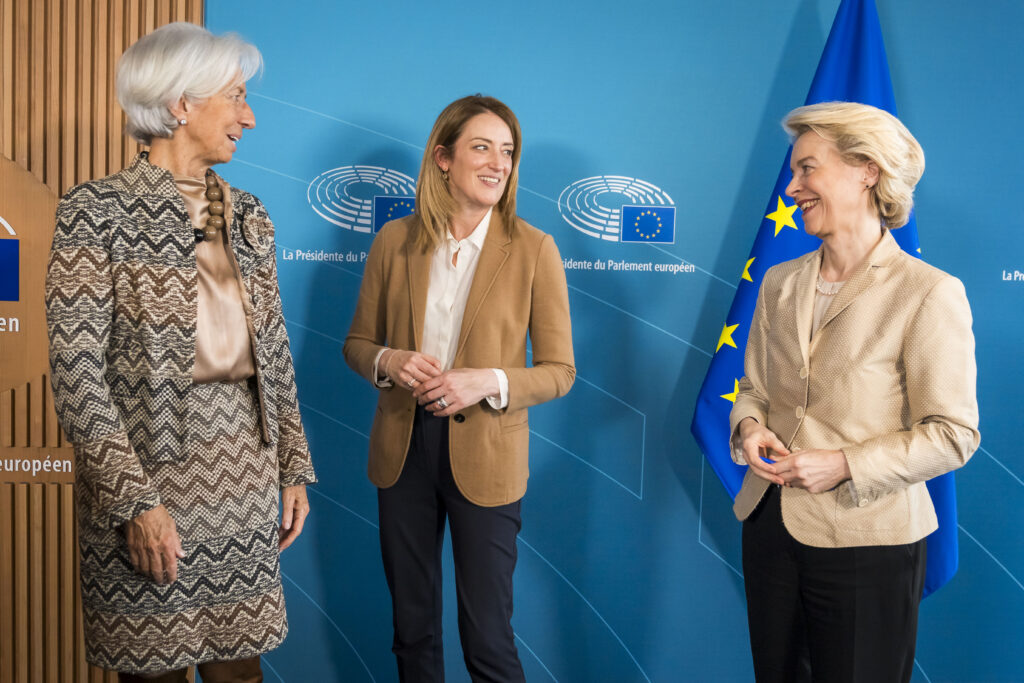

Rumours of Christine Lagarde’s early exit from the European Central Bank have lit a political fuse. Emmanuel Macron and Friedrich Merz could pick her successor months before France elects a new president. The manoeuvre may shield Frankfurt from Marine Le Pen’s looming assault on monetary orthodoxy.
Christine Lagarde chose to outrun a potential populist storm. On 18 February reports surfaced that the president of the European Central Bank will quit more than a year early, handing French President Emmanuel Macron—and Germany’s Chancellor Friedrich Merz—the right to anoint her successor before France’s 2027 presidential poll. Such timing could shield the ECB from Marine Le Pen’s National Rally, which rails against Frankfurt at every opportunity.
Central bankers loathe drama, yet the move would rank as the boldest personnel gambit in the euro’s short history. Ms Lagarde’s exit would let Paris and Berlin seal a deal while the current powers control their domestic calendars. This would deprive a populist French president to push for installing a governor more pliant to calls for easy money.
Ahead of the populists
Simona delle Chiaie, chief euro-area economist at Bloomberg Economics, assessed the issue. “The timing opens the door for Macron to shape the next appointment. He could keep it out of the hands of a far-right government. This is as recent developments in the US have put central bank independence back in focus.”
Financial Times’ Paris sources say Mr Macron “has for months wanted a say in choosing Lagarde’s successor”. The ECB insisted that Ms Lagarde “has not taken any decision regarding the end of her term”. Yet the phrasing signalled contemplation, not dismissal, of an early farewell.
You might be interested

Bank of France governor François Villeroy de Galhau—yet another top central banker whose early departure has raised eyebrows this month—was coy about the matter. “I’ve read a rumor concerning Madame Lagarde,” he told reporters in Paris. “It doesn’t seem to be information to me and I’ll let the ECB comment. It seems like a rumor to me.” Markets shrugged; the euro dipped only fractionally.
However, not all eurozone finance chiefs support the moves. Austrian finance minister Markus Marterbauer favours the usual schedule. His German counterpart, Lars Klingbeil, struck the same note: “The ECB has timetables, and we are going to stick with them and—as always—find a good solution.” Roland Lescure, France’s finance minister, limited himself to praise: Lagarde is “obviously a great president of the ECB”.
The runners and riders
An early vacancy would narrow the race. Klaas Knot, the former Dutch central-bank chief, and Pablo Hernández de Cos of Spain, now at the Bank for International Settlements, lead bookmakers’ lists. Nick Kounis of ABN Amro thinks the Dutchman gains from fresh momentum. “Timing wise, Knot has not taken a new big job yet, while de Cos has,” he told Bloomberg. “So an early appointment may favor Knot on the margin.”
The timing opens the door for Macron to shape the next appointment and keep it out of the hands of a potential far-right government. — Simona delle Chiaie, Bloomberg Economics
Madrid wants a seat of its own when several ECB board terms lapse. Economy minister Carlos Cuerpo reminded colleagues that Spain “is prepared if Europe accelerates its timetable,” and lusts to “play a leading role in the new executive board once the opening vacancies are renewed.” A package that swaps nationalities across posts would suit Mr Macron and placate Mr Merz, who may push for German heft on the board if the presidency drifts north.
Such manoeuvres rarely rattle traders. “Whether it is Lagarde or someone else at the helm, the ECB will leave rates unchanged this year,” judged Andrzej Szczepaniak of Nomura. “Ultimately, the ECB takes monetary-policy decisions by building consensus, and whomever replaces Lagarde is unlikely to radically shift or change the way the ECB works.”
Guarding the ramparts
That consensus may face new strains. National Rally’s Jordan Bardella vows to demand a restart of quantitative easing to cut France’s debt burden. Investors shudder at the image of a French governor storming into Frankfurt to lobby for money-printing. “The ECB is the most politically independent central bank in the world,” warned Frederik Ducrozet of Pictet Wealth Management. “If you have one of the extremes winning in 2027, you risk having someone who is opposed to anything the ECB does.”
I’m not a quitter. — Christine Lagarde, President of ECB
Mr Macron has been hardening institutions for months. The FT notes that he “recently named a close ally to the head of the national auditor” and welcomed Mr Villeroy’s surprise decision to quit in June—eighteen months early.
Mr Villeroy, for his part, swears the move is private: “All those who know me as a free man, and who know my independence, know that if I had been asked, I would have refused,” he told Les Echos, France’s leading daily financial newspaper. “This is a personal decision.”
The populist echo
National Rally will rage about stitch-ups and deep states. Such cries already ring across America, Britain and Italy. Ms Lagarde herself once lectured lawmakers that she was “fully determined to deliver my mission and I’m determined to complete my term,” and later told reporters, “I’m not a quitter.”
Then again, Ms Lagarde owes her own ascent to the top post to a political deal just like the one she denies now. In, 2019 she landed the ECB post because Mr Macron and then German chancellor Angela Merkel struck a surprise bargain that also elevated Ursula von der Leyen to head the European Commission.
Ultimately, the ECB takes monetary-policy decisions by building consensus, and whomever replaces Lagarde is unlikely to radically shift or change the way the ECB works. — Andrzej Szczepaniak, Nomura
Any successor will inherit healthier inflation and modest growth, which reduces near-term controversy. Still, if Ms Le Pen or Mr Bardella capture the Elysée, they may test the ECB’s boundaries. Ms Lagarde’s early departure could therefore amount to pre-emptive fortification: place a trusted sentinel in the tower before the siege engines roll into view.