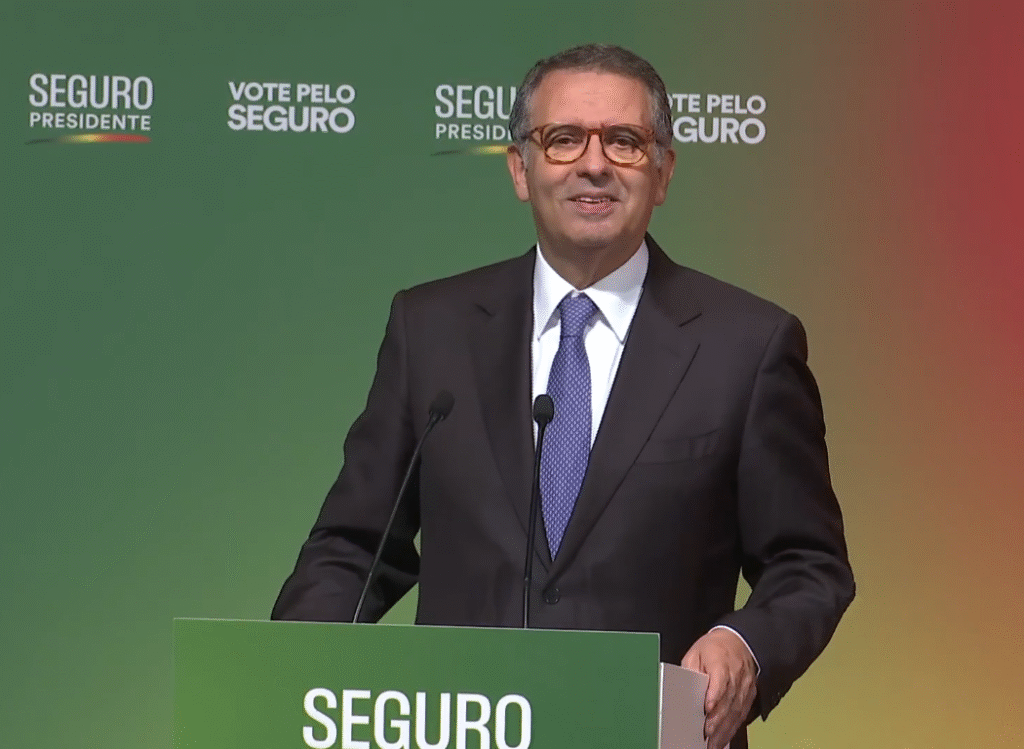
Although the second round of the Portugese presidential election was disrupted by a violent storm and voting in several constituencies will not take place until next week, nothing can now threaten António Seguro’s victory. He won approximately twice as many votes as the far-right leader André Ventura—but the fact that the defeated candidate won about a third of the vote shows that Portugal is no longer immune to the populist wave.
António José Seguro (*1961), member of Portugal’s Socialist Party, scored a convincing victory. Preliminary results after counting 99 percent of the votes give him about 66 percent, and he can no longer lose the contest. Mr Seguro will replace the current conservative president, Marcelo Rebelo de Sousa, who has been in office since 2016. Portugese constitution did not allow him to run for a third consecutive term.
“Attachment to the values of democracy”
“The Portuguese people are the best people in the world,” Mr Seguro told reporters as he left his home in Caldas da Rainha, central Portugal. He added they Portugese citizens had showed “an enormous civic responsibility” and “attachment to the values of democracy”.
According to many analysts, Mr. Seguro’s victory was due, in part, to mainstream conservative backing of his candidacy in order to beat back Mr Ventura and his surging Chega party. As a result, Mr Seguro’s convincing victory was welcomed by the ’establishment’, in Portugal and beyond—but the far right’s presence in the runoff nevertheless again put Europe on notice.
Portugal’s old reputation as an exception to the far-right surge in Europe is clearly over. – João Cancela, Professor of political science at NOVA University in Lisbon
João Cancela, Professor of political science at NOVA University in Lisbon, said that Mr Ventura’s strong showing illustrates that Chega now had geographic reach across a country. “Portugal’s old reputation as an exception to the far-right surge in Europe is clearly over,” Professor Cancela means.
President with special powers
The President of Portugal traditionally has a ceremonial role, though head of the state can veto laws and has special powers during political crises, such as dissolving Parliament. In the election campaign Mr Seguro said he would not overstep into the territory of ’shadow prime minister’. On the contrary, Mr Ventura had a more expansionist view, promising an ’interventionist presidency’.