
With proper treatment, even deep wounds can heal. The European Commission and the United Kingdom signed the EU-UK Competition Cooperation Agreement on Wednesday. The stand-alone pact supplements the 2020 Trade and Cooperation Agreement. For business, it brings a welcome dose of predictability.
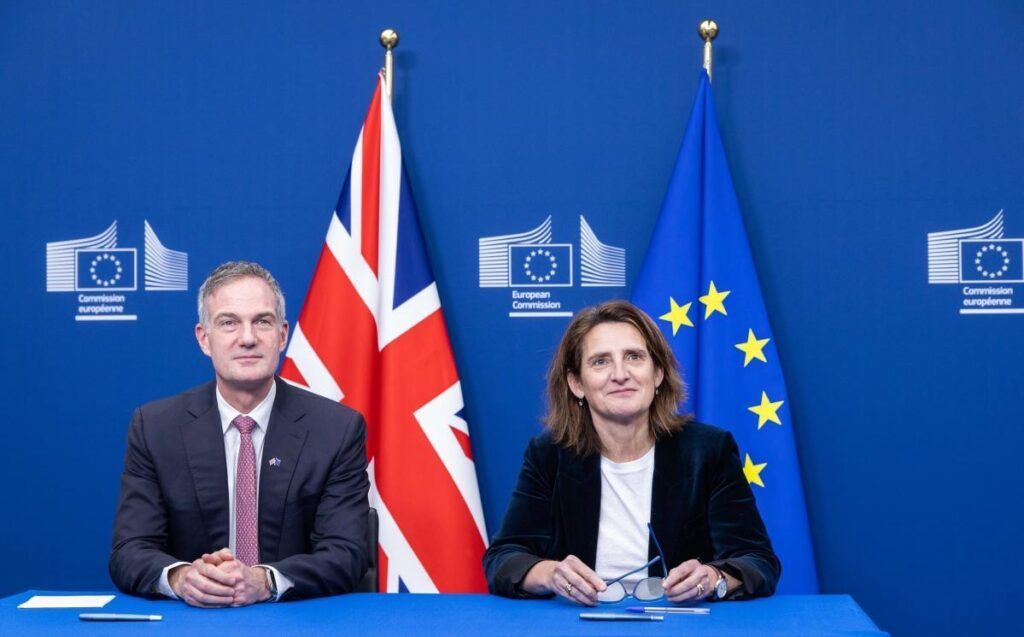
European and British officials have a history of not eeing eye to eye, yet on 25 February they shared pens quite happily. The agreement binds the Commission, all 27 national competition authorities and the Competition and Markets Authority in London to talk—quickly—whenever the same merger or cartel crosses the Channel.
An early cheer went up at the Berlaymont. Commission Executive Vice-President for Competition Teresa Ribera said, “The CCA is a privilege and an important step in uncertain times.” She urged the Council and Parliament to adopt a swift decision. Across Whitehall, UK Business Secretary Peter Kyle claimed vindication. “The accord vindicates the reset,” he said, and he added that “there is public appetite for deeper economic ties with the EU.”
Rules without borders
What it means is that any “significant” investigation must now be flagged to the other side. The authorities may coordinate timetables and share public information. Confidential data will travel only with a company’s consent, a nod to Britain’s looser privacy regime and the EU’s GDPR zealots.
Politically, Brussels views the pact as re-engagement without re-entry. The agreement touches no raw nerves about free movement or the Court of Justice. Instead it shows that pragmatic, sector-specific deals are possible even while the single market stays locked. Ms Ribera framed the text as a template for future accords with allies such as Canada and Türkiye. She hopes that including every national watchdog will become the gold standard.
You might be interested

London thinks the same, in mirror image. Mr Kyle sees alignment on big cross-border mergers—those that shape everything from steel to social media—as proof that Britain can cooperate without surrendering autonomy. Both sides therefore call the CCA modest. Each also insists it is momentous.
Their enthusiasm masks a few parliamentary grumbles. Early briefings from MEPs on the Internal Market and Economic Affairs committees point to worries over data sharing and the treaty’s silence on state aid. French and Polish representatives mutter that the level-playing-field guardrails inside the wider TCA must not fray. GDPR hawks, still nursing bruises from the privacy shield saga with America, want stricter wording before they wave the text through.
Leverage for the review
Timing sharpens those concerns. The CCA lands months before the first five-year review of the broader trade pact. Brussels can now argue that cooperation works best when London moves closer, not farther away.
Energy, sanitary rules and mobility will all feature in that review. The new competition accord gives the Commission a pleasant example to brandish. It is also a reminder that it can still stall ratification if Downing Street drags its feet elsewhere.
The CCA is a privilege and an important step in uncertain times. — Teresa Ribera, EU Commission Vice-President
Even so, the Council is unlikely to block the deal. National capitals have long wanted clarity on how to chase cartels that straddle the Channel. Legal uncertainty since Brexit has irritated ministers whose voters complain about high food prices or delayed pharmaceuticals. The CCA offers a cure that costs next to nothing.
Counting the gains
Economically, the benefits look small on paper but large in boardrooms. Early notification should curb duplicate document requests, a bane for lawyers and executives alike. Consultancy MLex reckons that streamlined procedures could shave ten to fifteen per cent off the legal bill for an average trans-Atlantic merger. For a €5bn deal in the life-sciences sector, that translates into savings of roughly €5m—peanuts to shareholders, manna to in-house counsel. (Large, complex cross-border mergers typically incur total legal and regulatory-compliance fees of around 0.7-1 per cent of deal value. On a €5bn transaction that produces a legal bill in the €35-50m range. If streamlined procedures remove 10-15 per cent of that bill, the cash saving equals €3.5-7.5m.)
Cartels may sweat more. Parallel dawn raids, easier under the CCA, reduce the scope for forum shopping. If either authority finds price-fixing that hits both markets, it can nudge its counterpart to open a file at once. Consumer advocates salute that change. Investors also gain: fewer surprises mean cleaner valuations, especially in digital markets where dominance can vanish in months.
Yet the pact is no panacea. It excludes subsidy control, enforcement of the Digital Markets Act and looming rules on artificial-intelligence competition. Divergence in those areas could still distort trade flows. The macro impact, academics suggest, will be marginal. Brexit clipped EU GDP by perhaps 0.2 percentage points; smoother competition enforcement may claw back only a sliver.
Signals to the City
The symbolism matters more than the sums. European bankers fear that Britain’s lighter rulebook on novel business models—crypto exchanges, for instance—may lure clients from Paris or Frankfurt. The CCA shows that Brussels can cooperate without blessing every British innovation. For the City, the message is similarly mixed. Alignment on antitrust removes one grey zone, but the omission of financial-services competition keeps another.
Still, equity analysts expect a mild rise in deal flow. Sectors with tight supply chains such as automotive components, speciality chemicals, biotech platforms should find cross-border mergers less tortuous. If even a handful of mid-sized transactions now proceed where they would have stalled, incremental capital will wash into both economies. That suits a continent flirting with recession.
The ratification path, though shorter than for a free-trade treaty, can still trip on politics. Data-protection committees in the European Parliament have a habit of adding last-minute amendments. British MPs, too, may grandstand. Some in the governing party bridle at any hint of European oversight. Should a headline-grabbing merger arise—imagine an American tech firm buying a British social-media darling while the EU investigates the very same firm for abuse of dominance—sentiment could harden.
Risks ahead
Corporate confidentiality offers a second booby-trap. The CCA lets firms veto the onward transfer of their secret sauce. That clause placates litigators but may blunt enforcement if suspects refuse cooperation. Brussels will rely on persuasion, and on the threat that refusal looks bad before a judge. Whether that suffices will shape the accord’s real-world bite.
The accord vindicates the reset. There is public appetite for deeper economic ties with the EU. — The Rt Hon Peter Kyle MP, UK’s Secretary of State for Business and Trade
For now, both sides bank on goodwill. The Commission’s competition directorate has forged smooth ties with Washington under a similar pact first struck in 1991. Lawmakers hope the UK version yields comparable trust. Britain, once a vigorous voice within the EU for stringent antitrust, possesses deep expertise. Continental officials, especially those from smaller member states, value that counsel.
Mr Kyle wants to bottle the mood. He notes that public support for closer economic links has crept up since the Windsor Framework cooled tempers over Northern Ireland. It gives him cover to pursue other micro-deals, in data adequacy or energy interconnectors, without inviting the charge of reversal on Brexit.
Future-proofing
Viewed from Beijing or Silicon Valley, the CCA reinforces Europe’s claim that its rule-making muscle endures. By aligning procedures with Britain the Union prevents rivals from playing one regulator against the other. A Japanese electronics group weighing an acquisition in Manchester can now expect a single set of questions rather than two discordant questionnaires. That clarity, modest though it sounds, nudges investment decisions.
Ms Ribera hints at wider ambitions. She tells member states that the agreement “frames modern competition cooperation” and could inform upgrades to older pacts with America and Japan. If that happens, the EU-UK text will rank as a useful prototype.
The Council must now stamp the text; the European Parliament must consent; Westminster must nod. None of these steps is certain, but all are more likely than not. If ratification proceeds, the agreement may take effect before the summer recess. That would give officials a dry run before the TCA review in the autumn. Success there could, in turn, grease the path for future single-issue deals. Emissions trading springs to mind, or cross-border data flows.
Final hurdles
In that sense the Competition Cooperation Agreement punches above its weight. It shows that the two old partners can still haggle, settle and move on. For an economy drifting sideways the gain is incremental, not transformational. For politics poisoned by mistrust the symbolism is richer. Small step may avoid big stumbles.