
The Industrial Accelerator Act, the legislative push for EU content production requirements, is due for Brussels presentation on 26 February. The initiative, however, finds detractors as easy as advocates everywhere: from member states to Commission directorates, from allies outside EU borders to France, its very cradle.
In the grand corridors of the Berlaymont, the phrase ‘strategic autonomy‘ has long been a French speciality. Now, President Emmanuel Macron and his close ally, European Commission Executive Vice-President for Prosperity and Industrial Strategy Stéphane Séjourné, are attempting to bake this rhetoric into European law. But Paris’s drive for local-content rules risks hitting significant roadblocks across the continent.
Mr Séjourné, a former chief of the Renew Europe group, has sought to translate Mr Macron’s vision of “une Europe qui protège“, Europe that protects, into binding regulation. The core of the policy is European preference in public procurement. It mandates that when states spend public money—particularly on cars, advanced technology, and green energy—the production of a substantial share of the value must take place within the Union.
The view from London
For Mr Macron, this is a symmetrical response to the ‘Buy American‘ policies of US President Donald Trump and the industrial subsidies of China. His political stakes are high. Mr Macron’s domestic coalition has struggled since the snap elections of 2024, and he faces a relentless challenge from the National Rally.
Delivering a major industrial win in Brussels would provide a necessary ‘re-industrialisation‘ narrative for blue-collar regions where the far-right is gaining ground. However, if more liberal-minded member states dilute or sefeat the legislation, it will merely provide more ammunition for his critics at home.
You might be interested
The most vocal opposition is currently coming from across the English Channel. Britain is lobbying Germany, Italy, and the Netherlands to push back against the strict French proposals, Bloomber reports. The British government fears these rules would exclude its firms from participating in European public procurement bids.
The tension comes at an inopportune time. During a speech at the Munich Security Conference, UK Prime Minister Keir Starmer made a plea for closer ties and mutual cooperation. “We are not the Britain of the Brexit years anymore,” Mr Starmer told an audience of diplomats. The Prime Minister argued that turning inward would be a strategic error for both sides of the Channel. “Because we know that, in dangerous times, we would not take control by turning inward—we would surrender it,” he said.
Cracks in the bloc
Sir Keir is seeking a new security and economic pact that integrates British and European interests more tightly, rather than seeing them drift apart through protectionist measures. But to London, Made in Europe represents a move toward a restrictive trade environment that ignores the shared challenges of the modern age.
Because we know that, in dangerous times, we would not take control by turning inward—we would surrender it. — Sir Keir Starmer, UK Prime Minister
Within the European Union, the French position is causing similar anxiety. While many member states support the principle of protecting supply chains, several are looking for a landing zone that is less restrictive than the one proposed by Mr Séjourné.
Germany, Italy, the Netherlands, and Poland have voiced worries that overly tough local-content rules could deter investment and increase manufacturing costs. Finland, Sweden, and the Baltic countries also prefer a more relaxed approach to third-country participation.
Trusted partners
The Swedish defence minister, Pål Jonson, expressed these concerns in Munich, noting that Sweden is an “ardent advocate“ of participation by trusted partners. “We think it’s good to have an open EU,” Mr Jonson told Bloomberg. This internal friction suggests that the hard-line position pushed by Paris lacks the unanimous support needed for a smooth passage through the Council. Critics argue that making the EU a fortress could ultimately aid competitors by raising the price of the very technologies required for the green transition.
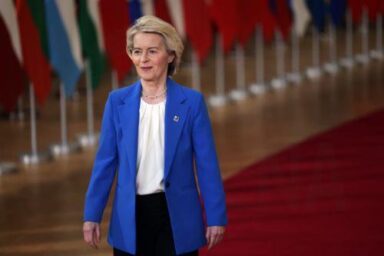
Commission President Ursula von der Leyen has attempted to reassure these sceptics, stressing that the plans would be limited to strategic sectors and based on “solid economic analysis”. However, the definition of a “trusted partner”—and which third countries would receive more generous terms—remains an open and contentious issue. Without a clear consensus, the 26 February deadline looks increasingly ambitious for a piece of legislation that must surmount so many obstacles.
For Mr Séjourné, the timing of the act is also a matter of personal prestige. By securing a deal before the 2027 French presidential election, he would cement his status as a front-rank liberal figure for the post-Macron era, French media opine. But the pressure he is applying to meet the February deadline has raised eyebrows in Brussels. EU officials have been quoted, albeit anonymously, as estimating that nine different European Commission departments claim that negotiations are far from over.
A ticking political clock
If the Industrial Accelerator Act stalls or is significantly watered down, the EU will suffer. The primary beneficiary will likely be the National Rally in France. The party’s leader-in-waiting, Jordan Bardella, is already leading in second-round polling scenarios for 2027.
The National Rally argues that Mr Séjourné’s Made in Europe is “too little, too late” compared to their own ‘Made in France‘ agenda. They would be quick to paint any Brussels failure as proof that Mr Macron has lost control of France’s destiny to a faceless and ineffective bureaucracy.
We think it’s good to have an open EU. — Pål Jonson, Sweden’s defence minister
The French president and his Brussels protégé have succeeded in turning an Elysée slogan into a draft of European law. They have even gathered a list of 1,141 CEOs to provide a ‘private-sector shield‘ against accusations of French mercantilism. Yet Made in Europe remains a high-stakes gamble. It must navigate a path between the protectionist demands of the French right and the liberal instincts of Northern Europe. It will become a test of both member states‘ loyalty and Commission directorates‘ flexibility. For now, the Europe that protects looks like it might struggle to protect even its own legislative schedule.