
With Trump’s America in the Russian camp, Europe needs new partners, the European Parliament has acknowledged. On Wednesday 11 February, the Strasbourg plenary approved by 440 votes in favour to 118 against (with 85 abstentions) a motion calling on the European Commission to establish such strategic partnerships.
For years the European Union has talked about strategic autonomy yet stumbled whenever rhetoric met reality. Russia’s full-scale invasion of Ukraine in 2022 gave the discussion a grim urgency. Since then Brussels has dribbled out policies—the European Defence Fund here, the Military Mobility project there—but never a single plan that binds allies, budgets and industry together. That gap is what the European Parliament’s newly adopted own-initiative report on ‘EU strategic defence and security partnerships‘ tries to close.
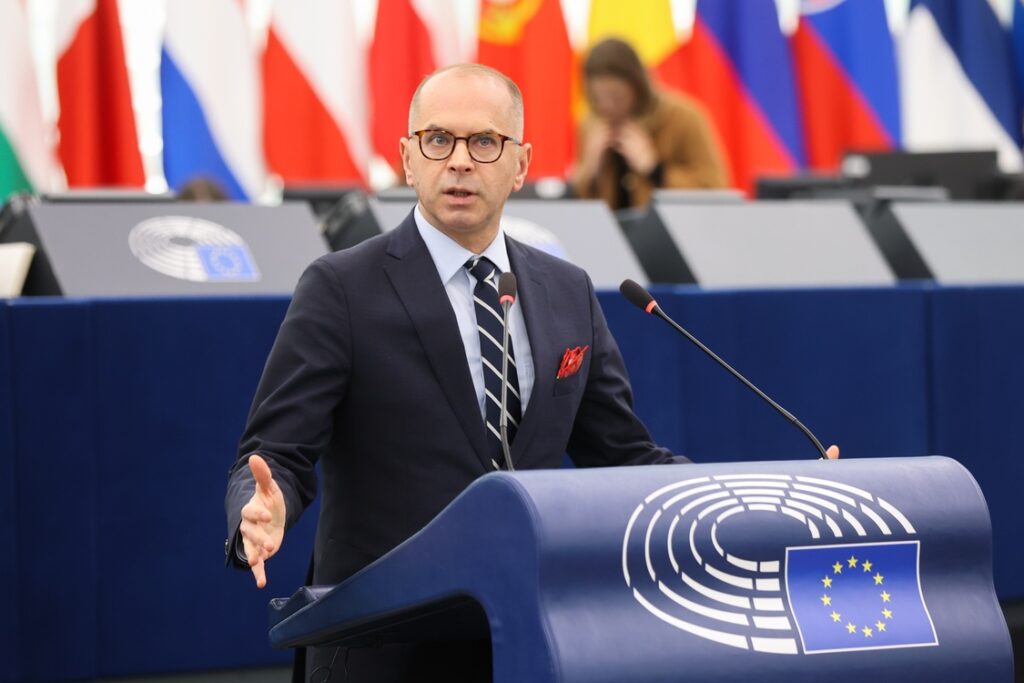
The dossier, filed under procedure 2025/2119(INI), was steered through the parliamentary Committee on Security and Defence (SEDE). MEP Michał Szczerba (EPP/POL), the rapporteur framed the text as a blueprint for a Union that can “set a path to enhanced and expanded cooperation between the EU and key bilateral partners, allowing the EU to respond effectively to current and future security threats and to strengthen its role as a global strategic actor”.
The strategic reorientation of the US
“The strategic reorientation of the US means that we need to invest more and close critical capability gaps, deepening cooperation with other NATO countries like Canada and especially our European NATO allies, the UK and Norway,“ Mr Sczcerba told the Strasbourg plenary on Wednesday. The committee endorsed the draft on 15 January; the plenary has now blessed it. Though the resolution is non-binding, it sets down markers that future legislation will find hard to ignore.
At its core the report advances three aims. First, it strengthens the EU’s network of strategic partnerships with like-minded countries such as America, Britain, Canada, Norway, Japan and Ukraine. “As we face Russian imperialism, the EU has no greater, no more important partner than Ukraine. Ukraine has not only been defending the EU, but also built innovative military force in Europe,“ the Polish rapporteur said.
You might be interested

Second, it pushes for a genuine single European defence market that chops away national barriers, speeds joint procurement and fattens the continent’s technological and industrial base. Third, it hard-wires resilience into critical infrastructure and supply chains, from ports and rail hubs to space assets and semiconductor fabs.
Allies and armour
Partnerships are at once the most visible and the most delicate strand. The report calls for a ‘Strategic Partnership Plus‘ tier—observer status in selected EU defence projects, early access to information and a structured political dialogue. The promise is tempting, especially for Britain, whose post-Brexit security ties with the bloc have been wafer-thin, and for Ukraine, whose survival depends on plugging into Western production lines.
Yet the authors tread carefully. Every new arrangement must be interoperable with NATO and must avoid needless duplication. The text even cites the 2023 EU-NATO Joint Declaration to prove the point. In practice that means partners may train, exercise and buy kit with the EU, but command structures and deterrence remain anchored in the Atlantic alliance.
Partnerships go hand-in-hand with cash. The report hints at a European Defence Industry Programme, or EDIP, funded separately from the existing European Defence Fund. Money would flow to joint research, prototyping and off-the-shelf buys that close glaring capability gaps—drones, air defence, artillery shells. If Brussels cannot pay, it cannot persuade.
A single defence bazaar
Industrial logic underpins the whole venture. National offset rules, local-content quotas and cartel-like purchasing practices bulk up prices and thin out supply chains. By tearing down these walls the Union hopes to stretch every euro. That in turn should make the planned €150 billion ReArm Europe scheme—unveiled in the Commission’s 2025 White Paper—easier to swallow for sceptical treasuries.
A continental market also cushions partners. Ukrainian firms that survive Russian missiles need capital, tooling and export licences fast. Folding them into European projects gives Kyiv a stake in long-term stability and offers EU buyers cheaper, battle-tested kit. Canada and Norway eye the same prospects: guaranteed outlets for specialised components and a say in standard-setting.
As we face Russian imperialism, the EU has no greater, no more important partner than Ukraine. — MEP Michał Szczerba (EPP/POL)
To police the bazaar, the report demands strict export-control, due-diligence and end-use monitoring rules. Equipment built with EU money must respect human-rights and non-proliferation norms. The strings aim to reassure Greens, socialists and the neutral Irish and Austrians who fear an arms bazaar without guard-rails.
Safeguards and NATO glue
Ukraine features prominently. The report wants it lodged as an associated partner in Permanent Structured Co-operation projects covering cyber-defence, air-defence and military mobility. That status would let Ukrainian engineers swap blueprints with German or French peers and join logistics simulations that move troops from the Baltic to the Black Sea. Symbolism matters: the EU sees Ukraine not only as a recipient of aid but as a future contributor to European security.
There are issues that still rankle. To some members, tighter EU-NATO ties present a threat to the constitutional neutrality of countries like Ireland and Austria. Fiscal hawks asked whether duplicating national spending with EU funds breaches the budget ceiling. Radical left demanded civilian-first benchmarks and stronger parliamentary vetoes over each partnership. Those amendments mostly failed.
Despite such skirmishes the text glided through committee and plenary with a hefty majority. That consensus masks real trade-offs still to come. Opening EU funding to outsiders could rile firms in member states that already fear American muscle or Korean price-cutting.
Why the vote matters
However, as Mr Szczerba has argued, allies will lean in only if the EU swings a big enough chequebook and if deals land before the shooting in Ukraine stops. Delay would turn the whole exercise into another glossy brochure.
Parliament’s backing sends three signals. First, it gives political cover to the Commission as it drafts the Defence Industry Programme promised for later this year. Second, it injects urgency into the March European Council, where heads of state will haggle over money for Ukraine and for home-grown arms plants. Third, it frames the incoming 2026–31 Commission work-programme: partnerships, market integration and resilience now sit atop the to-do list.
Because the resolution is an own-initiative file under Rule 55, it binds no one. Yet institutional gears will grind. The text travels to the Commission, the High Representative and the Council. If the Commission bites, a legislative package could appear in the third quarter. The Council will then argue over unanimity, spending caps and the rights of neutral states. The committee stands ready to police follow-through, promising a fresh report in 2027.
A court review ahead
Pilot compacts are already being whispered about. Officials eye three candidates—Britain, Norway and Ukraine—for the first ‘Strategic Partnership Plus‘ badges once the legal shell exists. Funding will depend on the mid-term review of the 2028-34 budget, where Parliament wants about €6.8bn ring-fenced for defence partnerships. A review clause asks the European Court of Auditors to judge cost-effectiveness two years after the first deals take effect.
The passage of 2025/2119(INI) will not conjure regiments overnight. But it does hard-wire a principle: in security, the European Union will now court allies with clear rules and its own money. Whether that turns lofty talk into credible power depends on how swiftly Brussels can turn this wish-list into hard contracts, humming factories and, ultimately, safer borders.